
Table of Contents
Vayuretas is a powerful Sanskrit name steeped in Hindu mythology and Vedic tradition. Meaning ‘Wind-god’ or ‘Lord of winds’, this name carries the essence of one of nature’s most fundamental forces. With roots in ancient Indian scriptures, Vayuretas represents both divine power and natural elemental energy. Parents choosing this name often seek to bestow qualities of strength, freedom, and spiritual connection.
Meaning of Vayuretas
Vayuretas is a compound Sanskrit name with profound mythological significance. The first component ‘Vayu’ (वायु) refers to wind, air, or breath—one of the five fundamental elements (Pancha Mahabhutas) in Hindu philosophy. The second component ‘Retas’ (रेतस्) means seed, essence, power, or lord, derived from the root ‘ri’ meaning to flow. Combined, Vayuretas literally translates to ‘wind-essence’ or ‘wind-lord’, specifically referring to the deity governing winds. In Vedic texts, Vayu is not merely atmospheric wind but represents prana (life force) and cosmic energy. The name appears in various Hindu scriptures as an epithet for wind gods and sages associated with atmospheric powers.
| 📛 Name | Vayuretas |
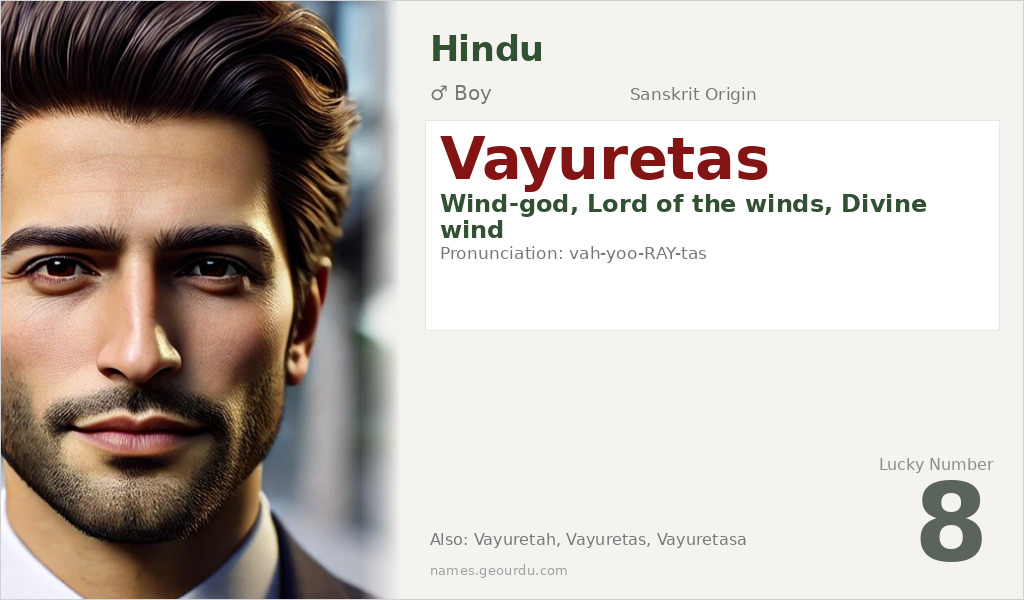
| 💎 Meaning | Wind-god, Lord of the winds, Divine wind |
| 👤 Gender | Boy |
| 🕌 Religion | Hindu |
| 🌍 Origin | Sanskrit |
| 🗣 Pronunciation | vah-yoo-RAY-tas |
| ✍️ Urdu | وایورتس |
| ✍️ Arabic | فايوريتاس |
| 🔢 Numerology | 8 |
| ✨ Spellings | Vayuretah, Vayuretas, Vayuretasa |
Origin & Cultural Significance
Vayuretas originates from ancient Sanskrit, the classical language of Hindu scriptures including the Vedas, Puranas, and Upanishads. The name has specific mythological connections to Vayu, the Hindu god of wind who serves as a messenger between realms and controls atmospheric phenomena. In Hindu tradition, Vayu is father to Hanuman and Bhima, making this name part of an important divine lineage. The name reflects the deep connection between natural elements and spiritual concepts in Dharmic traditions. While primarily used in Hindu communities, the name’s Sanskrit roots give it pan-Indian cultural relevance across various regions where Sanskrit-derived languages are spoken.
Personality Traits
Those named Vayuretas are often associated with qualities of movement, change, and intellectual freedom. Like the wind they represent, they may demonstrate adaptability, curiosity, and the ability to navigate different situations with ease. Their communication skills and persuasive abilities often stand out, reflecting the wind’s role as a carrier of messages and influences. While independent, they typically maintain strong connections to their cultural and spiritual roots.
Similar Names
If you like Vayuretas, consider: Vayu, Vayun, Vayudev, Marut, Anila, Pavan, Samir, Vata, Vayubhakt, Retas
Famous People Named Vayuretas
- No widely known contemporary figures with this name found in records
- Mythological references to Vayuretas appear in Hindu scriptures as wind deities
Frequently Asked Questions About Vayuretas
What does Vayuretas mean?
Vayuretas means 'Wind-god' or 'Lord of winds' in Sanskrit, combining 'Vayu' (wind) and 'Retas' (essence/lord).
Is Vayuretas a boy or girl name?
Vayuretas is exclusively a boy's name in Hindu naming tradition, derived from masculine Sanskrit grammatical forms and associated with male deities.
What is the origin of Vayuretas?
Vayuretas originates from Sanskrit, the ancient language of Hindu scriptures, with specific connections to Vedic mythology and the wind god Vayu.





