
Table of Contents
Venugopala is a beautiful and spiritually significant Sanskrit name that evokes one of Hinduism’s most beloved divine images. This compound name specifically refers to Lord Krishna in his iconic form as the enchanting flute-player among cows and cowherds. Steeped in devotional tradition, Venugopala carries both musical and pastoral connotations that resonate through Hindu art, literature, and worship. Parents choosing this name often seek to imbue their child’s identity with Krishna’s divine qualities of joy, protection, and artistic expression.
Meaning of Venugopala
Venugopala derives from classical Sanskrit, combining ‘Venu’ (वेणु), meaning ‘flute’ or specifically ‘bamboo reed flute’, with ‘Gopala’ (गोपाल), meaning ‘cowherd’, ‘protector of cows’, or more broadly ‘guardian’. The name doesn’t merely describe a generic flute player but specifically denotes Krishna in his pastoral Vrindavan aspect. In Hindu theology, Gopala represents Krishna’s role as protector and nurturer, while Venu symbolizes his divine music that attracts all beings. This theonym appears in texts like the Bhagavata Purana and is celebrated in South Indian temple architecture, particularly in Vijayanagara and Hoysala sculptures. The complete meaning is thus ‘Krishna as the flute-playing cowherd’, a specific devotional epithet rather than a general descriptor.
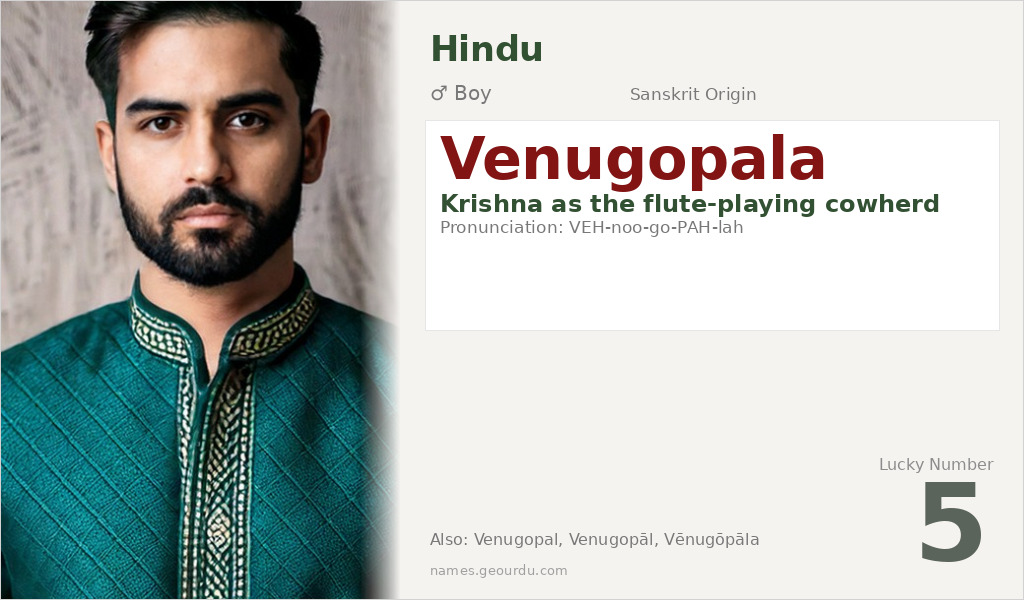
| 📛 Name | Venugopala |
| 💎 Meaning | Krishna as the flute-playing cowherd |
| 👤 Gender | Boy |
| 🕌 Religion | Hindu |
| 🌍 Origin | Sanskrit |
| 🗣 Pronunciation | VEH-noo-go-PAH-lah |
| ✍️ Urdu | وینوگوپال |
| ✍️ Arabic | فينوغوبالا |
| 🔢 Numerology | 5 |
| ✨ Spellings | Venugopal, Venugopāl, Vēnugōpāla |
Origin & Cultural Significance
Venugopala originates from Sanskrit, the classical language of Hindu scriptures, and emerged as a devotional name within Vaishnavism, particularly Krishna-centered traditions. The name gained prominence during the Bhakti movement (approximately 7th-17th centuries CE) when Krishna’s pastoral forms were extensively celebrated in poetry, music, and art. Iconographically, Venugopala statues became popular in South Indian temples from the 10th century onward, depicting Krishna in a graceful tribhanga posture with a flute. While the name is predominantly used in Hindu communities across India, especially in South Indian states like Tamil Nadu, Karnataka, and Andhra Pradesh, it also appears among Hindu diaspora worldwide. Its usage as a personal name reflects devotional naming traditions where children are named after divine forms or attributes.
Personality Traits
Those named Venugopala are often associated with artistic sensitivity, charismatic leadership, and compassionate nature, mirroring Krishna’s multifaceted personality. The flute element suggests creative expression, communication skills, and the ability to harmonize different aspects of life. Meanwhile, the cowherd component implies nurturing qualities, responsibility, and a connection to nature or community. Together, these traits create a personality profile that balances joyful expression with protective instincts, often making Venugopalas natural mediators and inspirers in their social circles.
Similar Names
If you like Venugopala, consider: Gopala, Gopal, Govinda, Muralidhara, Krishna, Madhava, Hari, Vasudeva, Shyam, Kanhaiya
Famous People Named Venugopala
- Venugopal Chandrasekhar — Indian former cricketer who played for Tamil Nadu
- Venugopal Rao — Indian cricketer who played for Andhra Pradesh and the Indian national team
Frequently Asked Questions About Venugopala
What does Venugopala mean?
Venugopala means 'Krishna as the flute-playing cowherd' in Sanskrit. It's a compound name combining 'Venu' (flute) and 'Gopala' (cowherd/protector of cows), specifically referring to this iconic form of the Hindu deity.
Is Venugopala a boy or girl name?
Venugopala is exclusively a boy's name in Hindu naming tradition, as it refers to the male deity Krishna. There are no documented instances of it being used for girls in any cultural context.
What is the origin of Venugopala?
Venugopala originates from Sanskrit, the classical language of Hindu scriptures. It emerged within Vaishnavite Krishna devotion and has been used for centuries in Hindu communities, particularly in South India, both as a divine epithet and personal name.





