
Table of Contents
Yadunath is a profound and historically rich name from the Sanskrit language, deeply embedded in Hindu tradition. It carries the powerful meaning of ‘Lord of the Yadu dynasty’, directly referencing Lord Krishna, a central deity in Hinduism. This name is chosen for boys to invoke divine protection, leadership, and a connection to ancient royal heritage. Exploring Yadunath reveals a tapestry of mythological significance and linguistic elegance.
Meaning of Yadunath
Yadunath is a compound Sanskrit name with a clear and well-documented meaning. It combines ‘Yadu’, referring to the ancient Yadu dynasty—a legendary lunar dynasty in Hindu texts like the Mahabharata and Puranas—and ‘Nath’, meaning ‘lord’, ‘master’, or ‘protector’. Thus, Yadunath translates precisely to ‘Lord of the Yadus’ or ‘Master of the Yadu clan’. This is a direct epithet for Lord Krishna, who was born into the Yadava lineage as a prince of Mathura. The name emphasizes Krishna’s royal ancestry and his role as a divine ruler, making it a popular choice among Hindus seeking to honor this aspect of his identity. Linguistically, it showcases the classical Sanskrit tradition of forming meaningful compounds that convey deep cultural and religious resonance.
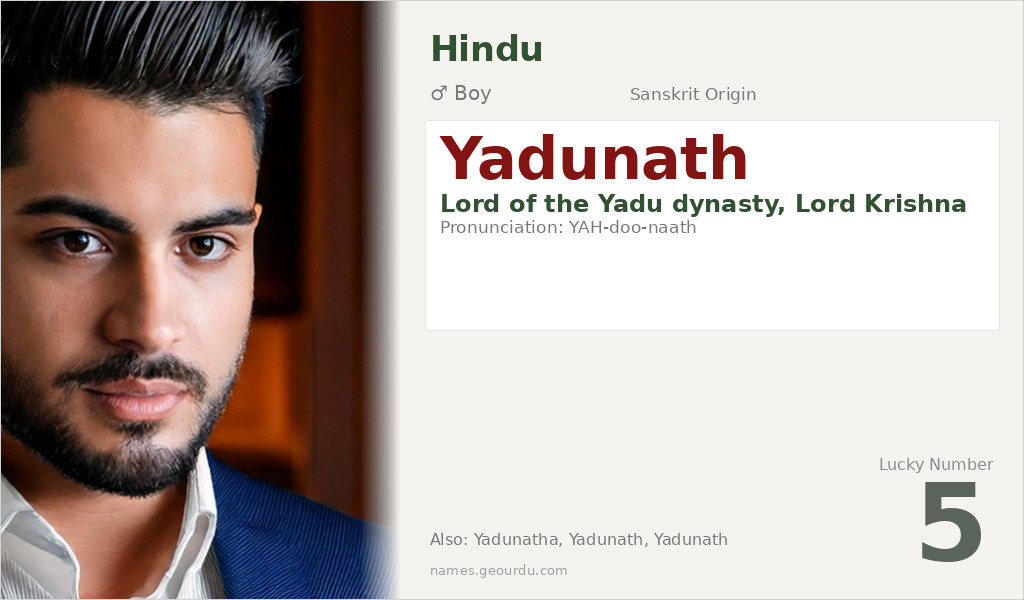
| 📛 Name | Yadunath |
| 💎 Meaning | Lord of the Yadu dynasty, Lord Krishna |
| 👤 Gender | Boy |
| 🕌 Religion | Hindu |
| 🌍 Origin | Sanskrit |
| 🗣 Pronunciation | YAH-doo-naath |
| ✍️ Urdu | یادوناتھ |
| ✍️ Arabic | يادوناث |
| 🔢 Numerology | 5 |
| ✨ Spellings | Yadunatha, Yadunath, Yadunath |
Origin & Cultural Significance
Originating from Sanskrit, the ancient liturgical language of Hinduism, Yadunath has its roots in Indian mythology and history. The Yadu dynasty is one of the major lineages described in Hindu scriptures, tracing back to King Yadu, a son of Emperor Yayati. Krishna, as an avatar of Vishnu, is celebrated as a descendant of this dynasty, often called Yadunandana (son of the Yadus) or Yadunath. The name gained prominence through religious texts, poetry, and regional naming customs across India, particularly in Hindu communities. It reflects a cultural emphasis on divine kinship and royal heritage, often used in states like Maharashtra, Uttar Pradesh, and Gujarat. Over centuries, Yadunath has been preserved in traditional naming practices, symbolizing devotion and a link to epic narratives.
Personality Traits
Those named Yadunath are often perceived as natural leaders with a protective and charismatic demeanor, mirroring the name’s meaning of ‘lord’ or ‘ruler’. They may exhibit traits such as wisdom, creativity, and a strong sense of responsibility, inspired by the qualities of Krishna. Their personality tends to blend authority with compassion, making them influential and respected figures in their social or professional circles.
Similar Names
If you like Yadunath, consider: Yadunandan, Yaduvansh, Krishna, Govind, Madhusudan, Yashwant
Famous People Named Yadunath
- Yadunath Singh — Indian Army officer and recipient of the Maha Vir Chakra for bravery in the 1971 Indo-Pakistani War
- Yadunath Kavthekar — 19th-century Marathi poet and scholar known for his contributions to Marathi literature
Frequently Asked Questions About Yadunath
What does Yadunath mean?
Yadunath means 'Lord of the Yadu dynasty' or 'Master of the Yadu clan' in Sanskrit, directly referring to Lord Krishna, who was a prince of the Yadava lineage.
Is Yadunath a boy or girl name?
Yadunath is exclusively a boy's name in Hindu tradition, derived from masculine Sanskrit roots and associated with male deities and figures.
What is the origin of Yadunath?
Yadunath originates from Sanskrit, the classical language of India, and is deeply rooted in Hindu mythology, specifically linked to the Yadu dynasty and Lord Krishna.





