Table of Contents
Elisa is a graceful and timeless feminine name with deep biblical roots. While often considered a variant of Elizabeth, it stands proudly on its own with a rich history spanning multiple cultures and languages. This name carries spiritual significance while maintaining a modern, melodic sound that has appealed to parents for generations.
Meaning of Elisa
Elisa originates from the Hebrew name Elisheva (אֱלִישֶׁבַע), which combines ‘El’ meaning ‘God’ and ‘sheva’ meaning ‘oath’ or ‘seven.’ The ‘seven’ component symbolizes completeness and abundance in Hebrew tradition, giving the name additional layers of meaning as ‘God is abundance.’ Through Greek and Latin transmission as Elisabet, the name spread throughout Europe where various contracted forms emerged, including Elisa. The name maintains its core theological meaning across languages, representing a covenant or dedication to God. In some Romance languages like Italian and Spanish, Elisa developed independently as a shortened form of Elisabeth while retaining the original Hebrew significance.
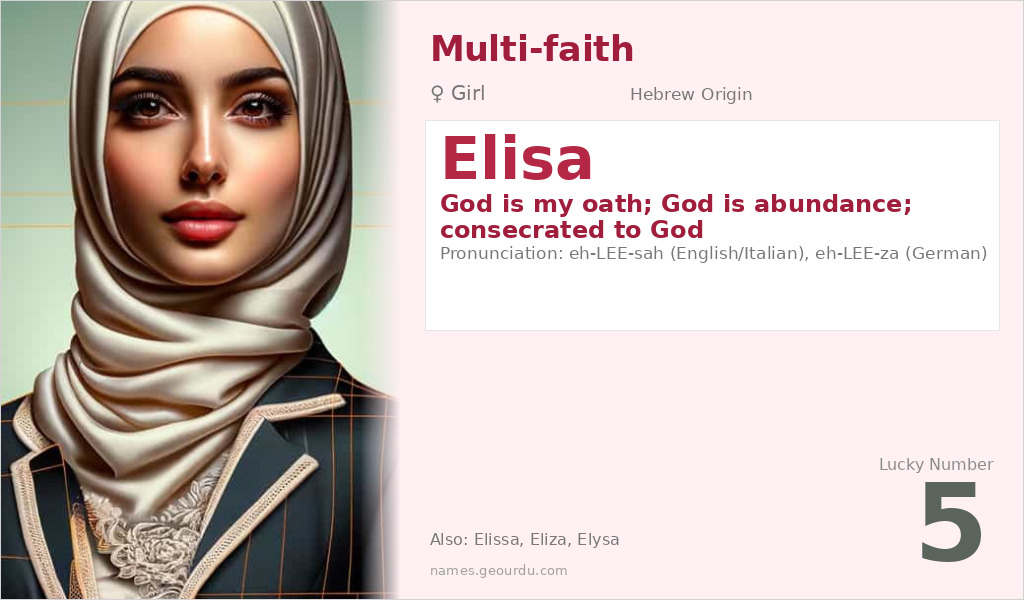
| 📛 Name | Elisa |
| 💎 Meaning | God is my oath; God is abundance; consecrated to God |
| 👤 Gender | Girl |
| 🕌 Religion | Multi-faith |
| 🌍 Origin | Hebrew |
| 🗣 Pronunciation | eh-LEE-sah (English/Italian), eh-LEE-za (German) |
| ✍️ Urdu | ایلیسا |
| ✍️ Arabic | إليزا |
| 🔢 Numerology | 5 |
| ✨ Spellings | Elissa, Eliza, Elysa, Alisa, Alyssa |
Origin & Cultural Significance
Elisa has its primary origins in ancient Hebrew culture, appearing in the Hebrew Bible as Elisheva, the wife of Aaron. The name entered Western tradition through the New Testament figure Elizabeth, mother of John the Baptist. During the Middle Ages, the name spread across Europe through Christian tradition, with variations developing in different languages. In Italian, Elisa became established as an independent name during the Renaissance, while in German-speaking regions it gained popularity in the 18th century. The name transcends religious boundaries, being used by Jewish, Christian, and secular families alike, though its etymological roots remain firmly in Semitic languages.
Personality Traits
Those named Elisa are often perceived as intelligent, compassionate, and artistically inclined individuals. They typically possess strong communication skills and a diplomatic nature that helps them navigate social situations gracefully. With their name’s meaning connected to spiritual commitment, many Elisas demonstrate reliability and depth in their personal relationships and pursuits.
Similar Names
If you like Elisa, consider: Elizabeth, Elisabeth, Elise, Eliana, Elisha
Famous People Named Elisa
- Elisa Toffoli — Italian singer-songwriter known mononymously as Elisa
- Elisa Donovan — American actress best known for 'Clueless' and 'Sabrina the Teenage Witch'
Frequently Asked Questions About Elisa
What does Elisa mean?
Elisa means 'God is my oath' or 'God is abundance' in Hebrew, derived from the name Elisheva.
Is Elisa a boy or girl name?
Elisa is primarily a feminine name across all cultures where it's used, though the masculine variant Elisha exists separately.
What is the origin of Elisa?
Elisa originates from Hebrew, specifically from the name Elisheva, and entered European languages through Greek and Latin translations of biblical texts.