
Table of Contents
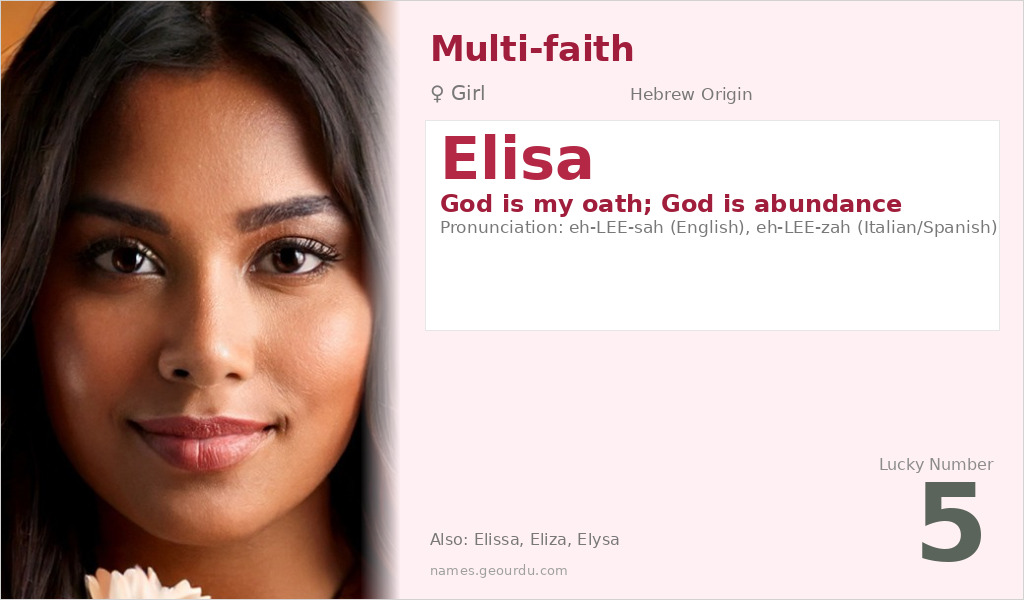
Elisa is a beautiful and timeless name with deep religious roots that has traveled across continents and cultures. While often considered a diminutive of Elizabeth, it stands strongly on its own with a rich history dating back to biblical times. This name carries a powerful meaning of divine promise and faithfulness that has resonated with parents for centuries. Today, Elisa remains popular in many European and Latin American countries, appreciated for its melodic sound and spiritual significance.
Meaning of Elisa
The name Elisa derives from the Hebrew name Elisheva (אֱלִישֶׁבַע), which is composed of two elements: ‘El’ (אֵל), meaning ‘God’, and ‘sheva’ (שֶׁבַע), meaning ‘oath’ or ‘seven’. In Hebrew numerology, seven represents completeness and abundance, giving the name the additional connotation of ‘God is abundance’. This name entered Western tradition through the Greek form Elisabet and Latin Elisabeth, eventually evolving into various shortened forms including Elisa. The biblical significance comes from Elisheva, wife of Aaron in the Old Testament and Elizabeth, mother of John the Baptist in the New Testament. The core meaning of ‘God is my oath’ reflects a covenant relationship with the divine, making it a name with profound spiritual weight.
| 📛 Name | Elisa |
| 💎 Meaning | God is my oath; God is abundance |
| 👤 Gender | Girl |
| 🕌 Religion | Multi-faith |
| 🌍 Origin | Hebrew |
| 🗣 Pronunciation | eh-LEE-sah (English), eh-LEE-zah (Italian/Spanish) |
| ✍️ Urdu | ایلیسا |
| ✍️ Arabic | إليزا |
| 🔢 Numerology | 5 |
| ✨ Spellings | Elissa, Eliza, Elysa, Alisa, Alyssa |
Origin & Cultural Significance
Elisa originated as a Hebrew name that spread through Jewish and early Christian communities. It entered European languages during the Hellenistic period when Hebrew names were translated into Greek, then later into Latin as Christianity spread throughout the Roman Empire. The name became particularly popular in Mediterranean countries like Italy, Spain, and Portugal, where it remains common today. While strongly associated with Christian tradition due to Saint Elizabeth, the name’s Hebrew roots give it significance in Jewish tradition as well. In modern times, Elisa has become a multicultural name used by people of various faiths and backgrounds, appreciated for its international appeal and elegant simplicity.
Personality Traits
People named Elisa are often perceived as vibrant and intellectually curious individuals who approach life with enthusiasm and adaptability. Their numerological association with the number 5 suggests a personality that thrives on freedom, variety, and new experiences. Elisas tend to be excellent communicators who build diverse social connections and demonstrate creative problem-solving abilities. While independent and adventurous, they also maintain the faithful, committed qualities suggested by their name’s meaning of ‘God is my oath’.
Similar Names
If you like Elisa, consider: Elizabeth, Elisabeth, Elise, Eliana, Elisha
Famous People Named Elisa
- Elisa Toffoli — Italian singer-songwriter known for pop and rock music
- Elisa Leonida Zamfirescu — Romanian engineer, one of the first female engineers in the world
Frequently Asked Questions About Elisa
What does Elisa mean?
Elisa means 'God is my oath' or 'God is abundance', originating from the Hebrew name Elisheva which combines 'El' (God) and 'sheva' (oath/seven).
Is Elisa a boy or girl name?
Elisa is primarily a feminine name across all cultures where it's used, though the masculine variant Elisha exists with different etymology and meaning.
What is the origin of Elisa?
Elisa originates from Hebrew, specifically as a shortened form of Elisheva/Elizabeth, and spread through Greek, Latin, and various European languages over centuries.





