
Table of Contents
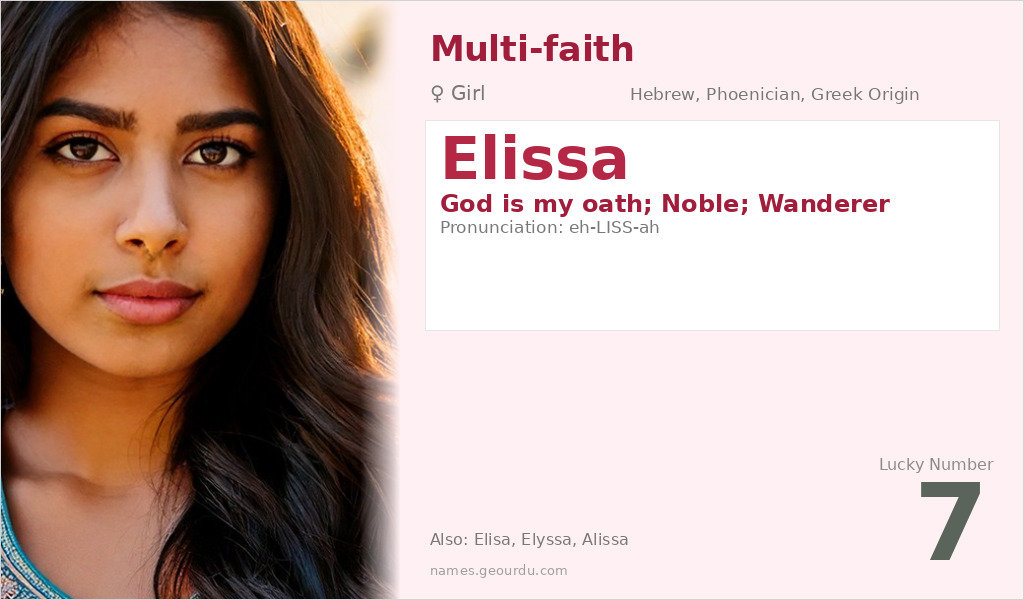
Elissa is a name rich with historical and linguistic depth, spanning from ancient Semitic roots to modern global usage. Whether inspired by biblical heritage or Phoenician legend, this name carries meanings of devotion, nobility, and journey. In this guide, we explore the true origins, cultural significance, and contemporary appeal of Elissa across diverse traditions.
Meaning of Elissa
Elissa derives primarily from the Hebrew name Elisheva (אֱלִישֶׁבַע), composed of ‘El’ (God) and ‘sheva’ (oath), meaning ‘God is my oath.’ This evolved into the Greek Elisabet and Latin Elizabeth, with Elissa emerging as a variant. In Phoenician mythology, Elissa (also known as Dido) was the founder of Carthage; her name may come from the Phoenician ‘Elishat,’ possibly meaning ‘wanderer’ or relating to the goddess Astarte. Additionally, in Greek, ‘elissa’ can signify ‘noble’ or ‘of noble kind,’ linking to terms like ‘elite.’ These layered meanings reflect the name’s journey through Hebrew, Phoenician, and Greek languages, emphasizing themes of faith, leadership, and status.
| 📛 Name | Elissa |
| 💎 Meaning | God is my oath; Noble; Wanderer |
| 👤 Gender | Girl |
| 🕌 Religion | Multi-faith |
| 🌍 Origin | Hebrew, Phoenician, Greek |
| 🗣 Pronunciation | eh-LISS-ah |
| ✍️ Urdu | ایلسا |
| ✍️ Arabic | إليسا |
| 🔢 Numerology | 7 |
| ✨ Spellings | Elisa, Elyssa, Alissa, Alyssa, Eliza |
Origin & Cultural Significance
The name Elissa has origins in multiple ancient cultures. In Hebrew tradition, it stems from Elisheva, the wife of Aaron in the Old Testament, later popularized through Christian usage as a form of Elizabeth. In Phoenician history, Elissa is celebrated as the legendary queen who founded Carthage (modern-day Tunisia), with her story preserved in Roman sources like Virgil’s Aeneid. The name spread through Greek and Latin adaptations, becoming common in European contexts. Today, it is used globally across Christian, Jewish, and secular communities, with notable popularity in Arabic-speaking regions due to modern celebrities like the Lebanese singer Elissa.
Personality Traits
Those named Elissa are often associated with traits of introspection, resilience, and a quest for meaning. Drawing from its etymological roots, they may exhibit a strong sense of loyalty (from ‘God is my oath’) and an adventurous spirit (from ‘wanderer’). In social settings, they can be charismatic yet thoughtful, balancing creativity with analytical depth, making them adaptable leaders or artists.
Similar Names
If you like Elissa, consider: Elizabeth, Elise, Eliana, Elisa, Alyssa
Famous People Named Elissa
- Elissa (born Elissar Zakaria Khoury) — Lebanese pop singer and actress known as the 'Queen of Arab Pop'
- Elissa Landi — Italian-born British-American actress and novelist of the early 20th century
Frequently Asked Questions About Elissa
What does Elissa mean?
Elissa primarily means 'God is my oath' from Hebrew, but also has meanings like 'wanderer' from Phoenician and 'noble' from Greek, depending on its cultural context.
Is Elissa a boy or girl name?
Elissa is almost exclusively a girl's name across all its historical and modern usage, from biblical references to contemporary figures.
What is the origin of Elissa?
Elissa originates from Hebrew (as a variant of Elisheva/Elizabeth), Phoenician (as the name of Queen Dido), and Greek, with influences in Christian, Jewish, and ancient Mediterranean cultures.





