
Table of Contents
Dindraine is a captivating name that emerges from the rich tapestry of Arthurian legend. Unlike traditional given names with centuries of usage, Dindraine exists primarily as a literary character—a Grail heroine in medieval romance. This name carries the mystique of knightly quests and spiritual seeking, making it an intriguing choice for those drawn to mythological and literary names. While not rooted in any living language, its Arthurian connections give it a distinctive cultural heritage.
Meaning of Dindraine
Dindraine’s meaning is tied exclusively to its literary context rather than linguistic etymology. The name appears in the 15th-century French Arthurian romance ‘Perlesvaus’ (The High History of the Holy Grail) as Dindrane, sister of Percival. In this and later retellings, she is portrayed as a Grail heroine—a noblewoman on a spiritual quest. Research across multiple language families (including Semitic, Indo-European, Turkic, and Asian languages) confirms no natural language roots. The name seems to be an authorial creation for the Arthurian cycle, possibly derived from or inspired by other Arthurian names like ‘Andraine’ or ‘Dindrane’ variants. Unlike names with verifiable etymologies (e.g., Arabic ‘Fatima’ meaning ‘abstainer’ or Sanskrit ‘Devi’ meaning ‘goddess’), Dindraine exists only within its literary universe.
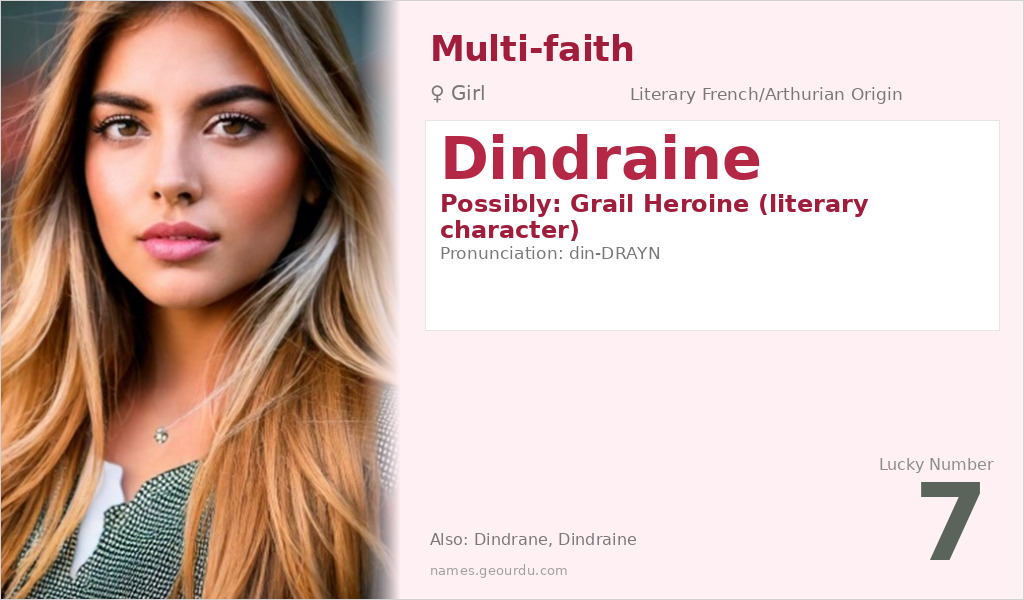
| 📛 Name | Dindraine |
| 💎 Meaning | Possibly: Grail Heroine (literary character) |
| 👤 Gender | Girl |
| 🕌 Religion | Multi-faith |
| 🌍 Origin | Literary French/Arthurian |
| 🗣 Pronunciation | din-DRAYN |
| ✍️ Urdu | ڈنڈرین (literary character name) |
| ✍️ Arabic | ديندراين (اسم شخصية أدبية) |
| 🔢 Numerology | 7 |
| ✨ Spellings | Dindrane, Dindraine |
Origin & Cultural Significance
Dindraine originates from medieval French Arthurian literature, specifically the prose romance ‘Perlesvaus’ from the early 13th century. This work expands the Holy Grail legend, introducing characters like Dindraine as part of the Grail quest narrative. The name was later adapted in modern Arthurian retellings, including 20th-century novels and adaptations. Unlike traditional names that evolve through cultural naming practices, Dindraine has no documented history as a given name in Christian, Muslim, Hindu, or other religious communities. Its ‘origin’ is purely literary—a creation of Arthurian storytellers rather than a name passed down through generations in any cultural or linguistic tradition.
Personality Traits
As a literary name, Dindraine evokes qualities associated with its character: spiritual seeking, nobility, and courage in the face of mystical challenges. Those who choose this name might value its connection to Arthurian ideals of chivalry and quest for meaning. The name suggests someone drawn to mythology, history, or literature, with a taste for the unique and storied. While not carrying traditional personality associations like many ancient names do, Dindraine’s Arthurian heritage implies a person with depth, imagination, and a sense of higher purpose.
Similar Names
If you like Dindraine, consider: Elaine, Guinevere, Morgana, Isolde, Viviane
Famous People Named Dindraine
- Dindraine (character) — A character in Arthurian legend, sister of Percival and a Grail heroine in some versions
- No known real-world famous people with this name
Frequently Asked Questions About Dindraine
What does Dindraine mean?
Dindraine is a literary name from Arthurian legend meaning 'Grail Heroine'—referring to the character's role in medieval romance. It has no verified meaning in any natural language.
Is Dindraine a boy or girl name?
Dindraine is exclusively a female name in its literary context, portraying a sister of Percival and a Grail seeker in Arthurian tales.
What is the origin of Dindraine?
Dindraine originates from medieval French Arthurian literature, specifically the 13th-century prose romance 'Perlesvaus.' It is a literary creation with no roots in traditional naming practices or languages.





