
Table of Contents
Callista is an elegant name with roots stretching back to ancient Greece, carrying the beautiful meaning of ‘most beautiful’ or ‘fairest’. This classical name has been borne by mythological figures and modern celebrities alike, maintaining its timeless appeal across centuries. With its melodic sound and rich history, Callista offers a connection to both artistic beauty and ancient storytelling traditions. Whether you’re drawn to its mythological origins or its lyrical quality, Callista remains a distinctive choice for parents seeking a name with depth and grace.
Meaning of Callista
Callista derives directly from the Ancient Greek word ‘kallistos’ (κάλλιστος), which is the superlative form of ‘kalos’ (καλός) meaning ‘beautiful, fair, or noble’. The ‘-istos’ suffix creates the superlative degree, making the literal translation ‘most beautiful’ or ‘fairest of all’. This linguistic construction appears frequently in Greek literature and philosophy to denote excellence or supreme quality. In mythological context, Callisto was a nymph of Artemis who played a central role in the Ursa Major constellation myth. The name’s meaning reflects the Greek cultural emphasis on physical beauty and aesthetic perfection, concepts that were deeply intertwined with virtue and harmony in ancient Greek thought.
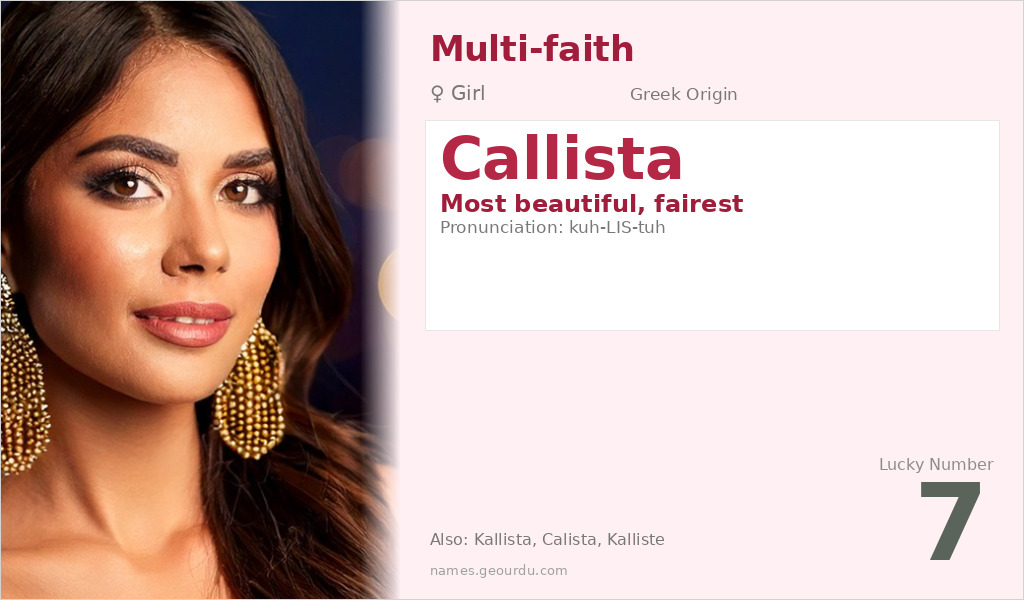
| 📛 Name | Callista |
| 💎 Meaning | Most beautiful, fairest |
| 👤 Gender | Girl |
| 🕌 Religion | Multi-faith |
| 🌍 Origin | Greek |
| 🗣 Pronunciation | kuh-LIS-tuh |
| ✍️ Urdu | کالسٹا |
| ✍️ Arabic | كاليسـتا |
| 🔢 Numerology | 7 |
| ✨ Spellings | Kallista, Calista, Kalliste, Kalista |
Origin & Cultural Significance
Callista originates from Ancient Greece, where it first appeared in mythological texts and historical records. The most famous bearer in mythology was Callisto, a nymph companion of Artemis who was transformed into a bear and later became the constellation Ursa Major. The name has been used sporadically throughout Western history, with notable revivals during the Renaissance when classical Greek names regained popularity. While the name has Christian usage through saints and historical figures, its origins are fundamentally Greek rather than specifically Christian. Today, Callista is used internationally, particularly in English-speaking countries, Europe, and among those appreciating classical names, maintaining its connection to Greek heritage while adapting to modern naming trends.
Personality Traits
Those named Callista are often associated with qualities of grace, aesthetic sensitivity, and intellectual depth. The name’s meaning suggests someone who appreciates beauty in both art and nature, potentially with creative talents or artistic inclinations. Historically, the mythological Callisto was independent and connected to the wilderness, traits that might translate to a love of nature and self-sufficiency in namesakes. While personality traits vary by individual, the name carries connotations of elegance, wisdom, and a certain classical refinement that has endured for millennia.
Similar Names
If you like Callista, consider: Calliope, Calantha, Calista, Kallias, Kallisto, Calypso, Cassandra, Cynthia, Artemis, Daphne
Famous People Named Callista
- Callista Gingrich — American diplomat and author, former U.S. Ambassador to the Holy See
- Callista Flockhart — American actress known for roles in 'Ally McBeal' and 'Supergirl'
Frequently Asked Questions About Callista
What does Callista mean?
Callista means 'most beautiful' or 'fairest', derived from the Ancient Greek word 'kallistos', which is the superlative form of 'kalos' meaning 'beautiful'.
Is Callista a boy or girl name?
Callista is predominantly a feminine name, though very rare masculine usage exists historically. In contemporary naming, it is almost exclusively used for girls.
What is the origin of Callista?
Callista originates from Ancient Greece, with its earliest recorded usage in Greek mythology as the name of a nymph who was transformed into the constellation Ursa Major.





