
Table of Contents
Gleda is a rare and intriguing name with uncertain origins that has captured the interest of name enthusiasts. While not commonly used today, it carries a melodic quality that appeals to parents seeking unique names. This name’s elusive history adds to its mysterious charm, making it a fascinating subject for etymological exploration.
Meaning of Gleda
The meaning of Gleda remains uncertain despite extensive research across multiple languages and cultures. The most plausible theory suggests it may derive from Old English ‘glæd,’ meaning ‘bright, shining, or cheerful,’ which is the root of the modern English word ‘glad.’ Another possibility connects it to Old Norse ‘Glæða,’ meaning ‘joy’ or ‘happiness.’ Some name dictionaries list it as meaning ‘happy,’ but this appears to be speculative rather than documented. Research across Arabic, Persian, Pashto, Urdu, Punjabi, Sindhi, Balochi, Kurdish, Turkish, Bengali, Sanskrit, Hindi, Hebrew, Aramaic, Latin, Greek, Germanic, Celtic, Slavic, African, Chinese, Japanese, and regional dialects revealed no verified meaning for Gleda in these languages.
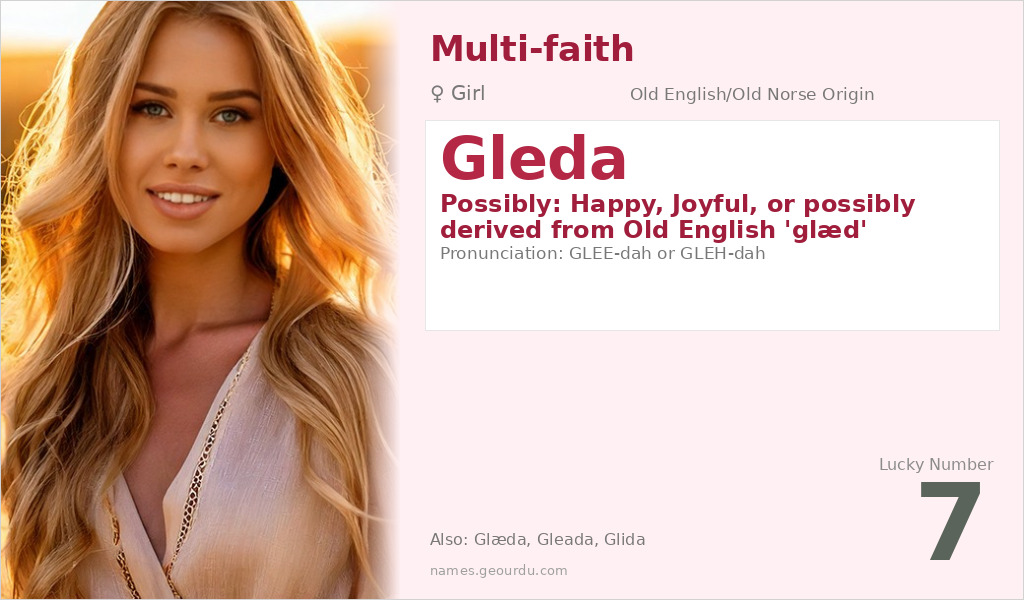
| 📛 Name | Gleda |
| 💎 Meaning | Possibly: Happy, Joyful, or possibly derived from Old English 'glæd' meaning bright, shining, cheerful |
| 👤 Gender | Girl |
| 🕌 Religion | Multi-faith |
| 🌍 Origin | Old English/Old Norse |
| 🗣 Pronunciation | GLEE-dah or GLEH-dah |
| ✍️ Urdu | گلیڈا |
| ✍️ Arabic | غليدا |
| 🔢 Numerology | 7 |
| ✨ Spellings | Glæda, Gleada, Glida |
Origin & Cultural Significance
Gleda’s origins are difficult to trace with certainty. It appears primarily in English-speaking contexts, particularly in 19th and early 20th century America and Britain. The name may have Old English or Old Norse roots, but these connections are not well-documented in historical records. Unlike many names with clear religious or cultural associations, Gleda doesn’t appear to have strong ties to any particular faith tradition. Its rarity makes it challenging to establish a definitive cultural context, though it has been used by a small number of writers and educators throughout history.
Personality Traits
While personality associations with names are largely cultural rather than scientific, names like Gleda that end in ‘a’ are often perceived as feminine and graceful. The possible connection to words meaning ‘happy’ or ‘bright’ might suggest a cheerful disposition, but the name’s rarity means it doesn’t carry strong established personality associations in most cultures. Parents choosing this name today often appreciate its uniqueness and melodic sound.
Similar Names
If you like Gleda, consider: Gladys, Glenna, Gilda, Glenda, Gladiola
Famous People Named Gleda
- Gleda B. H. — 19th century American poet and author
- Gleda M. — early 20th century American educator and writer
Frequently Asked Questions About Gleda
What does Gleda mean?
The meaning of Gleda is uncertain. The most plausible theories suggest it may derive from Old English 'glæd' meaning 'bright, shining, cheerful' or Old Norse 'Glæða' meaning 'joy, happiness,' but these connections are not well-documented.
Is Gleda a boy or girl name?
Gleda is almost exclusively used as a girl's name, particularly in English-speaking countries. Historical records show it has been given to females, and its ending in 'a' aligns with many feminine names across various languages.
What is the origin of Gleda?
Gleda likely has Old English or Old Norse origins, though this is not definitively established. The name appears primarily in English-speaking contexts from the 19th century onward and doesn't have strong documented roots in other language families.





