
Table of Contents
Hadasah is a beautiful Hebrew name with deep biblical roots and enduring cultural significance. Best known as the original Hebrew name of Queen Esther, this name carries the lovely meaning of ‘myrtle tree’ and represents beauty, resilience, and spiritual connection. While popular in Jewish communities, Hadasah has also been embraced by Christians who appreciate its Old Testament heritage. The name’s gentle sound and rich history make it a meaningful choice for parents seeking a name with both elegance and substance.
Meaning of Hadasah
Hadasah derives directly from the Hebrew word ‘hadas’ (הֲדַס), which specifically refers to the myrtle tree. In botanical terms, myrtle is an evergreen shrub with fragrant white flowers and dark berries, native to the Mediterranean region. Linguistically, the name follows a common Hebrew feminine pattern with the ‘-ah’ ending. The myrtle holds significant symbolic meaning in Jewish tradition as one of the ‘Four Species’ used during Sukkot celebrations, representing the eyes (according to rabbinic interpretation) and symbolizing beauty and righteousness. This connection to nature and religious symbolism gives the name Hadasah layers of meaning beyond its literal translation.
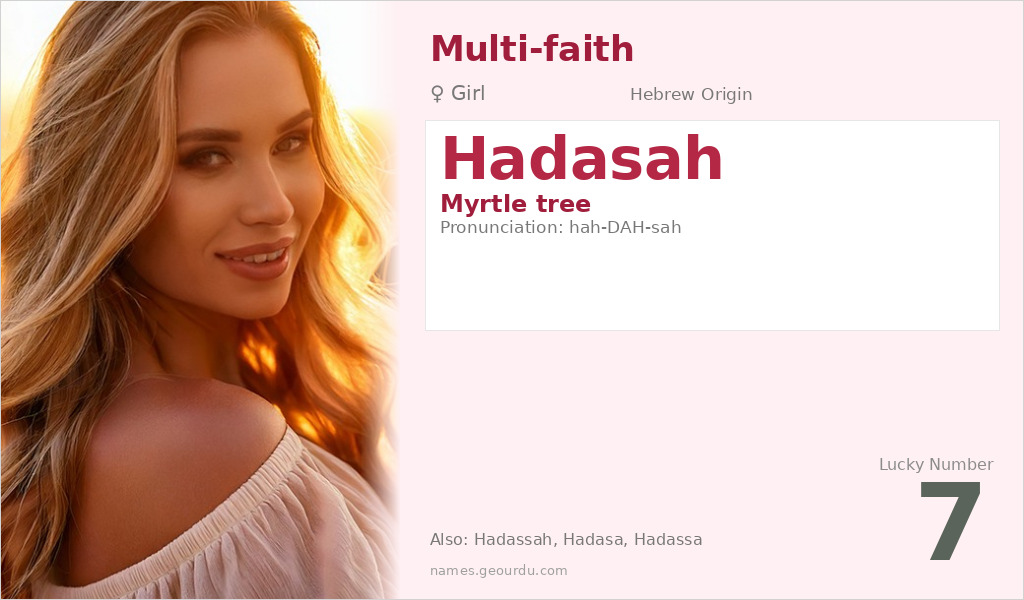
| 📛 Name | Hadasah |
| 💎 Meaning | Myrtle tree |
| 👤 Gender | Girl |
| 🕌 Religion | Multi-faith |
| 🌍 Origin | Hebrew |
| 🗣 Pronunciation | hah-DAH-sah |
| ✍️ Urdu | ہداسہ |
| ✍️ Arabic | هداسة |
| 🔢 Numerology | 7 |
| ✨ Spellings | Hadassah, Hadasa, Hadassa |
Origin & Cultural Significance
Hadasah originates from ancient Hebrew culture and appears in the biblical Book of Esther (2:7), where it is explicitly stated: ‘And he brought up Hadassah, that is, Esther, his uncle’s daughter.’ The name belongs to the Jewish heroine who became Queen of Persia and saved her people from destruction. While fundamentally a Jewish name, Hadasah has been adopted by some Christian communities due to its presence in the Old Testament, which Christians consider part of their sacred scriptures. The name gained modern prominence through Jewish communities worldwide and through organizations like Hadassah, the Women’s Zionist Organization of America, founded in 1912. Today, it remains most common among Jewish families but has cross-cultural appeal.
Personality Traits
The myrtle symbolism associated with Hadasah suggests personality traits of enduring beauty, resilience, and spiritual depth. Like the evergreen myrtle that remains vibrant through seasons, those named Hadasah may demonstrate consistent strength and grace through life’s challenges. The biblical Esther’s story adds connotations of courage, wisdom, and strategic thinking. These individuals often balance outward elegance with inner fortitude, making them both approachable and formidable when circumstances require principled action.
Similar Names
If you like Hadasah, consider: Esther, Miriam, Ruth, Hannah, Leah
Famous People Named Hadasah
- Hadassah Lieberman — American political figure and wife of former U.S. Senator Joe Lieberman
- Hadassah B. — Israeli singer and actress known professionally as 'Hadas'
Frequently Asked Questions About Hadasah
What does Hadasah mean?
Hadasah means 'myrtle tree' in Hebrew. It comes from the Hebrew word 'hadas' referring specifically to the myrtle plant, which has symbolic importance in Jewish tradition.
Is Hadasah a boy or girl name?
Hadasah is exclusively a feminine name. In Hebrew grammar, the '-ah' ending typically indicates feminine gender, and the name has only been used for girls and women throughout its history.
What is the origin of Hadasah?
Hadasah originates from ancient Hebrew language and culture. It appears in the Hebrew Bible (Book of Esther) as the original name of Queen Esther, making it approximately 2,500 years old with continuous usage in Jewish communities.





