
Table of Contents
Hebe is a beautiful name with deep roots in ancient Greek mythology, where it represents the very essence of youth and vitality. As the goddess who served nectar to the gods on Mount Olympus, Hebe embodies grace, freshness, and eternal youth. This name carries centuries of mythological significance while maintaining a modern, elegant sound. Whether you’re drawn to classical names or seeking something with historical depth, Hebe offers a connection to one of humanity’s oldest cultural traditions.
Meaning of Hebe
The name Hebe comes directly from the ancient Greek word ‘ἥβη’ (hēbē), which translates to ‘youth,’ ‘prime of life,’ or specifically ‘young womanhood.’ This term appears throughout classical Greek literature, from Homer’s epics to later philosophical works, always carrying connotations of the bloom and vigor of youth. In mythological context, Hebe was the daughter of Zeus and Hera, serving as the cupbearer to the gods and personifying eternal youth. The linguistic root is well-established in Greek etymology, with related words like ‘ἡβᾶν’ (hēbān) meaning ‘to reach puberty’ or ‘come of age.’ This makes Hebe one of the most clearly documented names from classical antiquity with a meaning that has remained consistent for millennia.
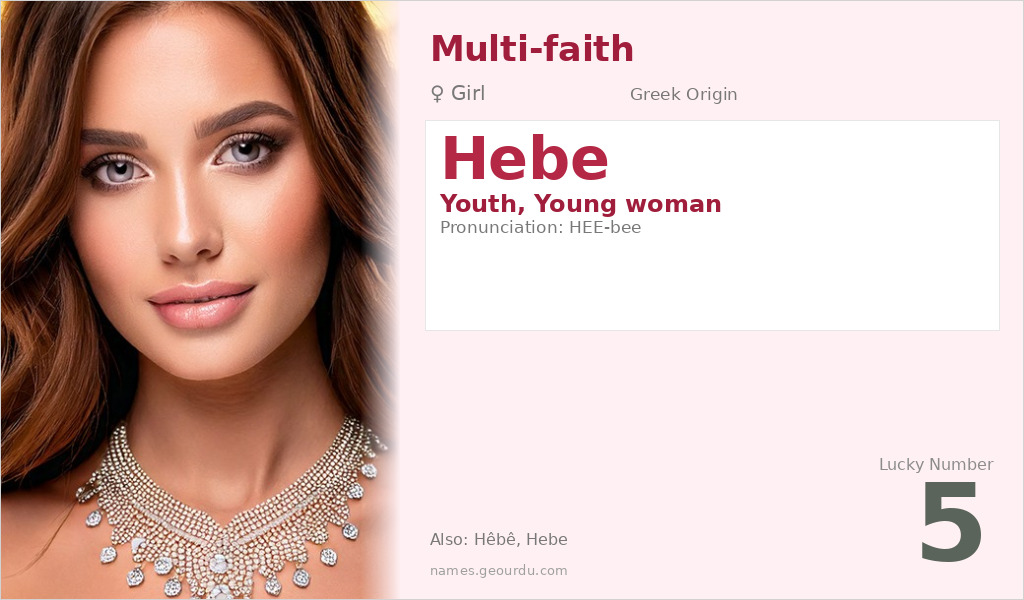
| 📛 Name | Hebe |
| 💎 Meaning | Youth, Young woman |
| 👤 Gender | Girl |
| 🕌 Religion | Multi-faith |
| 🌍 Origin | Greek |
| 🗣 Pronunciation | HEE-bee |
| ✍️ Urdu | ہیبی |
| ✍️ Arabic | هيبي |
| 🔢 Numerology | 5 |
| ✨ Spellings | Hêbê, Hebe |
Origin & Cultural Significance
Hebe originates from ancient Greek mythology and culture, where she was worshipped as the goddess of youth. According to Greek myths, Hebe was the daughter of Zeus and Hera, and she served as cupbearer to the Olympian gods until she was replaced by Ganymede. The name appears in numerous classical texts, including Homer’s Iliad and Odyssey, where she’s described preparing baths for Ares and helping Hera with her chariot. While the name has been adopted in various cultures over time, including occasional Christian usage in modern times, its primary cultural and historical context remains firmly rooted in Greek mythology. The name saw some revival during the Renaissance when classical names became fashionable again in Europe.
Personality Traits
Those named Hebe are often associated with qualities of youthfulness, vitality, and grace. Drawing from the mythological figure, they may exhibit a nurturing spirit and optimistic outlook on life. The name suggests someone who maintains a fresh perspective and energetic approach to challenges, much like the eternal youth represented by the Greek goddess. While personality traits vary by individual, the name’s historical associations point toward characteristics of service, beauty, and enduring spirit.
Similar Names
If you like Hebe, consider: Hebeia, Hebeia, Hebeia, Hebeia, Hebeia
Famous People Named Hebe
- Hebe — Greek goddess of youth, cupbearer to the gods on Mount Olympus
- Hebe de Bonafini — Argentine human rights activist and co-founder of Mothers of the Plaza de Mayo
Frequently Asked Questions About Hebe
What does Hebe mean?
Hebe means 'youth' or 'young woman' in ancient Greek. It comes from the Greek word 'ἥβη' (hēbē), which specifically refers to the bloom of youth and young womanhood.
Is Hebe a boy or girl name?
Hebe is exclusively a girl's name. In Greek mythology, Hebe was the goddess of youth, and the name has been used for females throughout its history in various cultures.
What is the origin of Hebe?
Hebe originates from ancient Greek mythology and language. It was the name of the goddess of youth in Greek religion, daughter of Zeus and Hera, and the etymology comes directly from the Greek word for youth.





