
Table of Contents
Hylda is a distinctive girl’s name with deep historical roots and a powerful meaning. Derived from the Old English name Hilda, it carries the bold significance of ‘battle’ or ‘warfare’. This name has been cherished in Christian tradition since the 7th century through Saint Hilda of Whitby. Today, Hylda offers a unique alternative to more common H-names with its strong, timeless appeal.
Meaning of Hylda
Hylda’s meaning is definitively ‘battle’, originating from the Germanic element ‘hild’. This root appears across Germanic languages: Old Norse ‘hildr’ (a valkyrie name meaning battle), Old High German ‘hiltja’, and Gothic ‘hilds’. The name entered English as Hilda through Anglo-Saxon settlement, with ‘Hylda’ emerging as a Middle English spelling variant. Unlike many names that have evolved to have multiple interpretations, Hylda maintains this single, clear martial meaning. The name reflects the warrior culture of early Germanic peoples, where battle names were common for both genders. Its preservation in Christian tradition through Saint Hilda shows how pagan names were adapted into new religious contexts.
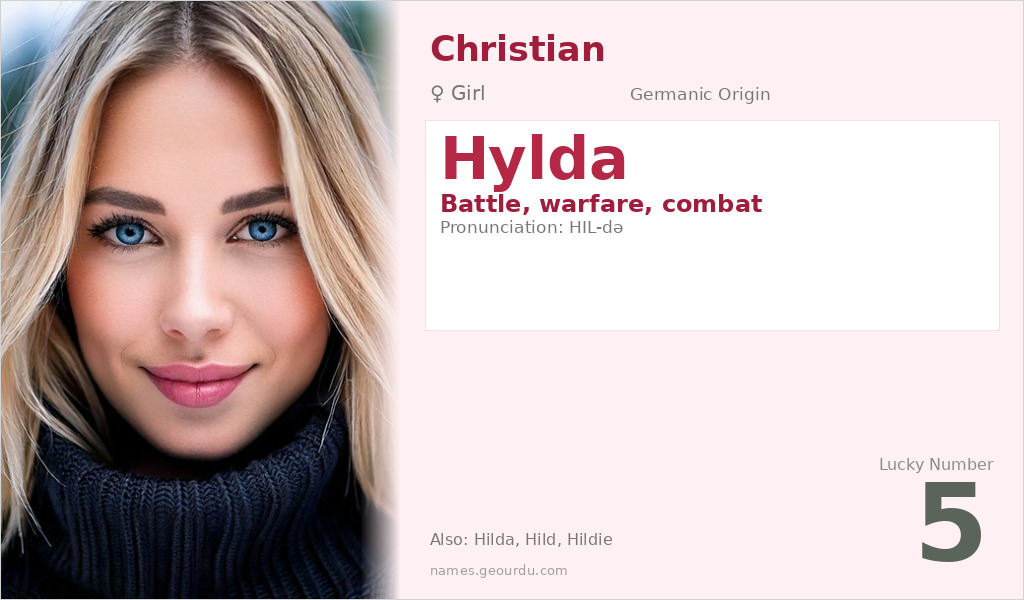
| 📛 Name | Hylda |
| 💎 Meaning | Battle, warfare, combat |
| 👤 Gender | Girl |
| 🕌 Religion | Christian |
| 🌍 Origin | Germanic |
| 🗣 Pronunciation | HIL-də |
| ✍️ Urdu | ہلڈا |
| ✍️ Arabic | هيلدا |
| 🔢 Numerology | 5 |
| ✨ Spellings | Hilda, Hild, Hildie, Hyldah, Hildur |
Origin & Cultural Significance
Hylda originates from Germanic languages, specifically Old English, where it developed from the name Hilda. The name gained prominence in England through Saint Hilda of Whitby (614–680), who founded Whitby Abbey and hosted the important Synod of Whitby. As abbess, she educated five future bishops, cementing the name’s Christian association. The ‘Hylda’ spelling variation appeared in Middle English manuscripts as orthography evolved. While the name declined after the Norman Conquest, it saw revivals in the 19th and 20th centuries, particularly in English-speaking countries. Unlike names from Arabic, Persian, or South Asian languages, Hylda has no verified meanings in those linguistic traditions—its etymology is firmly Germanic.
Personality Traits
Those named Hylda often embody the strength and determination suggested by their name’s meaning. They tend to be natural problem-solvers who approach challenges with strategic thinking and courage. Their independent nature makes them self-reliant, while their historical connection to leadership (through Saint Hilda) suggests organizational abilities. While ‘battle’ might sound aggressive, in practice Hyldas often channel this energy into constructive pursuits and advocacy for their beliefs.
Similar Names
If you like Hylda, consider: Hildegard, Brunhilda, Matilda, Gunhilda, Clotilda
Famous People Named Hylda
- Saint Hilda of Whitby — 7th-century English abbess and saint who founded Whitby Abbey
- Hilda Doolittle (H.D.) — American modernist poet and novelist (1886–1961)
Frequently Asked Questions About Hylda
What does Hylda mean?
Hylda means 'battle' or 'warfare'. It comes from the Old English name Hilda, which derives from the Germanic element 'hild' meaning battle.
Is Hylda a boy or girl name?
Hylda is exclusively a girl's name. It has been used for females since at least the 7th century, most notably by Saint Hilda of Whitby.
What is the origin of Hylda?
Hylda originates from Germanic languages, specifically Old English. It's a variant spelling of Hilda, which comes from the Proto-Germanic word for battle.





