
Table of Contents
Magdalen is a timeless name steeped in Christian tradition, evoking images of ancient Galilee and spiritual devotion. Derived from the town of Magdala, it carries a rich historical legacy through its most famous bearer, Mary Magdalene. This name has been cherished for centuries, symbolizing faith and resilience. In this guide, we delve into its origins, meaning, and cultural significance.
Meaning of Magdalen
Magdalen means ‘woman from Magdala,’ referring to a town on the Sea of Galilee. The name comes from the Greek ‘Magdalēnē’ (Μαγδαληνή), which itself derives from the Aramaic ‘Magdala,’ meaning ‘tower’ or ‘elevated.’ In Hebrew, the related term is Migdal (מִגְדָּל), also signifying ‘tower.’ This etymology highlights the geographical and linguistic roots, connecting to the Biblical era. The name gained prominence through Mary Magdalene, a key figure in the New Testament, emphasizing its deep Christian heritage. Over time, it has been adapted into various forms across languages, retaining its core meaning.
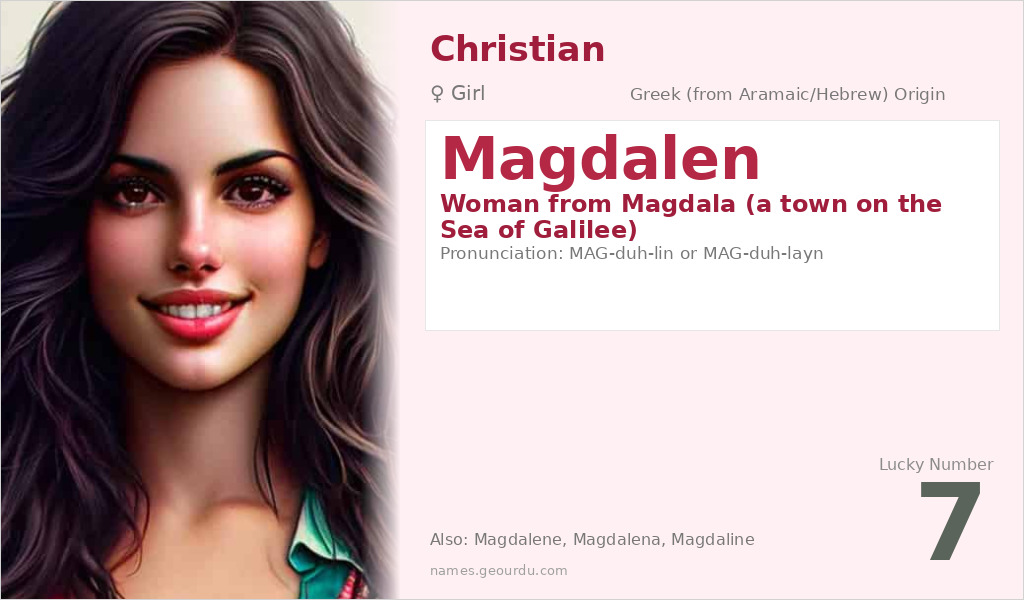
| 📛 Name | Magdalen |
| 💎 Meaning | Woman from Magdala (a town on the Sea of Galilee) |
| 👤 Gender | Girl |
| 🕌 Religion | Christian |
| 🌍 Origin | Greek (from Aramaic/Hebrew) |
| 🗣 Pronunciation | MAG-duh-lin or MAG-duh-layn |
| ✍️ Urdu | میگڈلین |
| ✍️ Arabic | مجدلين |
| 🔢 Numerology | 7 |
| ✨ Spellings | Magdalene, Magdalena, Magdaline, Magdalen |
Origin & Cultural Significance
Magdalen originates from the Greek adaptation of an Aramaic place name, Magdala, a fishing village in ancient Israel. Its usage in Christian contexts dates back to the first century, primarily associated with Mary Magdalene, who is mentioned in the Gospels as a follower of Jesus. The name spread through Europe via Latin and later vernacular languages, becoming popular in English-speaking countries from the medieval period onward. It is particularly common in Christian communities, often chosen for its Biblical resonance and historical depth. Variations like Magdalena and Madeleine have further enriched its cultural footprint.
Personality Traits
Those named Magdalen are often seen as embodying traits of loyalty, spirituality, and inner strength, inspired by the Biblical figure’s narrative. They may be drawn to compassionate pursuits and value deep, meaningful connections. The name’s historical roots can inspire a sense of tradition and resilience in its bearers.
Similar Names
If you like Magdalen, consider: Mary, Magdalena, Madeleine, Madeline, Maud
Famous People Named Magdalen
- Mary Magdalene — Biblical figure, follower of Jesus in the New Testament
- Magdalen College — Oxford University college founded in 1458
Frequently Asked Questions About Magdalen
What does Magdalen mean?
Magdalen means 'woman from Magdala,' a town on the Sea of Galilee. It comes from Greek 'Magdalēnē,' derived from Aramaic 'Magdala' meaning 'tower.'
Is Magdalen a boy or girl name?
Magdalen is traditionally a girl's name, rooted in Christian tradition through Mary Magdalene. It is rarely used for boys.
What is the origin of Magdalen?
Magdalen originates from Greek, based on the Aramaic place name Magdala, with strong ties to Christian history and the Bible.





