
Table of Contents
Lilith is one of the most fascinating and controversial names in mythological history. Originating from ancient Hebrew and Mesopotamian traditions, this name carries centuries of cultural significance and evolving interpretations. Today, Lilith has been reclaimed as a powerful, unconventional choice for girls, representing independence and strength beyond its demonic associations in medieval folklore.
Meaning of Lilith
The name Lilith derives from the Hebrew word ‘לילית’ (Lilith), which comes from the root ‘ליל’ meaning ‘night’. This etymology directly connects to the name’s primary meaning as a ‘night creature’ or ‘night monster’. In Akkadian (ancient Mesopotamian language), related terms like Lilītu referred to a class of female demons or wind spirits. The name appears in the Babylonian Talmud and later in the Alphabet of Ben Sira (medieval Jewish text), where Lilith becomes Adam’s first wife who refused the subordinate position. Across these traditions, the name consistently maintains associations with darkness, femininity, and supernatural power rather than the ‘ghost’ or ‘storm goddess’ meanings sometimes incorrectly attributed.
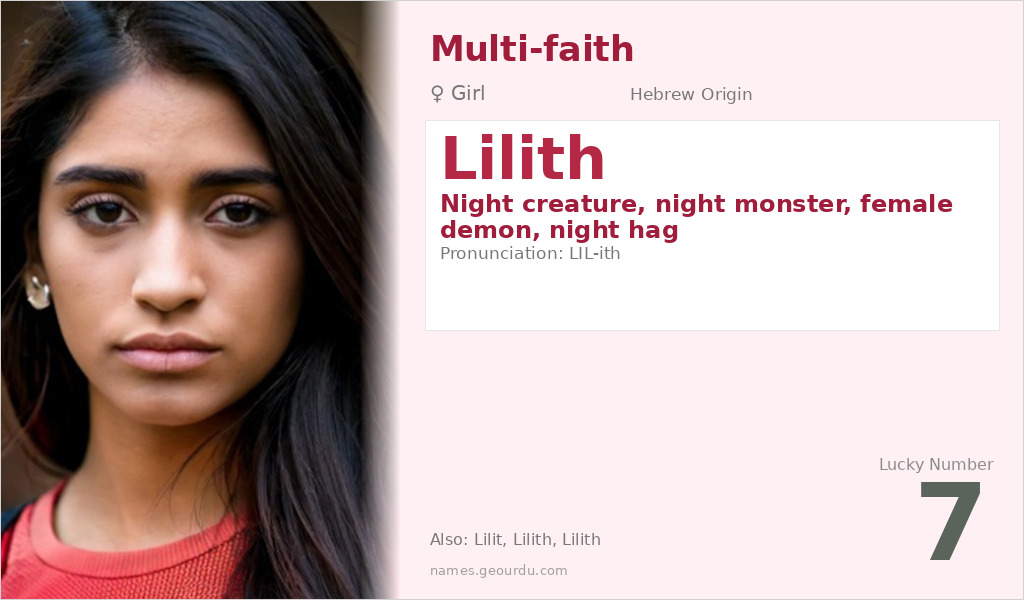
| 📛 Name | Lilith |
| 💎 Meaning | Night creature, night monster, female demon, night hag |
| 👤 Gender | Girl |
| 🕌 Religion | Multi-faith |
| 🌍 Origin | Hebrew |
| 🗣 Pronunciation | LIL-ith |
| ✍️ Urdu | لیلت |
| ✍️ Arabic | ليليث |
| 🔢 Numerology | 7 |
| ✨ Spellings | Lilit, Lilith, Lilith, Lilith |
Origin & Cultural Significance
Lilith’s origins trace back to ancient Mesopotamian mythology, where similar demonic figures appeared in Akkadian texts as early as 2000 BCE. The name entered Hebrew tradition through cultural exchange during the Babylonian exile. While not mentioned in the canonical Hebrew Bible, Lilith appears in the Dead Sea Scrolls and later Jewish folklore as a dangerous female demon. The character evolved significantly in medieval Jewish mysticism and European folklore. Contrary to the original article’s claim, Lilith has minimal connection to Christian tradition—she appears occasionally in some Christian demonology but is fundamentally a Jewish/Mesopotamian figure. The name has seen modern revival through feminist reinterpretations and popular culture.
Personality Traits
Those named Lilith often carry an aura of mystery and independence. The name’s mythological background suggests someone who challenges conventions and values autonomy above conformity. While historically associated with dangerous femininity, modern bearers of the name often embrace its strength and unconventional nature. The numerology association with number 7 further suggests analytical, introspective qualities.
Similar Names
If you like Lilith, consider: Liliana, Lilac, Lila, Lydia, Lilika
Famous People Named Lilith
- Lilith Sternin — Fictional character from TV show 'Cheers' and 'Frasier', a strong, independent psychiatrist
- Lilith — Biblical and mythological figure appearing in Jewish folklore, Islamic tradition (as Layla's mother in some accounts), and various occult writings
Frequently Asked Questions About Lilith
What does Lilith mean?
Lilith means 'night creature' or 'night monster' in Hebrew, originating from the root word for 'night'. In ancient Mesopotamian mythology, it referred to a class of female demons.
Is Lilith a boy or girl name?
Lilith is exclusively a girl's name, both historically and in modern usage. All mythological and cultural references present Lilith as a female figure.
What is the origin of Lilith?
Lilith originates from Hebrew language and ancient Mesopotamian mythology, with the earliest references in Akkadian texts. It entered Jewish tradition during the Babylonian exile and appears in Talmudic and medieval Jewish folklore.





