
Table of Contents
Malvina is a name that carries the romantic spirit of 18th-century Scottish poetry into the modern era. With its melodic three-syllable rhythm and literary heritage, this name has captivated parents across Europe and the Americas. While not common, it maintains a distinctive charm that sets it apart from more traditional choices. The name’s journey from Ossianic legend to contemporary usage reveals much about cultural transmission and naming trends.
Meaning of Malvina
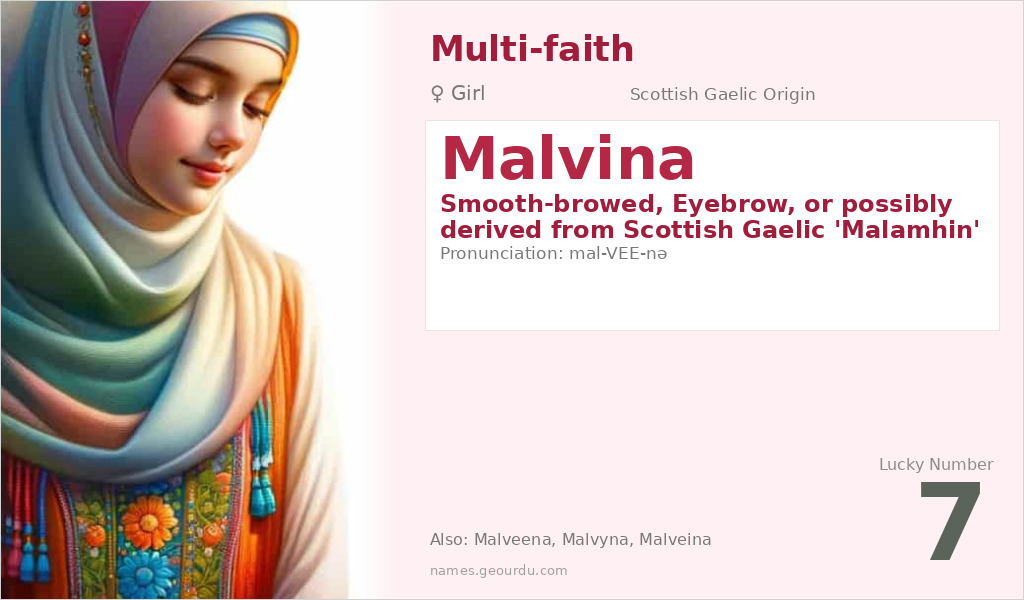
The meaning of Malvina is most commonly understood as ‘smooth brow’ or ‘eyebrow,’ derived from Scottish Gaelic roots. Scholars generally accept its connection to the Gaelic word ‘Malamhin,’ though some debate exists about whether this represents a genuine Gaelic name or was invented for literary purposes. The name first appeared in James Macpherson’s controversial but influential ‘Ossian’ poems in the 1760s, where Malvina was portrayed as the granddaughter of the legendary warrior Fingal. This literary creation then entered European naming traditions, particularly in Romantic-era Germany and Italy, where it was embraced for its poetic sound and tragic heroine associations. The name’s etymology remains somewhat speculative, as it exists in that gray area between genuine folk tradition and artistic invention.
| 📛 Name | Malvina |
| 💎 Meaning | Smooth-browed, Eyebrow, or possibly derived from Scottish Gaelic 'Malamhin' meaning 'smooth brow' |
| 👤 Gender | Girl |
| 🕌 Religion | Multi-faith |
| 🌍 Origin | Scottish Gaelic |
| 🗣 Pronunciation | mal-VEE-nə |
| ✍️ Urdu | مالوینا |
| ✍️ Arabic | مالفينا |
| 🔢 Numerology | 7 |
| ✨ Spellings | Malveena, Malvyna, Malveina, Melvina |
Origin & Cultural Significance
Malvina’s origins are firmly rooted in 18th-century Scottish literary revival rather than ancient naming traditions. James Macpherson claimed to have translated ancient Gaelic epics in his ‘Works of Ossian,’ though modern scholarship suggests he substantially created or heavily adapted the material. The character Malvina, a beautiful and tragic figure in these poems, captured European imagination during the Romantic period. From Scotland, the name spread to Germany (where it became popular in the 19th century), Italy, France, and eventually to English-speaking countries. Unlike many names with religious or tribal origins, Malvina represents a fascinating case of literary invention becoming authentic naming tradition. Its adoption across multiple cultures demonstrates how artistic works can generate lasting cultural artifacts.
Personality Traits
Those named Malvina often inherit the artistic and romantic associations of their name’s literary origins. They frequently demonstrate creative talents, particularly in writing, music, or visual arts. The name’s melodic quality seems to attract individuals with aesthetic sensitivity and emotional depth. Many Malvinas show strong intuition and intellectual curiosity, combined with a certain resilience that echoes their namesake’s tragic but noble literary character.
Similar Names
If you like Malvina, consider: Melvina, Alvina, Selvina, Malina, Melina
Famous People Named Malvina
- Malvina Reynolds — American folk singer-songwriter known for 'Little Boxes'
- Malvina Hoffman — American sculptor famous for her 'Races of Mankind' series
Frequently Asked Questions About Malvina
What does Malvina mean?
Malvina most likely means 'smooth brow' or 'eyebrow,' derived from Scottish Gaelic 'Malamhin.' The name was popularized through 18th-century Ossianic poetry rather than ancient tradition.
Is Malvina a boy or girl name?
Malvina is exclusively a girl's name. It was created as a feminine character in Scottish literature and has never been used traditionally for boys in any culture.
What is the origin of Malvina?
Malvina originates from 18th-century Scottish literary tradition, specifically from James Macpherson's 'Ossian' poems. While based on Gaelic linguistic elements, it represents literary invention rather than ancient naming practice.





