Table of Contents
Kimberlin is an elegant feminine name that carries the regal heritage of Old English origins. As a variant of the popular name Kimberly, Kimberlin offers a distinctive twist while maintaining its noble meaning. This name has gained recognition through notable bearers in entertainment and continues to appeal to parents seeking a name with both traditional roots and contemporary flair. Discover the rich linguistic history and cultural significance behind this beautiful name.
Meaning of Kimberlin
Kimberlin derives from the Old English name Kimberly, which itself comes from a place name meaning ‘Cyneburg’s meadow’ or ‘royal fortress meadow.’ The first element ‘Cyneburg’ combines ‘cyne’ (royal) and ‘burg’ (fortress), while the second element ‘leah’ means woodland clearing or meadow. This etymology reflects the name’s origins as a geographical identifier in medieval England, specifically referring to locations in Nottinghamshire and West Yorkshire. As a given name, Kimberlin emerged in the 20th century as a creative feminine variation, maintaining the royal connotations of its source while developing its own distinct identity. The name’s components trace back to Proto-Germanic roots, with ‘cyne’ related to ‘kuningaz’ (king) and ‘leah’ to clearing or pasture land.
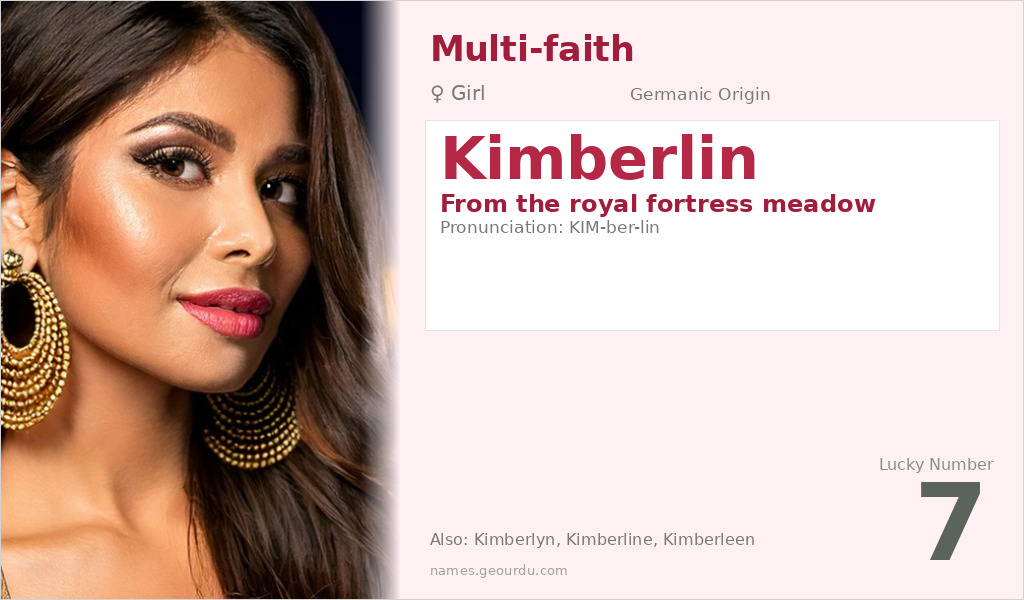
| 📛 Name | Kimberlin |
| 💎 Meaning | From the royal fortress meadow |
| 👤 Gender | Girl |
| 🕌 Religion | Multi-faith |
| 🌍 Origin | Germanic |
| 🗣 Pronunciation | KIM-ber-lin |
| ✍️ Urdu | کمبرلن |
| ✍️ Arabic | كيمبرلين |
| 🔢 Numerology | 7 |
| ✨ Spellings | Kimberlyn, Kimberline, Kimberleen, Kimberlynn |
Origin & Cultural Significance
Kimberlin originated as a variant of the English surname Kimberly, which was derived from place names in Nottinghamshire and West Yorkshire, England. The name transitioned from a surname to a feminine given name in the mid-20th century, particularly in the United States and other English-speaking countries. Unlike names with specific religious origins, Kimberlin has secular roots in English topography and aristocracy. The name gained popularity during the mid-20th century naming trends that favored elaborated versions of established names. While not tied to any particular faith tradition, Kimberlin has been used by families of various religious backgrounds due to its neutral linguistic origins.
Personality Traits
Those named Kimberlin are often associated with qualities of introspection, intelligence, and spiritual depth. The name’s connection to royalty and nature suggests a personality that balances leadership qualities with a grounded, thoughtful approach to life. Individuals with this name may exhibit strong analytical skills and a preference for meaningful connections over casual acquaintances. Their combination of regal heritage and natural elements in the name’s meaning often translates to someone who values both tradition and authenticity in their personal and professional lives.
Similar Names
If you like Kimberlin, consider: Kimberly, Kimber, Kim, Kimbell, Kemberly
Famous People Named Kimberlin
- Kimberlin Brown — American actress known for her roles in soap operas like 'The Bold and the Beautiful' and 'The Young and the Restless'
- Kimberlin Brown Pelzer — American actress and businesswoman, also known for her soap opera roles and political involvement
Frequently Asked Questions About Kimberlin
What does Kimberlin mean?
Kimberlin means 'from the royal fortress meadow,' originating from Old English elements 'cyne' (royal), 'burg' (fortress), and 'leah' (meadow or clearing).
Is Kimberlin a boy or girl name?
Kimberlin is primarily a feminine name, though as with many modern names, it could theoretically be used for any gender. Historically and culturally, it has been almost exclusively given to girls since its emergence as a given name in the 20th century.
What is the origin of Kimberlin?
Kimberlin originates from Old English through the name Kimberly, which was originally a place name in England meaning 'Cyneburg's meadow.' It evolved from a surname to a feminine given name in the 20th century, particularly in English-speaking countries.