
Table of Contents
Loreto is a name rich in history and spiritual significance, originating from the Latin word for ‘laurel grove’. While it might sound modern, its roots stretch back to ancient Roman times and a famous Italian pilgrimage site. Today, it’s used across the Christian world, particularly in Italy, Spain, and the Philippines, carrying connotations of victory, honor, and faith. Whether chosen for a boy or a girl, Loreto offers a unique blend of classical elegance and religious depth.
Meaning of Loreto
Loreto’s meaning is firmly rooted in Latin etymology. It derives from ‘Lauretum’, a term referring to a grove of laurel trees (Laurus nobilis). In ancient Rome, laurel wreaths were awarded to victors in athletic competitions, military triumphs, and poetic contests, making the laurel a powerful symbol of achievement and honor. The name later became associated with the town of Loreto in Italy, home to the Basilica della Santa Casa, which Catholics believe houses the original Holy House of Mary from Nazareth. This religious connection imbued the name with Marian devotion, especially in Catholic cultures. Thus, Loreto carries dual layers of meaning: the classical symbolism of victory from its Latin roots and the spiritual significance from its Christian pilgrimage site.
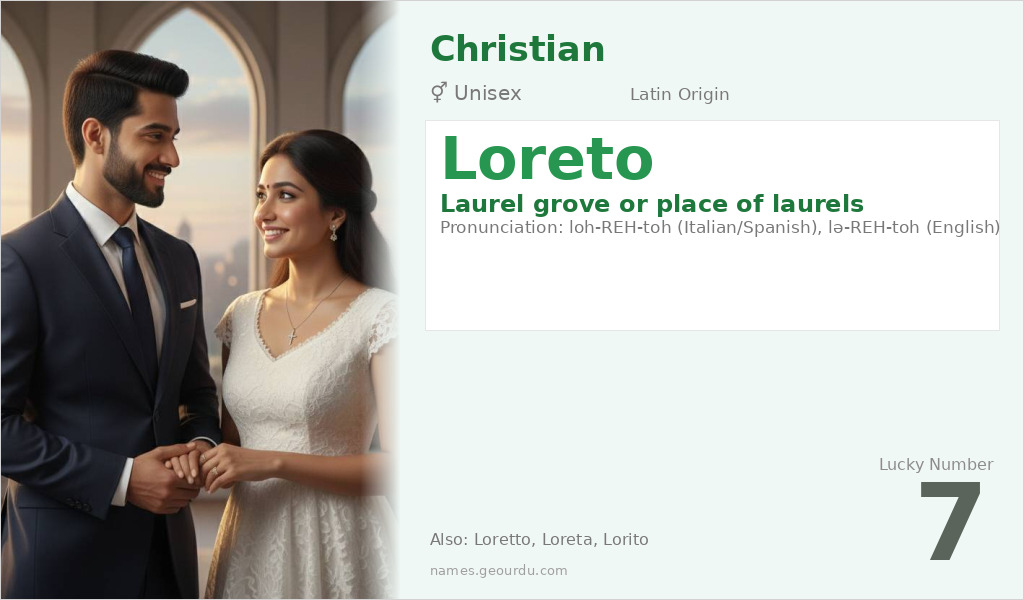
| 📛 Name | Loreto |
| 💎 Meaning | Laurel grove or place of laurels |
| 👤 Gender | Unisex |
| 🕌 Religion | Christian |
| 🌍 Origin | Latin |
| 🗣 Pronunciation | loh-REH-toh (Italian/Spanish), lə-REH-toh (English) |
| ✍️ Urdu | لوریٹو |
| ✍️ Arabic | لوريتو |
| 🔢 Numerology | 7 |
| ✨ Spellings | Loretto, Loreta, Lorito |
Origin & Cultural Significance
Loreto originates from Latin, specifically as a toponym (place name) for locations with laurel groves. Its most famous association is with the Italian town of Loreto in the Marche region, which gained prominence in the late 13th century when the Holy House was believed to have been miraculously transported there by angels. This event made Loreto a major Marian pilgrimage destination, leading to the name’s adoption as a given name in honor of the Virgin Mary (Our Lady of Loreto). Culturally, Loreto spread through Spanish and Italian colonization, becoming popular in the Philippines and Latin America. While it is used for both genders, it is more commonly masculine in Italy (e.g., as a variant of Lorenzo) and feminine in Spanish-speaking countries.
Personality Traits
Those named Loreto often embody traits linked to its etymological and cultural heritage. The laurel’s symbolism suggests a personality marked by resilience, dignity, and a striving for excellence, much like the ancient victors crowned with laurel wreaths. The religious connection may inspire a deep sense of faith, compassion, and tradition, guiding them toward purposeful actions. Together, these influences can shape individuals who are both grounded in their values and aspirational in their pursuits.
Similar Names
If you like Loreto, consider: Lorenzo, Laurence, Laura, Lorena, Lorraine
Famous People Named Loreto
- Loreto Paraiso — Filipino actress known for roles in ABS-CBN dramas
- Loreto Tupas — Filipino journalist and news anchor
Frequently Asked Questions About Loreto
What does Loreto mean?
Loreto means 'laurel grove' or 'place of laurels', derived from the Latin word 'Lauretum'. It is also associated with the Italian pilgrimage town of Loreto, linked to the Virgin Mary.
Is Loreto a boy or girl name?
Loreto is a unisex name. It is used for both boys and girls, though it tends to be more masculine in Italy and more feminine in Spanish-speaking cultures like the Philippines and Latin America.
What is the origin of Loreto?
Loreto originates from Latin as a place name meaning 'laurel grove'. It gained prominence as a given name through the Italian town of Loreto, a major Catholic pilgrimage site dedicated to Our Lady of Loreto.





