
Table of Contents
Lucia is a timeless name that has illuminated cultures for centuries. Derived from the Latin word for ‘light,’ this name carries both historical depth and spiritual significance. From ancient Rome to modern nurseries, Lucia continues to shine as a popular choice for girls worldwide. Its connection to Saint Lucia of Syracuse adds a layer of Christian heritage that has sustained its popularity through generations.
Meaning of Lucia
The name Lucia originates from the Latin word ‘lux,’ meaning ‘light.’ It is the feminine form of Lucius, a common Roman praenomen (personal name) that literally translates to ‘light’ or ‘illumination.’ This etymology is well-documented in classical Latin literature and Roman naming conventions. The name gained particular prominence through Saint Lucia of Syracuse, whose martyrdom in the early 4th century cemented the association between the name and spiritual illumination. Across languages, variations maintain this core meaning—from Italian ‘Lucia’ to German ‘Luzia’ and Slavic ‘Lucija.’ The name’s consistent meaning across cultures demonstrates its strong linguistic roots.
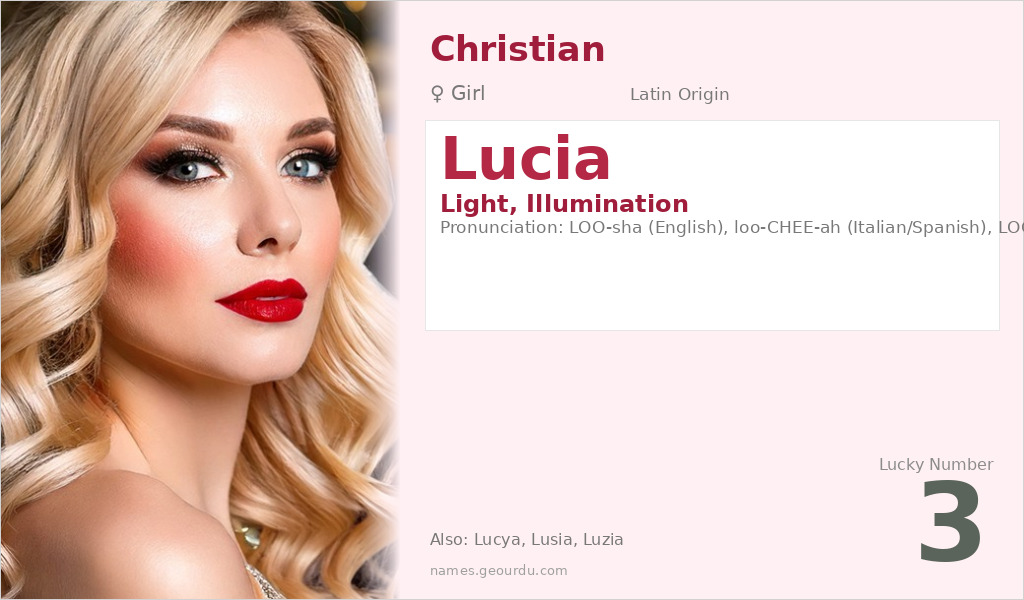
| 📛 Name | Lucia |
| 💎 Meaning | Light, Illumination |
| 👤 Gender | Girl |
| 🕌 Religion | Christian |
| 🌍 Origin | Latin |
| 🗣 Pronunciation | LOO-sha (English), loo-CHEE-ah (Italian/Spanish), LOO-tsya (German) |
| ✍️ Urdu | لوچیا |
| ✍️ Arabic | لوسيا |
| 🔢 Numerology | 3 |
| ✨ Spellings | Lucya, Lusia, Luzia, Lucía, Lucija, Lusiya |
Origin & Cultural Significance
Lucia has its origins in ancient Rome, where Lucius was a common masculine name among patrician families. The feminine form Lucia emerged during the Roman Republic and early Empire periods. The name’s spread throughout Europe was primarily driven by Christianity, particularly through veneration of Saint Lucia, who was martyred during the Diocletianic Persecution. Her feast day on December 13th was historically celebrated as the winter solstice in the Julian calendar, reinforcing the ‘light’ symbolism during the darkest time of year. Today, Lucia remains particularly popular in Italy, Spain, Scandinavia, and Slavic countries, with variations adapted to local phonetics while preserving the original meaning.
Personality Traits
Names meaning ‘light’ often carry expectations of brightness and positivity. Lucia suggests someone who brings illumination to dark situations, whether through intelligence, compassion, or spiritual insight. Historically associated with Saint Lucia’s martyrdom, the name also implies strength of conviction and resilience. In modern contexts, Lucia evokes a balanced personality—both radiant and substantial, much like light itself which reveals truth while remaining intangible.
Similar Names
If you like Lucia, consider: Lucy, Lucille, Luciana, Lucinda, Luna
Famous People Named Lucia
- Saint Lucia of Syracuse — 4th-century Christian martyr and patron saint of the blind
- Lucia Popp — Slovak operatic soprano renowned for Mozart and Strauss roles
Frequently Asked Questions About Lucia
What does Lucia mean?
Lucia means 'light' or 'illumination.' It comes from the Latin word 'lux' and is the feminine form of the Roman name Lucius.
Is Lucia a boy or girl name?
Lucia is exclusively a feminine name. The masculine equivalent is Lucius or Luke. While some names have become unisex, Lucia has remained consistently feminine across cultures.
What is the origin of Lucia?
Lucia originates from Latin, specifically from ancient Roman naming traditions. It gained widespread popularity through Christianity, particularly due to Saint Lucia of Syracuse, a 4th-century martyr.





