
Table of Contents
Goliath is one of the most recognizable names from ancient history, immortalized in the Biblical story of David’s victory over the Philistine giant. This Hebrew name carries profound historical and religious significance across multiple faith traditions. While often associated with physical strength due to its Biblical context, the name’s actual meaning reveals a more nuanced origin. Understanding Goliath requires exploring its authentic Hebrew etymology rather than modern invented associations.
Meaning of Goliath
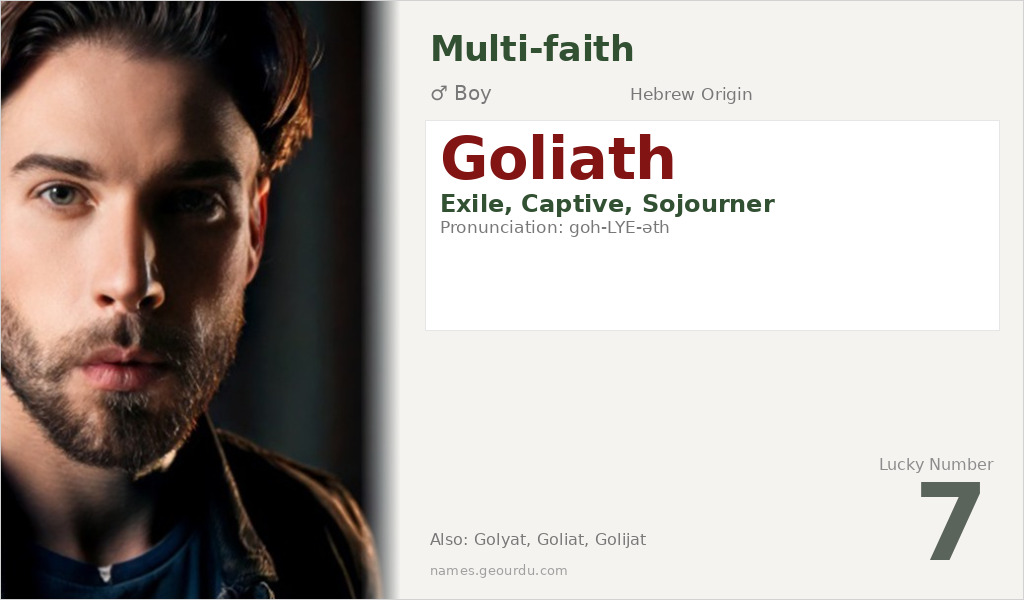
The name Goliath derives from the Hebrew גָּלְיָת (Golyat), which comes from the root verb גָּלָה (galah). This Hebrew root has multiple meanings including ‘to uncover, reveal, go into exile, or be carried away’. In the context of the name Goliath, it specifically means ‘exile’, ‘captive’, or ‘sojourner’—someone taken from their homeland. The name appears in the Masoretic Text of the Hebrew Bible and was transliterated into Greek as Γολιάθ in the Septuagint. This etymology reflects the Philistine warrior’s status as a foreigner in the land of Israel, though ironically the Israelites viewed themselves as exiles in relation to the Philistines during that period.
| 📛 Name | Goliath |
| 💎 Meaning | Exile, Captive, Sojourner |
| 👤 Gender | Boy |
| 🕌 Religion | Multi-faith |
| 🌍 Origin | Hebrew |
| 🗣 Pronunciation | goh-LYE-əth |
| ✍️ Urdu | جالوت |
| ✍️ Arabic | جالوت |
| 🔢 Numerology | 7 |
| ✨ Spellings | Golyat, Goliat, Golijat |
Origin & Cultural Significance
Goliath originates from ancient Hebrew culture and appears in the First Book of Samuel in the Hebrew Bible/Old Testament. The name belongs to the Philistine warrior from Gath who was defeated by the Israelite shepherd David. While the Philistines were a Sea Peoples group possibly originating from the Aegean region, the name Goliath itself is recorded in Hebrew scriptures. The story appears in Jewish, Christian, and Islamic traditions, with the Quran mentioning Jalut (the Arabic form of Goliath) as a formidable opponent defeated by David. The name has been used sparingly in Western cultures, primarily as a reference to the Biblical character rather than as a common given name.
Personality Traits
The name Goliath carries immense historical baggage that inevitably shapes perceptions of anyone bearing it. While the Biblical Goliath represents physical might and opposition, the name’s Hebrew meaning of ‘exile’ suggests deeper themes of displacement and foreignness. Those named Goliath often develop strong personalities to match the name’s formidable reputation, though they may also cultivate resilience from understanding the name’s original meaning of overcoming displacement. The name encourages reflection on strength versus vulnerability, a duality present in the original Biblical narrative.
Similar Names
If you like Goliath, consider: David, Samson, Jonathan, Saul, Elijah
Famous People Named Goliath
- Goliath (Biblical figure) — Philistine warrior from Gath defeated by David in the Hebrew Bible/Old Testament
- Goliath (wrestler) — Professional wrestler from the 1970s-1980s
Frequently Asked Questions About Goliath
What does Goliath mean?
Goliath means 'Exile', 'Captive', or 'Sojourner' in Hebrew, derived from the root word גָּלָה (galah) meaning 'to go into exile'.
Is Goliath a boy or girl name?
Goliath is exclusively a masculine name, originating as the name of the male Philistine warrior in the Hebrew Bible/Old Testament.
What is the origin of Goliath?
Goliath originates from Hebrew language and culture, specifically from the Biblical account in 1 Samuel where it appears as the name of the Philistine giant defeated by David.





