
Table of Contents
Barth is a distinctive boy’s name with deep biblical roots that has maintained its appeal across centuries. As a shortened form of Bartholomew, this name carries the weight of apostolic tradition while offering a more modern, streamlined option. With its Aramaic origins meaning ‘son of Talmai’, Barth connects bearers to one of Jesus’s twelve disciples and represents a meaningful choice for Christian families seeking names with spiritual heritage.
Meaning of Barth
The name Barth derives from the Aramaic ‘Bar-Talmai’, where ‘Bar’ means ‘son of’ and ‘Talmai’ is a personal name meaning ‘furrow’ or ‘plowman’. This gives the complete meaning ‘son of Talmai’ or metaphorically ‘son of the plowman’. In the New Testament, Bartholomew appears as one of the twelve apostles, though some scholars believe Bartholomew and Nathanael may refer to the same person. The name entered European languages through Latin ‘Bartholomaeus’ and Greek ‘Bartholomaios’, with Barth emerging as a common shortened form. This etymology reflects the agricultural context of ancient Aramaic-speaking communities where names often referenced occupations or familial relationships.
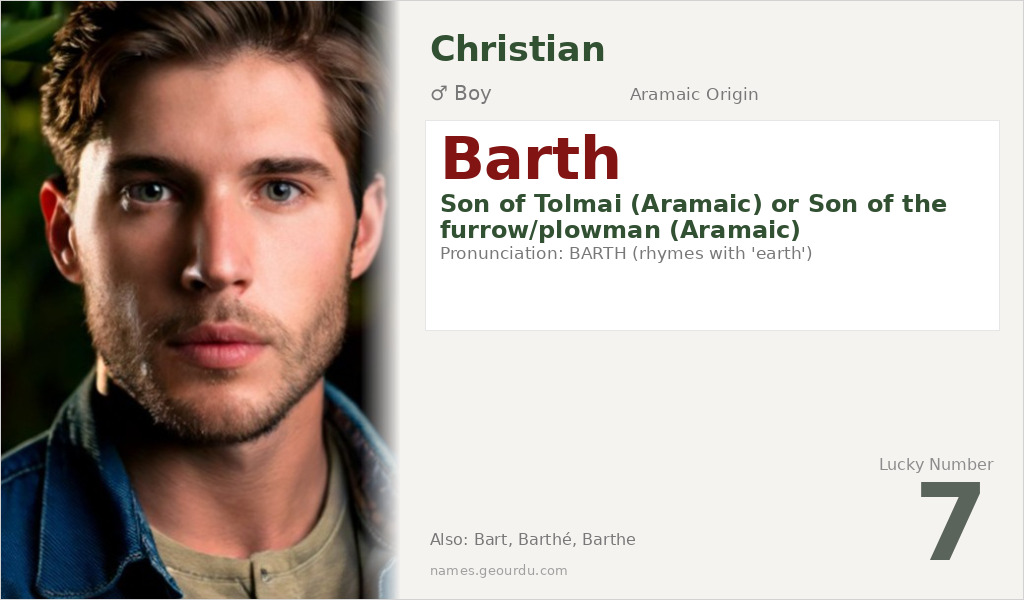
| 📛 Name | Barth |
| 💎 Meaning | Son of Tolmai (Aramaic) or Son of the furrow/plowman (Aramaic) |
| 👤 Gender | Boy |
| 🕌 Religion | Christian |
| 🌍 Origin | Aramaic |
| 🗣 Pronunciation | BARTH (rhymes with 'earth') |
| ✍️ Urdu | بارتھ |
| ✍️ Arabic | بارث |
| 🔢 Numerology | 7 |
| ✨ Spellings | Bart, Barthé, Barthe |
Origin & Cultural Significance
Barth originates from Aramaic, the language spoken by Jesus and his disciples, making it one of the few names with direct biblical Aramaic roots. The name gained prominence through Saint Bartholomew the Apostle, who according to tradition preached in Armenia, India, and Mesopotamia before being martyred. During the Middle Ages, the name spread throughout Europe via Christianization, with Bartholomew becoming particularly popular in England after the Norman Conquest. While Barth began as a diminutive, it has evolved into an independent given name, especially in English-speaking countries and Germany, where it maintains its Christian associations while offering a concise alternative to the longer Bartholomew.
Personality Traits
Those named Barth are often associated with qualities of depth, introspection, and spiritual seeking. The name’s biblical origins suggest a connection to faith and tradition, while its concise form implies practicality and directness. People with this name may be perceived as having an analytical mind combined with a grounded, earthy sensibility that reflects the name’s agricultural etymology. These traits make Barth a name that balances intellectual depth with practical application.
Similar Names
If you like Barth, consider: Bartholomew, Bart, Bartley, Barton, Barrett
Famous People Named Barth
- Bartholomew the Apostle — One of the twelve apostles of Jesus in Christian tradition
- Barthélemy Boganda — First president of the Central African Republic
Frequently Asked Questions About Barth
What does Barth mean?
Barth means 'son of Talmai' in Aramaic, where Talmai means 'furrow' or 'plowman'. It's a shortened form of Bartholomew, the name of one of Jesus's twelve apostles.
Is Barth a boy or girl name?
Barth is exclusively a boy's name with strong biblical and Christian associations. It has never been used traditionally as a feminine name.
What is the origin of Barth?
Barth originates from Aramaic, the language spoken in ancient Palestine. It comes from 'Bar-Talmai' meaning 'son of Talmai' and entered European languages through Greek and Latin translations of the New Testament.





