
Table of Contents
Casimir is a distinguished Slavic name with a rich royal and saintly heritage. Meaning ‘proclaimer of peace’ or ‘peacemaker,’ it has been borne by Polish kings and a beloved patron saint. This classic name combines historical depth with a timeless, noble sound that appeals across cultures.
Meaning of Casimir
The name Casimir originates from the Slavic languages, specifically Old Polish, where it is composed of two elements: ‘kazić,’ meaning ‘to destroy’ or ‘to ruin,’ and ‘mir,’ meaning ‘peace’ or ‘world.’ This combination yields the literal meaning ‘destroyer of peace,’ though over time it has been reinterpreted more positively as ‘proclaimer of peace’ or ‘peacemaker.’ The name’s etymology reflects a complex interplay of conflict and harmony, which may symbolize someone who brings peace through decisive action. It is closely associated with Saint Casimir, a 15th-century Polish prince revered for his piety and peacemaking efforts, further cementing its connotation of virtue and tranquility.
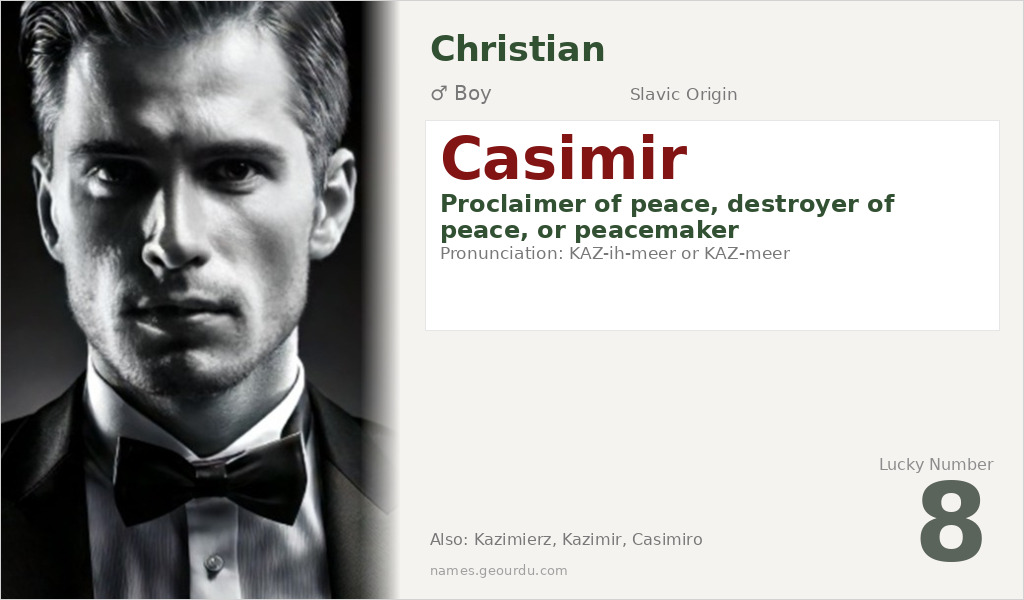
| 📛 Name | Casimir |
| 💎 Meaning | Proclaimer of peace, destroyer of peace, or peacemaker |
| 👤 Gender | Boy |
| 🕌 Religion | Christian |
| 🌍 Origin | Slavic |
| 🗣 Pronunciation | KAZ-ih-meer or KAZ-meer |
| ✍️ Urdu | کیسیمیر |
| ✍️ Arabic | كازيمير |
| 🔢 Numerology | 8 |
| ✨ Spellings | Kazimierz, Kazimir, Casimiro, Kázmér |
Origin & Cultural Significance
Casimir has its roots in Slavic culture, particularly in Poland, where it has been used since the Middle Ages. It gained prominence through several Polish rulers, most notably Casimir III the Great, who significantly expanded and reformed Poland in the 14th century. The name’s spread across Europe was largely due to the veneration of Saint Casimir, the patron saint of Poland and Lithuania, whose feast day is celebrated on March 4th. In modern times, Casimir remains popular in Polish-speaking regions and has seen usage in other countries, often in variations like Kazimierz or Casimiro. Its association with nobility and sanctity has made it a enduring choice for boys in Christian communities, though it is not exclusive to any single religion.
Personality Traits
Those named Casimir are often perceived as calm, diplomatic, and morally grounded individuals. Inspired by historical figures like Saint Casimir, they may exhibit a strong sense of duty, compassion, and a desire to foster harmony in their surroundings. Their thoughtful and sometimes reserved nature can make them effective mediators or leaders who prioritize justice and tradition.
Similar Names
If you like Casimir, consider: Kazimierz, Casimiro, Kazimir, Mirko, Caspar, Casparus, Casparian, Kazmer, Kázmér, Casimirus
Famous People Named Casimir
- Saint Casimir — 15th-century Polish prince and patron saint of Poland and Lithuania
- Casimir III the Great — King of Poland from 1333 to 1370 who expanded Polish territory and established legal reforms
- Casimir Pulaski — Polish nobleman and military commander who fought in the American Revolutionary War
Frequently Asked Questions About Casimir
What does Casimir mean?
Casimir means 'proclaimer of peace,' 'destroyer of peace,' or 'peacemaker.' It comes from the Slavic elements 'kazić' (to destroy) and 'mir' (peace), with interpretations varying by context.
Is Casimir a boy or girl name?
Casimir is traditionally a boy's name, with a long history of male bearers in Slavic cultures, including kings and saints. It is rarely used for girls.
What is the origin of Casimir?
Casimir originates from Slavic languages, specifically Old Polish. It has been used in Poland since the Middle Ages and is associated with Polish royalty and Christian saints.





