
Table of Contents
Basil is a distinguished name with regal Greek origins that has traveled across continents and centuries. From early Christian saints to Byzantine emperors, this name carries a legacy of leadership and spiritual significance. Its meaning ‘royal’ or ‘kingly’ reflects the noble qualities associated with its most famous bearers throughout history.
Meaning of Basil
The name Basil derives from the ancient Greek word ‘basileus’ (βασιλεύς), which specifically meant ‘king’, ‘monarch’, or ‘sovereign’. This root appears in numerous Greek compounds and titles, emphasizing its royal connotations. Through Latinization as ‘Basilius’, the name entered Western Christian tradition while maintaining its original meaning. In Eastern Orthodox Christianity, the name became particularly prominent through Saint Basil the Great, whose theological works and monastic rules shaped Christian thought. The semantic field includes not just political royalty but also spiritual leadership and moral authority.
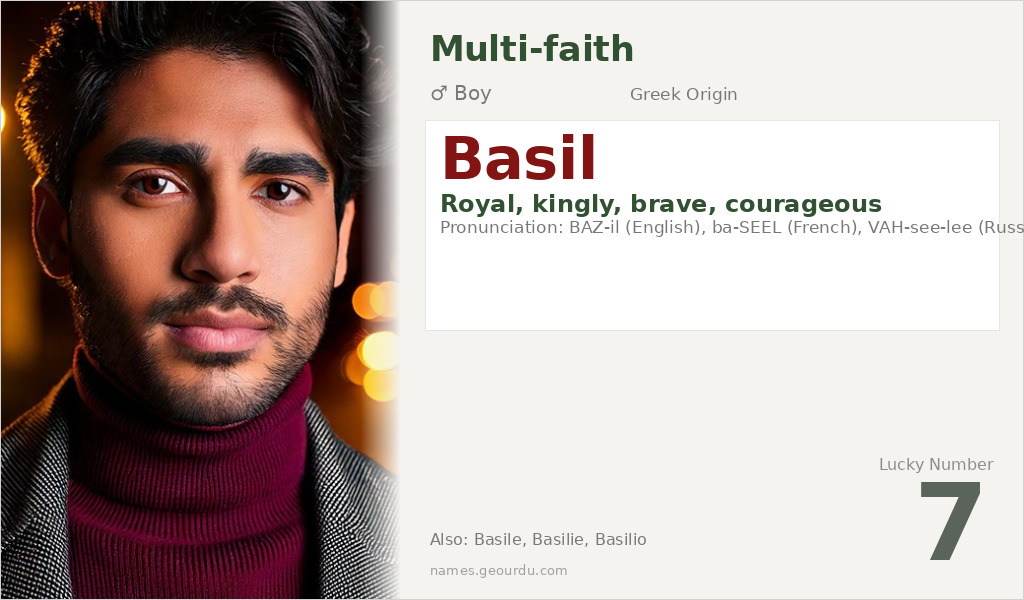
| 📛 Name | Basil |
| 💎 Meaning | Royal, kingly, brave, courageous |
| 👤 Gender | Boy |
| 🕌 Religion | Multi-faith |
| 🌍 Origin | Greek |
| 🗣 Pronunciation | BAZ-il (English), ba-SEEL (French), VAH-see-lee (Russian) |
| ✍️ Urdu | باسل |
| ✍️ Arabic | باسيل |
| 🔢 Numerology | 7 |
| ✨ Spellings | Basile, Basilie, Basilio, Vasili, Vasily, Vasil, Bazil |
Origin & Cultural Significance
Basil originated in the Greek-speaking world of late antiquity, first appearing as a given name in the 4th century AD with Saint Basil the Great from Caesarea in Cappadocia (modern Turkey). The name spread rapidly through Christian communities in the Byzantine Empire and later throughout Europe via religious texts and saint veneration. In the Arab world, the name entered through Christian communities and Byzantine cultural exchange, appearing as باسيل (Basīl). Russian adoption came via Byzantine Christianity as Василий (Vasiliy), while Western Europe received it through Latin ecclesiastical tradition. The name’s persistence across cultures demonstrates its strong association with respected religious figures rather than pagan royalty.
Personality Traits
Those named Basil often inherit the name’s historical associations with leadership, wisdom, and moral fortitude. They may exhibit natural authority combined with intellectual curiosity and spiritual depth. The name’s connection to Saint Basil suggests qualities of compassion, organizational ability, and commitment to community welfare. While dignified and traditional, Basils often balance this with innovative thinking and courage in facing challenges.
Similar Names
If you like Basil, consider: Basileus, Basilides, Vasilis, Basiliano, Basilian, Basiliscus, Basilissa, Basilla, Basim, Bashir
Famous People Named Basil
- Saint Basil the Great — 4th-century Greek bishop, theologian, and Doctor of the Church who established guidelines for monastic life
- Basil II — Byzantine Emperor (976-1025) known as 'Bulgar-Slayer' for his military campaigns
- Basil Rathbone — British actor famous for playing Sherlock Holmes in films
- Basil of Caesarea — Early Christian bishop and saint, brother of Gregory of Nyssa
Frequently Asked Questions About Basil
What does Basil mean?
Basil means 'royal', 'kingly', or 'brave' originating from the Greek word 'basileus' meaning king. The name carries connotations of leadership and nobility.
Is Basil a boy or girl name?
Basil is traditionally a masculine name across all cultures where it appears, from Greek and Russian to Arabic and English contexts. Female variants like Basilissa exist but are rare.
What is the origin of Basil?
Basil originates from ancient Greek, specifically from the word 'basileus' meaning king. It was popularized by early Christian saints, most notably Saint Basil the Great in the 4th century AD.





