
Table of Contents
Erland is a distinctive Scandinavian name with deep roots in Norse history and mythology. This masculine name carries the intriguing meaning of ‘foreigner’s land’ or ‘stranger’s territory’, reflecting the Viking Age’s exploration and settlement patterns. While less common today than traditional Norse names like Erik or Bjorn, Erland maintains a strong cultural presence in Nordic countries. Its unique sound and historical significance make it an appealing choice for parents seeking a name with authentic Scandinavian heritage.
Meaning of Erland
The name Erland originates from Old Norse, specifically from the word ‘erlendr’ which means ‘foreigner’, ‘stranger’, or ‘person from another land’. Combined with ‘land’ meaning territory or country, the full meaning translates to ‘foreigner’s land’ or ‘stranger’s territory’. This etymology reflects the Viking Age context where Norse explorers and settlers established communities in foreign lands. The name appears in medieval Scandinavian records and Icelandic sagas, often referring to settlers from abroad or those living in newly established territories. Unlike the incorrect ‘nobleman’s land’ interpretation, the true meaning emphasizes movement, settlement, and cultural exchange rather than aristocratic status.
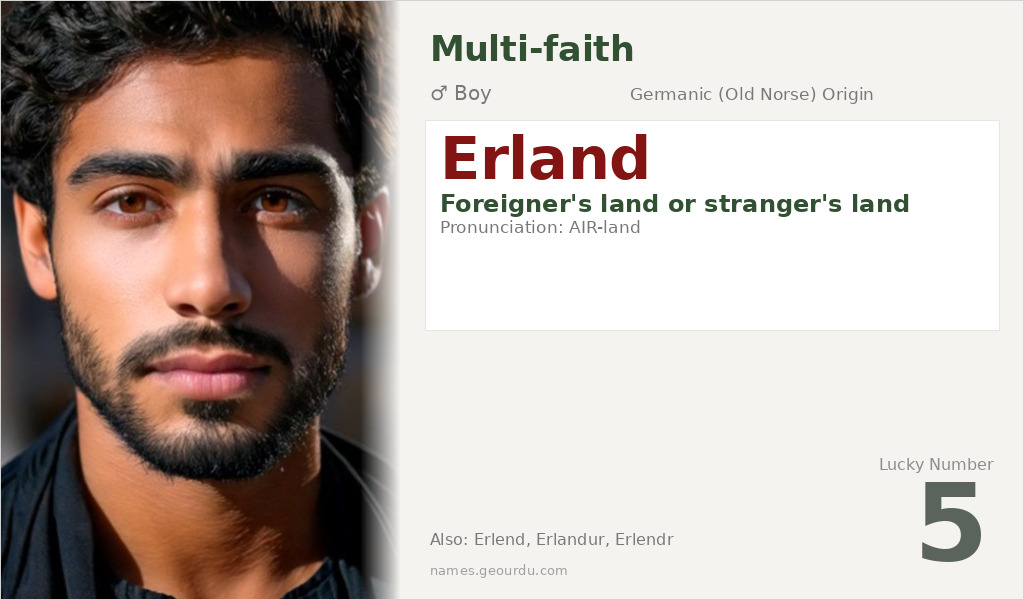
| 📛 Name | Erland |
| 💎 Meaning | Foreigner's land or stranger's land |
| 👤 Gender | Boy |
| 🕌 Religion | Multi-faith |
| 🌍 Origin | Germanic (Old Norse) |
| 🗣 Pronunciation | AIR-land |
| ✍️ Urdu | ارلینڈ |
| ✍️ Arabic | إرلاند |
| 🔢 Numerology | 5 |
| ✨ Spellings | Erlend, Erlandur, Erlendr, Erlender |
Origin & Cultural Significance
Erland has its origins in medieval Scandinavia, particularly in Norway and Sweden where it was used during the Viking Age and Middle Ages. The name reflects the Norse expansion period when Scandinavian explorers settled in places like Iceland, Greenland, the British Isles, and parts of continental Europe. While primarily associated with Scandinavian culture, the name has been adopted in other Germanic-speaking regions. It’s important to note that Erland is not specifically tied to any particular religion—it’s a cultural name used by Christians, secular Scandinavians, and others in Nordic countries. The name continues to be used today, though less frequently than more common Scandinavian names.
Personality Traits
People named Erland are often perceived as adventurous and adaptable, reflecting the name’s meaning of ‘foreigner’s land’. They tend to be curious about different cultures and comfortable in new environments. Many Erlands display independence and resilience, qualities that align with the historical context of Norse explorers and settlers. While personality traits vary by individual, the name’s etymology suggests someone who bridges different worlds or perspectives.
Similar Names
If you like Erland, consider: Erik, Einar, Harald, Bjorn, Leif
Famous People Named Erland
- Erland Josephson — Swedish actor and director known for collaborations with Ingmar Bergman
- Erland von Koch — Swedish composer known for his symphonic works
Frequently Asked Questions About Erland
What does Erland mean?
Erland means 'foreigner's land' or 'stranger's territory' in Old Norse, derived from 'erlendr' (foreigner) and 'land' (land).
Is Erland a boy or girl name?
Erland is exclusively a masculine name in Scandinavian naming traditions and has historically been used only for boys.
What is the origin of Erland?
Erland originates from Old Norse/Scandinavian languages, specifically from medieval Norway and Sweden during the Viking Age.





