
Table of Contents
Bathsheba is a name rich with biblical history and Hebrew etymology. As the wife of King David and mother of King Solomon, this name carries centuries of cultural significance. While most familiar from Christian and Jewish traditions, Bathsheba’s meaning and legacy transcend religious boundaries. Let’s explore the true origins and modern relevance of this timeless name.
Meaning of Bathsheba
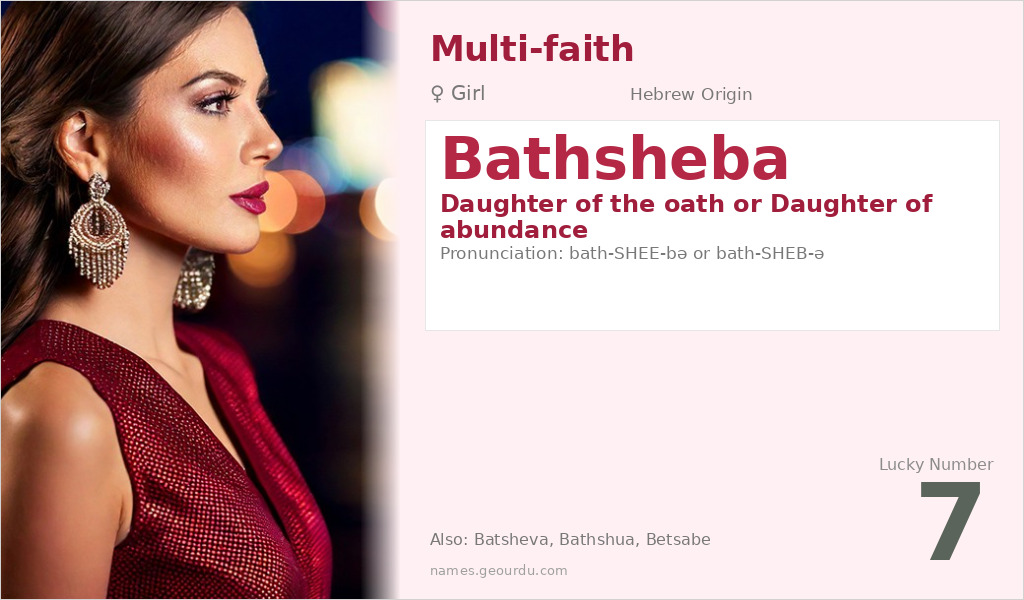
Bathsheba derives from the Hebrew בַּת־שֶׁבַע (Bat-Sheva), composed of two distinct elements. The first part, ‘bat’ (בַּת), straightforwardly means ‘daughter.’ The second component, ‘sheba’ (שֶׁבַע), presents dual interpretations: it can mean ‘oath’ or refer to the number ‘seven.’ In biblical numerology, seven symbolizes completeness, perfection, and abundance. Thus, Bathsheba is most accurately translated as ‘daughter of the oath’ or ‘daughter of abundance.’ This name appears in the Books of Samuel and Kings, where Bathsheba’s story unfolds as a pivotal narrative in Israelite monarchy. The name has been preserved through millennia in religious texts and continues to be studied in theological and historical contexts.
| 📛 Name | Bathsheba |
| 💎 Meaning | Daughter of the oath or Daughter of abundance |
| 👤 Gender | Girl |
| 🕌 Religion | Multi-faith |
| 🌍 Origin | Hebrew |
| 🗣 Pronunciation | bath-SHEE-bə or bath-SHEB-ə |
| ✍️ Urdu | بت شبع |
| ✍️ Arabic | بَثْشَبَع |
| 🔢 Numerology | 7 |
| ✨ Spellings | Batsheva, Bathshua, Betsabe, Bethsabée |
Origin & Cultural Significance
Bathsheba originates from ancient Hebrew culture and appears in the Tanakh (Hebrew Bible) around the 10th century BCE. The name entered Christian tradition through the Old Testament and has been used in various forms across European languages since medieval times. While primarily associated with Jewish and Christian contexts, the name appears in Islamic tradition as well, mentioned in Quranic commentary as the wife of Prophet David (Dawud). The name has seen periodic revivals, particularly among communities valuing biblical heritage. In modern times, the Hebrew variant ‘Batsheva’ is more commonly used in Jewish communities, while ‘Bathsheba’ remains familiar in English-speaking Christian contexts.
Personality Traits
Those named Bathsheba often inherit associations with the biblical figure’s intelligence, resilience, and influential role. The name suggests someone with deep intuition, strong family values, and the ability to navigate complex situations with grace. Historically, Bathsheba demonstrated wisdom in securing her son Solomon’s succession to the throne, qualities that continue to shape perceptions of the name today.
Similar Names
If you like Bathsheba, consider: Batsheva, Sheba, Bathshua, Elizabeth, Rebecca
Famous People Named Bathsheba
- Bathsheba (Biblical figure) — Wife of King David and mother of King Solomon in the Hebrew Bible
- Bathsheba Spooner — American woman executed in 1778, subject of historical accounts
Frequently Asked Questions About Bathsheba
What does Bathsheba mean?
Bathsheba means 'daughter of the oath' or 'daughter of abundance' in Hebrew, from the elements 'bat' (daughter) and 'sheba' (oath/seven).
Is Bathsheba a boy or girl name?
Bathsheba is exclusively a female name, originating from the biblical wife of King David. It has never been traditionally used for boys.
What is the origin of Bathsheba?
Bathsheba originates from ancient Hebrew language and culture, first appearing in the Hebrew Bible/Tanakh around the 10th century BCE.





