
Table of Contents
Beaver is a distinctive name that immediately calls to mind the industrious, dam-building rodent of North American waterways. While uncommon as a given name today, it carries a rich history as both an occupational surname and a symbolic name representing hard work and determination. This name’s straightforward meaning and unique character make it an intriguing choice for parents seeking something truly distinctive. Let’s explore the origins and significance of this unusual but meaningful name.
Meaning of Beaver
The name Beaver directly refers to the semi-aquatic rodent known scientifically as Castor fiber. Etymologically, it traces back to Old English ‘beofor’, which evolved from Proto-Germanic ‘*bebruz’ and ultimately from the Proto-Indo-European root ‘*bʰébʰrus’, meaning ‘brown’ or ‘beaver’. Historically, Beaver functioned as an occupational surname for someone who worked with beaver pelts or resembled the animal in some characteristic, particularly industriousness. In some Native American cultures, especially among Algonquian tribes, the beaver holds symbolic importance as a representation of determination, building, and resourcefulness. The name thus carries connotations of hard work, practicality, and constructive energy.
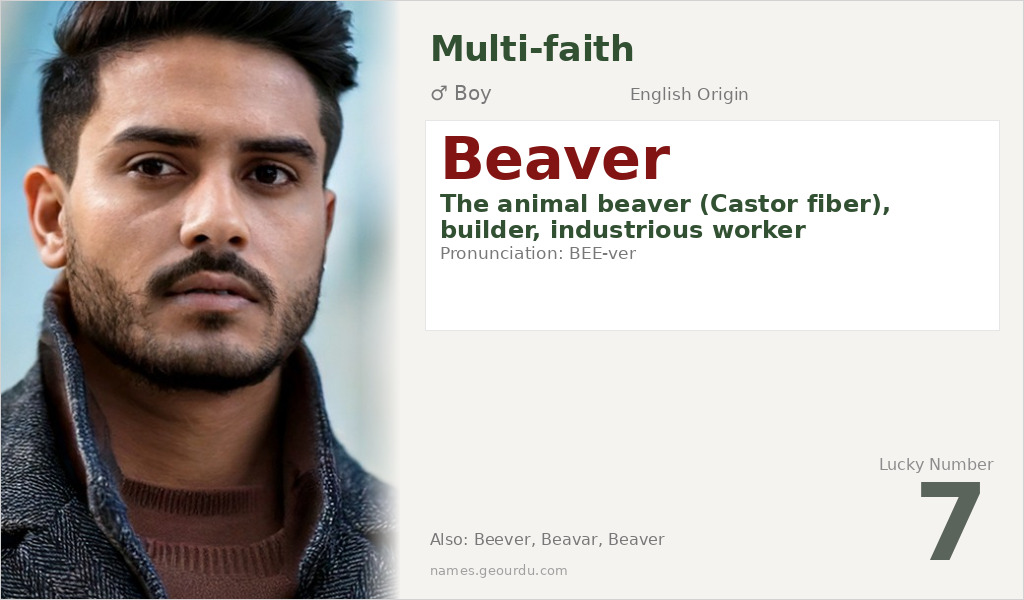
| 📛 Name | Beaver |
| 💎 Meaning | The animal beaver (Castor fiber), builder, industrious worker |
| 👤 Gender | Boy |
| 🕌 Religion | Multi-faith |
| 🌍 Origin | English |
| 🗣 Pronunciation | BEE-ver |
| ✍️ Urdu | بیور |
| ✍️ Arabic | بيفر |
| 🔢 Numerology | 7 |
| ✨ Spellings | Beever, Beavar, Beaver |
Origin & Cultural Significance
Beaver originated as an English surname derived from the Old English word for the animal. It emerged during the Middle Ages when surnames based on occupations, characteristics, or animals became common. While rare as a first name historically, it gained some usage in English-speaking countries, particularly in North America where the beaver is an important cultural symbol (notably as Canada’s national animal). The name has no specific religious origins or associations, though it has been used by people of various faiths. Its usage as a given name peaked in the early 20th century but remains uncommon today, valued primarily for its unique character and symbolic meaning of industriousness.
Personality Traits
People named Beaver are often associated with the characteristics of their namesake animal: they’re typically seen as hardworking, determined, and practical individuals. Like beavers who meticulously build complex dams and lodges, those with this name tend to be systematic problem-solvers who work steadily toward long-term goals. They often possess strong engineering or creative building instincts, whether in literal construction or metaphorical life-building. Their persistent nature makes them reliable friends and colleagues who can be counted on to complete what they start.
Similar Names
If you like Beaver, consider: Castor, Fisher, Otter, Badger, Buck
Famous People Named Beaver
- Beaver Bauer — American football player
- Beaver Robinson — American musician and songwriter
Frequently Asked Questions About Beaver
What does Beaver mean?
Beaver means 'the animal beaver' or 'industrious worker'. It comes from Old English 'beofor', which traces back to Proto-Germanic and Proto-Indo-European roots meaning 'brown' or 'beaver'.
Is Beaver a boy or girl name?
Beaver is traditionally a boy's name, though it could theoretically be used for any gender. Historically and culturally, it has been almost exclusively masculine, originating from occupational surnames typically borne by men.
What is the origin of Beaver?
Beaver originates from English, specifically from the Old English word for the animal. It began as an occupational surname before occasional use as a given name, with roots in Proto-Germanic and Proto-Indo-European languages.





