
Table of Contents
Colby is a distinctive name with roots stretching back to medieval England and Viking settlers. Originally a surname denoting geographical origin, it has evolved into a popular given name with a rich historical background. The name carries the legacy of Norse settlers who left their mark on English place names and personal nomenclature. Today, Colby maintains its appeal as a strong, masculine name with ancient Scandinavian connections.
Meaning of Colby
The name Colby has a clear etymological path from Old Norse to modern English. It combines two elements: ‘Koli’, an Old Norse personal name meaning ‘dark’ or ‘swarthy’, and ‘býr’, meaning ‘farm’, ‘settlement’, or ‘village’. This creates the literal meaning ‘Koli’s farm’ or ‘dark settlement’. The name first appeared in England after Scandinavian settlement, particularly in areas like Norfolk and Lincolnshire where Viking influence was strong. As a toponymic surname, it identified people who came from places named Colby, with several villages in England bearing this name. The transition from surname to given name occurred primarily in the 20th century, particularly in the United States.
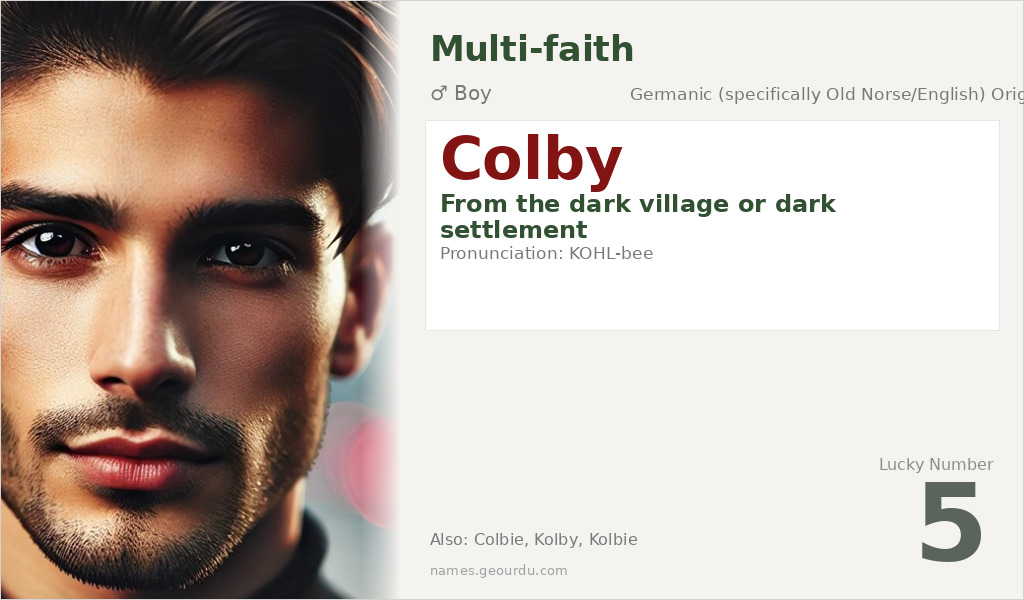
| 📛 Name | Colby |
| 💎 Meaning | From the dark village or dark settlement |
| 👤 Gender | Boy |
| 🕌 Religion | Multi-faith |
| 🌍 Origin | Germanic (specifically Old Norse/English) |
| 🗣 Pronunciation | KOHL-bee |
| ✍️ Urdu | کولبی |
| ✍️ Arabic | كولبي |
| 🔢 Numerology | 5 |
| ✨ Spellings | Colbie, Kolby, Kolbie |
Origin & Cultural Significance
Colby originated as a locational surname in England during the Middle Ages, derived from places named Colby in Norfolk, Lincolnshire, and Cumbria. These place names themselves have Scandinavian origins, reflecting the extensive Viking settlement in eastern England during the 9th-11th centuries. The name entered the English language through Old Norse influence during the Danelaw period when Scandinavian settlers established communities across northern and eastern England. While the name has Christian usage in predominantly Christian countries, it has no inherent religious meaning or origin—it’s simply a geographical identifier that became a personal name. The name gained popularity as a first name in the United States during the 20th century and has since spread to other English-speaking countries.
Personality Traits
People named Colby often exhibit traits associated with adventure and adaptability. Their name’s connection to exploration and settlement history seems to manifest in a love for new experiences and environments. They typically possess natural curiosity and versatility, allowing them to thrive in various situations. Many Colbys demonstrate resilience and practical problem-solving skills, reflecting the pioneering spirit embedded in their name’s origin.
Similar Names
If you like Colby, consider: Colton, Cole, Coby, Colin, Calvin
Famous People Named Colby
- Colby Covington — American mixed martial artist
- Colby Rasmus — American professional baseball player
- Colby Caillat — American singer-songwriter (father of Colbie Caillat)
Frequently Asked Questions About Colby
What does Colby mean?
Colby means 'from the dark village' or 'dark settlement'. It comes from Old Norse 'Koli' (dark) + 'býr' (farm/settlement), originally referring to places named after a dark-complexioned settler named Koli.
Is Colby a boy or girl name?
Colby is primarily a masculine name, though occasionally used for girls. Historically and statistically, it remains overwhelmingly a boy's name in English-speaking countries.
What is the origin of Colby?
Colby originated as an English surname with Old Norse roots. It comes from Scandinavian settlers in medieval England who named villages after individuals, with 'Koli's farm' evolving into the place name Colby, which then became a surname and eventually a given name.





