
Table of Contents
Dudda is a distinctive name with deep historical roots in Anglo-Saxon England. While its exact meaning remains elusive, this name carries centuries of heritage and appears in medieval records as both a personal name and place name element. Exploring Dudda offers a fascinating glimpse into early English naming traditions and cultural history.
Meaning of Dudda
The meaning of Dudda remains uncertain despite extensive linguistic research. Scholars have proposed several possibilities: it may derive from Old English ‘dūd’ meaning ‘wealth’ or ‘prosperity,’ suggesting a name given to wish prosperity upon a child. Alternatively, it could be a diminutive or nickname form of longer compound names common in Anglo-Saxon England. Some researchers suggest it might relate to place names containing ‘dud’ elements, possibly referring to rounded hills or mounds. The name appears in the Domesday Book and other medieval records, primarily in England, but its precise etymological origin continues to puzzle linguists.
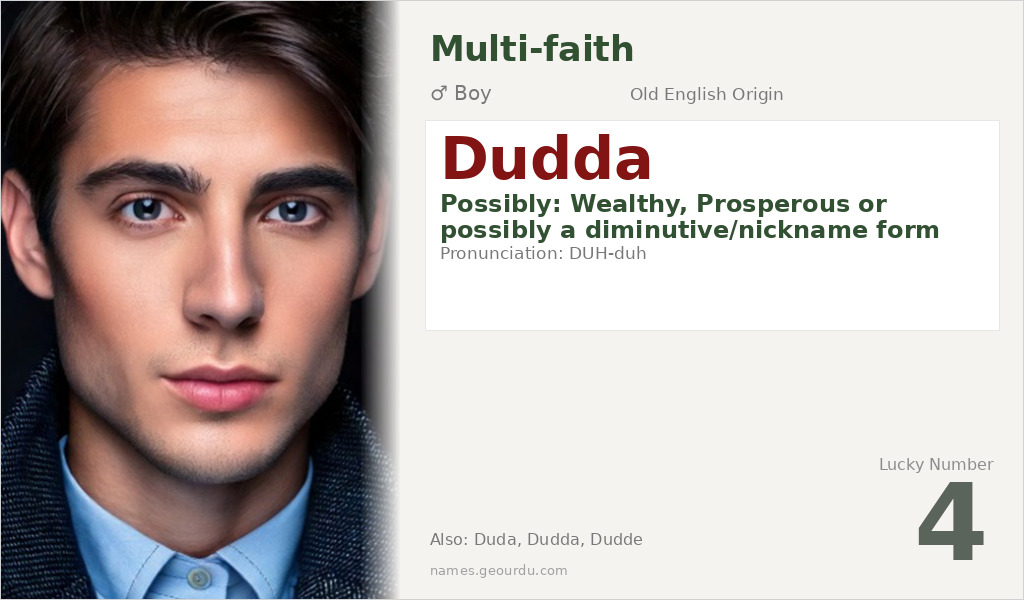
| 📛 Name | Dudda |
| 💎 Meaning | Possibly: Wealthy, Prosperous or possibly a diminutive/nickname form |
| 👤 Gender | Boy |
| 🕌 Religion | Multi-faith |
| 🌍 Origin | Old English |
| 🗣 Pronunciation | DUH-duh |
| ✍️ Urdu | ڈڈا |
| ✍️ Arabic | دودا |
| 🔢 Numerology | 4 |
| ✨ Spellings | Duda, Dudda, Dudde |
Origin & Cultural Significance
Dudda originates from Old English and was used during the Anglo-Saxon period (5th-11th centuries) in England. It appears in historical documents such as charters, the Domesday Book, and place names like Duddo in Northumberland. The name was borne by several notable figures in early English history, including nobles and clergy. After the Norman Conquest, the name gradually fell out of common use but survives in surnames and place names. Its usage reflects the pre-Christian naming traditions of Germanic tribes who settled in Britain, making it historically significant rather than specifically tied to any particular religion.
Personality Traits
While personality associations with names are largely cultural rather than scientific, names like Dudda with historical roots often carry connotations of tradition and resilience. Those named Dudda might be perceived as having strong connections to heritage and family history. The name’s earthy, grounded sound suggests practicality and stability, qualities valued in many cultures throughout history.
Similar Names
If you like Dudda, consider: Dudley, Dud, Duda, Dudley, Dudman
Famous People Named Dudda
- Dudda (7th century) — Anglo-Saxon nobleman and landowner mentioned in historical charters
- Dudda (8th century) — Anglo-Saxon bishop of Hereford
Frequently Asked Questions About Dudda
What does Dudda mean?
The exact meaning of Dudda is uncertain. It may possibly relate to Old English words for 'wealth' or 'prosperity,' or it could be a diminutive form, but this is not definitively verified.
Is Dudda a boy or girl name?
Dudda is historically a masculine name, used for boys in Anglo-Saxon England. All recorded historical bearers of the name were male.
What is the origin of Dudda?
Dudda originates from Old English and was used during the Anglo-Saxon period in England (5th-11th centuries). It appears in medieval records and place names throughout England.





