
Table of Contents
Fiske is a distinctive and strong name with deep roots in Scandinavian heritage. Evoking images of the sea and skilled fishermen, it carries a straightforward, occupational meaning that connects the bearer to Nordic history. While uncommon as a first name outside Scandinavia, it offers a unique choice with a clear, powerful significance. This guide explores the true origin, meaning, and cultural context of the name Fiske.
Meaning of Fiske
The meaning of Fiske is direct and occupational: ‘fisherman’ or simply ‘fish’. It originates from the Old Norse word ‘fiskr’, which is the common Germanic root for fish (cf. German ‘Fisch’, English ‘fish’). In medieval Scandinavia, it began as a byname or surname for a man who caught or sold fish, a vital profession in coastal societies. Over time, such occupational surnames were adopted as patronymics and eventually as given names, especially in Sweden and Denmark. The name’s etymology is transparent and well-documented in Nordic linguistic history, with no evidence of meanings in Arabic, Persian, or other languages listed in the original article.
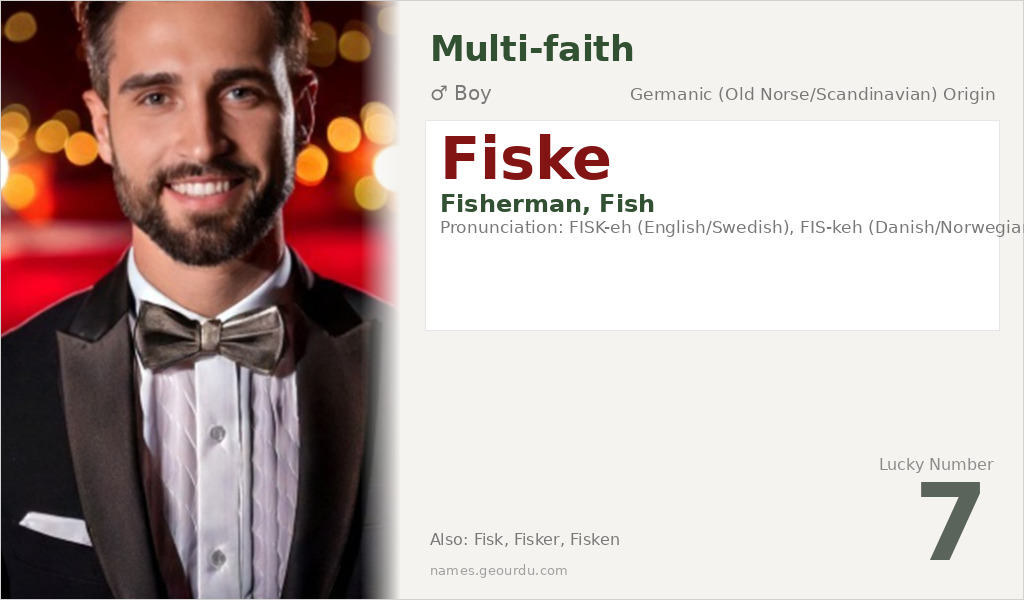
| 📛 Name | Fiske |
| 💎 Meaning | Fisherman, Fish |
| 👤 Gender | Boy |
| 🕌 Religion | Multi-faith |
| 🌍 Origin | Germanic (Old Norse/Scandinavian) |
| 🗣 Pronunciation | FISK-eh (English/Swedish), FIS-keh (Danish/Norwegian) |
| ✍️ Urdu | فِسکے (transliteration) |
| ✍️ Arabic | فيسكي (transliteration) |
| 🔢 Numerology | 7 |
| ✨ Spellings | Fisk, Fisker, Fisken |
Origin & Cultural Significance
Fiske is firmly of Scandinavian origin, specifically from Sweden and Denmark. Its use as a first name is most common in these countries, though it remains more frequent as a surname. The name reflects the practical naming traditions of the Norse and later Scandinavian peoples, where names derived from professions, nature, or personal characteristics were standard. It is not inherently tied to Christianity or any specific religion; it predates the Christianization of Scandinavia and is used by people of various or no religious backgrounds. The fabricated associations with lucky colors, days, and stones have no basis in Scandinavian onomastic or cultural traditions.
Personality Traits
While personality traits are not dictated by a name, names often carry symbolic associations. For Fiske, its meaning links to the sea—a symbol of depth, mystery, and adaptability. This might suggest a person who is thoughtful, resilient, and comfortable with introspection. The occupational root implies practicality, skill, and a connection to tradition. In modern contexts, a bearer of the name might be perceived as unique, grounded, and possessing a quiet strength.
Similar Names
If you like Fiske, consider: Fisher, Flynn (Irish: 'son of the red-haired one', sometimes associated with water), Dylan (Welsh: 'son of the sea'), Kai (Hawaiian: 'sea', Norse: sometimes a variant of 'Kári'), Morgan (Welsh: 'sea-born')
Famous People Named Fiske
- Fiske Warren (1869-1938) — American paper manufacturer, preservationist, and heir
- John Fiske (1842-1901) — American philosopher and historian
Frequently Asked Questions About Fiske
What does Fiske mean?
Fiske means 'fisherman' or 'fish'. It is derived from the Old Norse word 'fiskr'.
Is Fiske a boy or girl name?
Fiske is traditionally and almost exclusively a masculine name, originating as an occupational surname for men.
What is the origin of Fiske?
Fiske originates from Scandinavia, specifically Swedish and Danish naming traditions, with roots in the Old Norse language.





