
Table of Contents
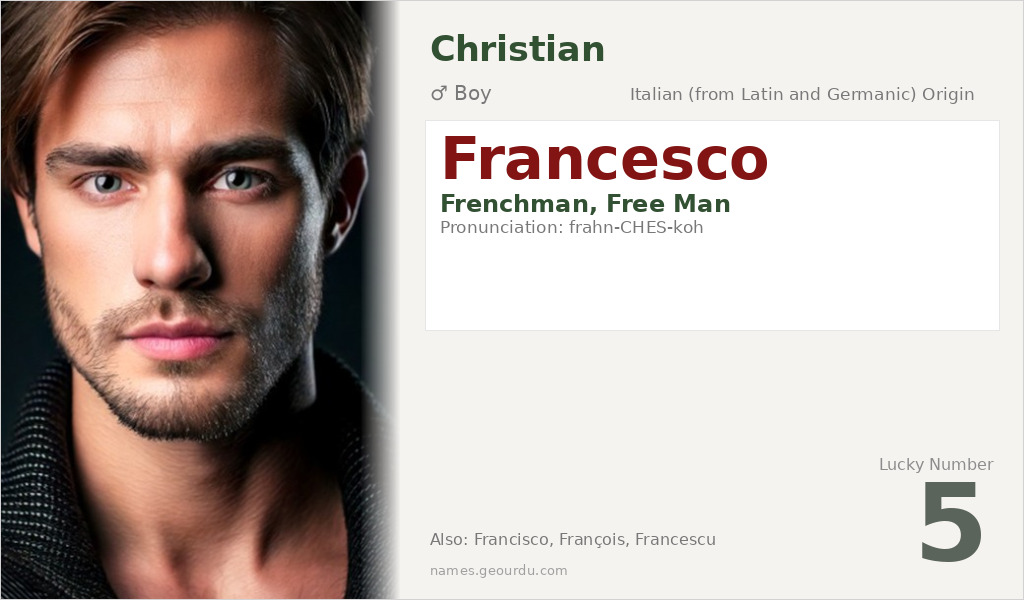
Francesco is a timeless Italian name that carries rich historical and cultural weight. Derived from the Latin Franciscus, it means ‘Frenchman’ or ‘free man,’ reflecting the legacy of the Franks. Popularized by Saint Francis of Assisi, this name has been borne by poets, artists, and leaders throughout history. Its melodic sound and profound meaning make it a beloved choice for boys in Christian traditions.
Meaning of Francesco
The name Francesco originates from the Late Latin name Franciscus, which itself comes from the Germanic tribal name ‘Frank.’ The Franks were a Germanic people who established the Frankish Empire in early medieval Europe, with their name meaning ‘the free ones’ or ‘spear.’ Thus, Francesco translates to ‘Frenchman’ in a geographic sense and ‘free man’ in a symbolic one. This dual meaning highlights both cultural identity and personal liberty. The name gained widespread use in Italy after Saint Francis of Assisi, whose father nicknamed him Francesco due to his admiration for French culture. Over centuries, it has evolved into various forms across languages, but its core etymology remains rooted in Latin and Germanic linguistics.
| 📛 Name | Francesco |
| 💎 Meaning | Frenchman, Free Man |
| 👤 Gender | Boy |
| 🕌 Religion | Christian |
| 🌍 Origin | Italian (from Latin and Germanic) |
| 🗣 Pronunciation | frahn-CHES-koh |
| ✍️ Urdu | فرانسیسکو |
| ✍️ Arabic | فرانشيسكو |
| 🔢 Numerology | 5 |
| ✨ Spellings | Francisco, François, Francescu, Franz, Francesko |
Origin & Cultural Significance
Francesco has its origins in Italy, where it developed as the Italian variant of the Latin Franciscus. The name spread throughout Europe during the Middle Ages, largely due to the influence of Saint Francis of Assisi, a revered Catholic saint known for his humility and love of nature. In Christian tradition, Francesco is exclusively used for boys and is common in Catholic-majority countries like Italy, Spain (as Francisco), and France (as François). Its usage reflects the deep cultural ties between Italian naming customs and Christian heritage. Today, it remains a classic name in Italian-speaking regions and among diaspora communities worldwide.
Personality Traits
People named Francesco are often associated with traits of independence and charm, mirroring the name’s meaning of ‘free man.’ They may exhibit a adventurous spirit, enjoying exploration and new experiences. Their adaptable nature allows them to thrive in social settings, often making them natural leaders or creative thinkers. While these traits are generalized, they align with the historical figures who have borne this name, such as the poetic Francesco Petrarca and the athletic Francesco Totti.
Similar Names
If you like Francesco, consider: Francis, Frank, Franco, Frances
Famous People Named Francesco
- Francesco Petrarca — Italian scholar and poet, known as Petrarch, a key figure in the Renaissance
- Francesco Totti — Italian footballer who spent his entire career with AS Roma, considered one of the greatest Italian players
Frequently Asked Questions About Francesco
What does Francesco mean?
Francesco means 'Frenchman' or 'free man.' It comes from the Italian form of the Latin Franciscus, derived from the Germanic tribal name Frank, referring to the Franks who were known as 'the free ones.'
Is Francesco a boy or girl name?
Francesco is exclusively a boy's name in Italian and Christian traditions. There are feminine variants like Francesca for girls.
What is the origin of Francesco?
Francesco originates from Italian, with roots in Late Latin (Franciscus) and Germanic (Frank). It gained popularity through Saint Francis of Assisi and is primarily used in Christian cultures.





