
Table of Contents
Crispin is a distinguished boy’s name with roots stretching back to ancient Rome. Derived from the Latin word for ‘curly-haired’, this name carries centuries of history and Christian significance. Most famously associated with Saint Crispin, the patron saint of shoemakers, it remains a classic choice with literary and historical resonance. Let’s explore the rich etymology and cultural journey of this timeless name.
Meaning of Crispin
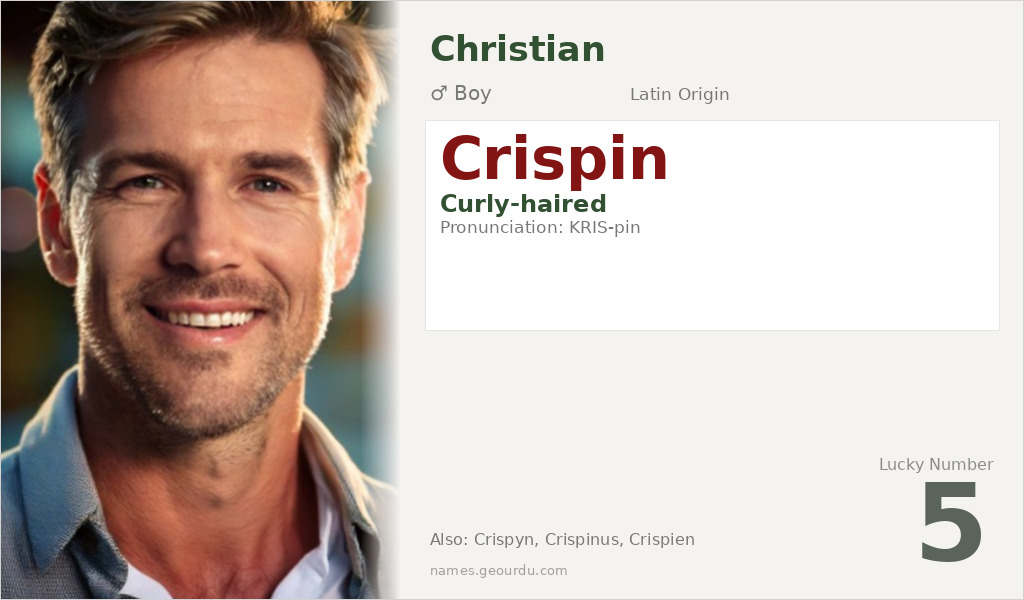
Crispin originates from the Late Latin name ‘Crispinus’, which is a diminutive form of ‘Crispus’. The root word ‘crispus’ in Latin specifically means ‘curly’, ‘curled’, or ‘wavy’, typically referring to hair texture. This naming pattern was common in Roman culture where physical attributes often became hereditary surnames. The transition from ‘Crispus’ to ‘Crispinus’ follows standard Latin diminutive formation, similar to how ‘Paul’ becomes ‘Paulinus’. The meaning has remained consistent through centuries, preserved in historical records and etymological dictionaries across European languages.
| 📛 Name | Crispin |
| 💎 Meaning | Curly-haired |
| 👤 Gender | Boy |
| 🕌 Religion | Christian |
| 🌍 Origin | Latin |
| 🗣 Pronunciation | KRIS-pin |
| ✍️ Urdu | کرسپن |
| ✍️ Arabic | كريسبين |
| 🔢 Numerology | 5 |
| ✨ Spellings | Crispyn, Crispinus, Crispien, Crispiano |
Origin & Cultural Significance
Crispin emerged in Roman antiquity as a cognomen (third name) denoting physical characteristics. The name gained Christian prominence through Saint Crispin and his brother Saint Crispinian, third-century martyrs who preached Christianity while working as shoemakers in Soissons, Gaul. Their feast day on October 25th became famous through Shakespeare’s ‘Henry V’ speech referencing the Battle of Agincourt on ‘Saint Crispin’s Day’. While primarily associated with Christian tradition due to the saint’s veneration, the name itself predates Christianity as a Roman name. It spread throughout Europe during the Middle Ages and remains used in various forms across Romance and Germanic language regions.
Personality Traits
Those named Crispin often embody the creative spirit suggested by their ‘curly-haired’ etymology. They tend to be adaptable individuals who approach life with curiosity and artistic sensibility. The historical association with craftsmanship (through Saint Crispin) suggests practical creativity and dedication to one’s work. Their communicative nature and intellectual curiosity make them engaging companions and thoughtful problem-solvers.
Similar Names
If you like Crispin, consider: Crispus, Crispian, Cris, Crisanto, Crisóstomo
Famous People Named Crispin
- Saint Crispin — 3rd-century Roman Christian martyr and patron saint of shoemakers, leatherworkers, and saddle makers
- Crispin Glover — American actor known for roles in 'Back to the Future' and 'Charlie's Angels'
Frequently Asked Questions About Crispin
What does Crispin mean?
Crispin means 'curly-haired' or 'curly-headed', derived from the Latin word 'crispus' meaning curled or wavy.
Is Crispin a boy or girl name?
Crispin is traditionally a masculine name, though rare feminine variants like Crispina exist. Historically and culturally, it has been used almost exclusively for boys.
What is the origin of Crispin?
Crispin originates from Latin, specifically from the Roman name Crispinus, which was a diminutive of Crispus meaning 'curly-haired'. It gained prominence through Christian tradition via Saint Crispin.





