
Table of Contents
Garland is a distinctive name with rich historical roots, evoking images of floral wreaths and crowns of honor. Originally a Middle English term for a decorative circle of flowers or leaves, it has transitioned into a meaningful given name, particularly within Christian communities. This name carries connotations of celebration, victory, and natural beauty, making it a unique choice for parents seeking a name with both tradition and symbolic depth. Explore the fascinating etymology and cultural significance of the name Garland in this comprehensive guide.
Meaning of Garland
The name Garland derives from the Middle English ‘gerland’ and Old French ‘garlande’, meaning a wreath or crown made from flowers, leaves, or branches. Its deeper etymology traces back to Frankish *wralda or Proto-Germanic *wraldōn, meaning ‘to twist’ or ‘to wind’, which describes the act of weaving materials into a circular form. Historically, garlands were used in ancient Greek and Roman cultures as symbols of victory, honor, and festivity, often awarded to athletes, military heroes, and celebrants. In Christian contexts, garlands sometimes appear in religious art and symbolism, representing eternal life or divine favor. The name thus encapsulates themes of achievement, beauty, and cyclical renewal, rooted in European linguistic traditions.
| 📛 Name | Garland |
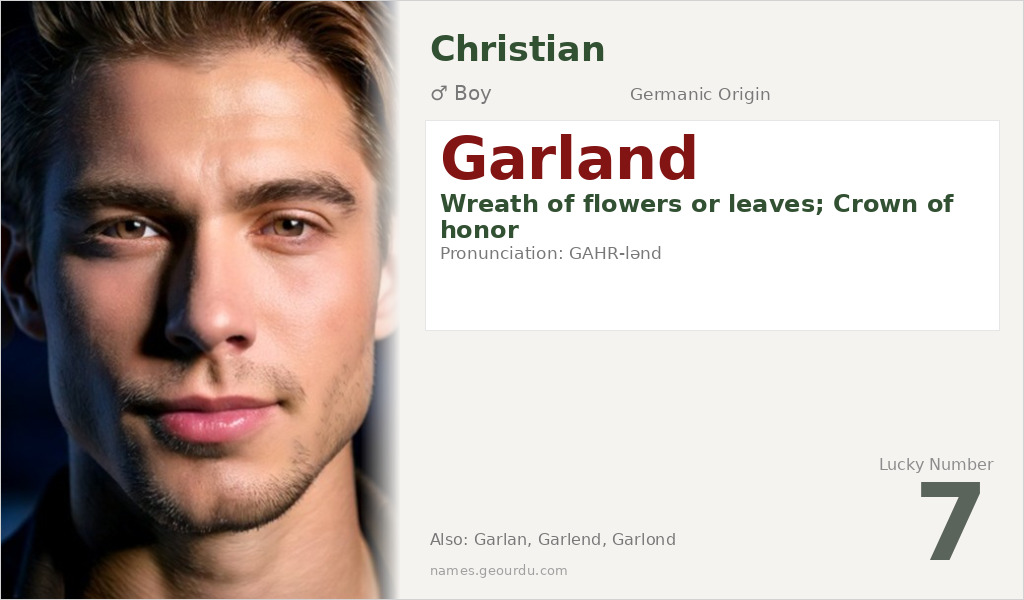
| 💎 Meaning | Wreath of flowers or leaves; Crown of honor |
| 👤 Gender | Boy |
| 🕌 Religion | Christian |
| 🌍 Origin | Germanic |
| 🗣 Pronunciation | GAHR-lənd |
| ✍️ Urdu | گارلینڈ |
| ✍️ Arabic | غارلاند |
| 🔢 Numerology | 7 |
| ✨ Spellings | Garlan, Garlend, Garlond |
Origin & Cultural Significance
Garland originated as an occupational or descriptive surname in medieval England, referring to someone who made or wore garlands, possibly for festivals or ceremonies. It entered usage as a given name in the 19th century, primarily in English-speaking countries with Christian heritage, though it is not exclusively religious. The name’s cultural significance spans various traditions where garlands symbolize honor, such as in ancient Greek athletics, Roman triumphs, and European May Day celebrations. While it has Christian associations due to its adoption in Western naming practices, it is not tied to a specific religious doctrine but rather to broader cultural symbols of joy and accomplishment. Today, it remains a rare but meaningful choice, reflecting a connection to nature and historical pageantry.
Personality Traits
People named Garland are often perceived as creative, sociable, and inclined toward artistic or decorative pursuits, mirroring the name’s association with floral wreaths and celebration. They may exhibit a harmonious nature, striving to bring beauty and unity to their surroundings, much like a garland adorns and enhances. Their personality can be seen as reflective of tradition and honor, with a potential for leadership in communal or festive settings. While these traits are generalized, the name’s etymology suggests a person who values aesthetics, ceremony, and positive social interactions.
Similar Names
If you like Garland, consider: Garrett, Garrison, Garrick, Gareth, Garnet
Famous People Named Garland
- Garland Jeffreys — American singer-songwriter known for blending rock, reggae, and blues
- Garland Wright — American theater director and former artistic director of the Guthrie Theater
Frequently Asked Questions About Garland
What does Garland mean?
Garland means 'wreath of flowers or leaves' or 'crown of honor', originating from Middle English and Old French, with roots in Germanic languages meaning 'to twist'.
Is Garland a boy or girl name?
Garland is primarily a boy's name, though it can be used as unisex in modern contexts. Historically, it has been more common for males, especially in Christian naming traditions.
What is the origin of Garland?
Garland originates from Germanic languages via Old French and Middle English, initially as a surname for garland-makers, later adopted as a given name in English-speaking Christian cultures.





