
Table of Contents
Lyman is a distinctive name with deep roots in English history, originally serving as a surname before transitioning to first name usage. With its meaning of ‘meadow-dweller’ or ‘man from the meadow’, it evokes pastoral imagery and connection to the land. This name carries the weight of centuries of English linguistic development while maintaining a modern, approachable sound. Though not extremely common today, Lyman has been borne by notable historical figures and continues to appeal to parents seeking names with natural connotations.
Meaning of Lyman
The name Lyman has a clear and well-documented meaning derived from Old English, the Germanic language spoken in England from approximately 450 to 1150 CE. It combines two Old English elements: ‘lēah’ (pronounced lay-ah), meaning ‘wood, clearing, or meadow’, and ‘mann’, meaning ‘man’. Thus, Lyman literally translates to ‘meadow man’ or ‘dweller in the meadow’. This type of name formation was common in medieval England, where topographic surnames identified people by their residence or occupation. The ‘lēah’ element appears in many English place names and surnames, demonstrating its importance in describing the landscape of early England. As a given name, Lyman preserves this connection to nature and specific geographical features.
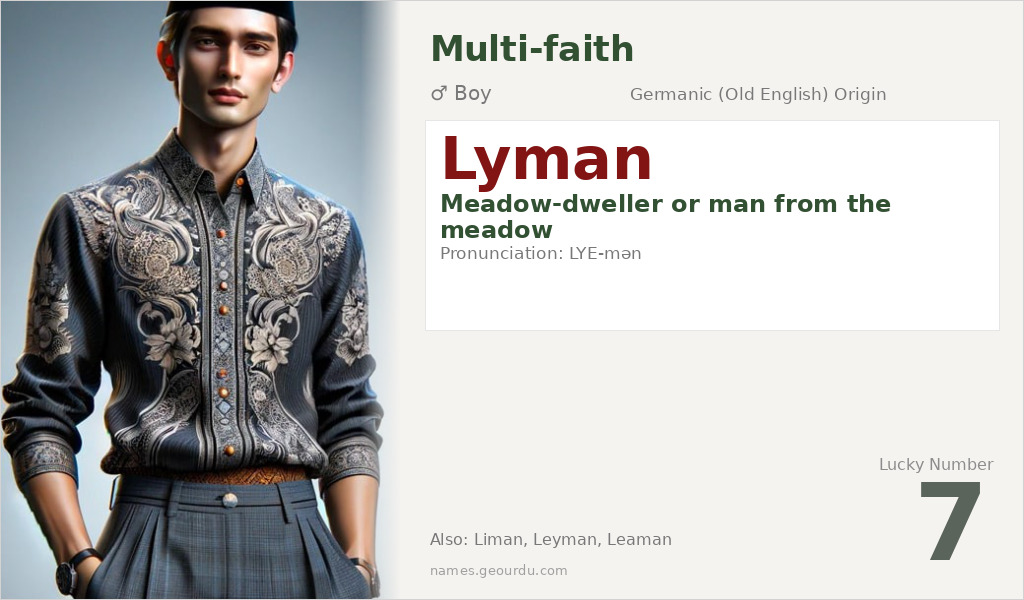
| 📛 Name | Lyman |
| 💎 Meaning | Meadow-dweller or man from the meadow |
| 👤 Gender | Boy |
| 🕌 Religion | Multi-faith |
| 🌍 Origin | Germanic (Old English) |
| 🗣 Pronunciation | LYE-mən |
| ✍️ Urdu | لائیمن |
| ✍️ Arabic | لايمان |
| 🔢 Numerology | 7 |
| ✨ Spellings | Liman, Leyman, Leaman |
Origin & Cultural Significance
Lyman originated as an English surname during the Middle Ages, when the practice of adopting hereditary surnames became widespread in England following the Norman Conquest. It belongs to the category of topographic surnames, which were derived from geographical features near where a person lived or worked. The name would have initially described someone who resided by or worked in a meadow or clearing. During the 19th century, like many surnames, Lyman began to be used as a first name, particularly in English-speaking countries. While it has Old English roots, the name doesn’t have specific religious origins and has been used by people of various faiths, though it gained some popularity in Puritan communities in colonial America.
Personality Traits
Those named Lyman are often associated with qualities of stability, practicality, and connection to the natural world. The meadow-dwelling meaning suggests someone grounded, peaceful, and in harmony with their environment. Historically, individuals with this name have often been associated with thoughtful, steady personalities—traits reflected in notable bearers like Founding Father Lyman Hall. While personality associations with names are culturally constructed rather than deterministic, the pastoral imagery of Lyman continues to influence perceptions of those who bear it.
Similar Names
If you like Lyman, consider: Leland, Layton, Linden, Meadow, Fielding
Famous People Named Lyman
- Lyman Hall — American Founding Father and signer of the Declaration of Independence
- Lyman Beecher — American Presbyterian clergyman and father of Harriet Beecher Stowe
Frequently Asked Questions About Lyman
What does Lyman mean?
Lyman means 'meadow-dweller' or 'man from the meadow', derived from the Old English elements 'lēah' (meadow/clearing) and 'mann' (man).
Is Lyman a boy or girl name?
Lyman is traditionally and almost exclusively a masculine name, originating as a surname meaning 'meadow man'. There are no significant records of it being used for girls.
What is the origin of Lyman?
Lyman originates from Old English (a Germanic language) as a topographic surname that later became used as a first name. It has no specific religious origin and has been used across different cultures where English names are adopted.





