
Table of Contents
Kenan is a name with deep historical roots that spans multiple cultures and religious traditions. From its biblical origins in the Hebrew scriptures to its contemporary usage in Turkish and Kurdish communities, this name carries centuries of heritage. Whether you’re drawn to its ancient biblical connections or its modern cross-cultural appeal, Kenan offers a meaningful choice with rich linguistic background.
Meaning of Kenan
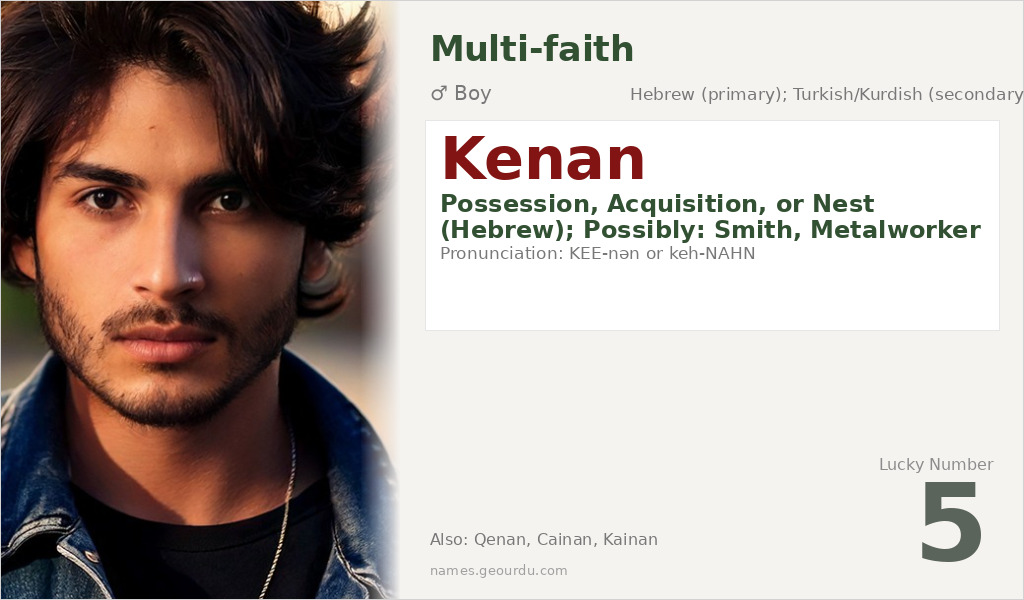
The name Kenan derives primarily from the Hebrew קֵינָן (Qēynān), appearing in the Book of Genesis as a descendant of Adam in the genealogy from Adam to Noah. The Hebrew root is connected to ‘qanah’ (קָנָה), meaning ‘to acquire, possess, or get,’ suggesting meanings of ‘possession’ or ‘acquisition.’ Some scholars also relate it to ‘qen’ (קֵן) meaning ‘nest,’ possibly implying protection or dwelling. In Turkish and Kurdish languages, ‘Kenan’ independently means ‘smith’ or ‘metalworker,’ representing a separate but significant usage that has made the name popular in Turkic-speaking regions. This dual etymology gives the name distinct cultural layers depending on its context of use.
| 📛 Name | Kenan |
| 💎 Meaning | Possession, Acquisition, or Nest (Hebrew); Possibly: Smith, Metalworker (from Turkish/Kurdish 'Kenan' meaning 'smith' or 'metalworker') |
| 👤 Gender | Boy |
| 🕌 Religion | Multi-faith |
| 🌍 Origin | Hebrew (primary); Turkish/Kurdish (secondary usage) |
| 🗣 Pronunciation | KEE-nən or keh-NAHN |
| ✍️ Urdu | کنعان |
| ✍️ Arabic | قينان |
| 🔢 Numerology | 5 |
| ✨ Spellings | Qenan, Cainan, Kainan, Kenan, Qeynan |
Origin & Cultural Significance
Kenan’s origins trace back to ancient Semitic languages, most prominently appearing in the Hebrew Bible where Kenan (or Cainan) is listed as the son of Enosh and father of Mahalalel. The name entered Christian tradition through biblical translations and Islamic tradition through Quranic references to prophets. In the modern era, the name gained particular popularity in Turkey and Kurdish communities where it carries the meaning of ‘smith’ or ‘metalworker,’ possibly relating to occupational naming traditions. This cross-cultural adoption has made Kenan a name with both religious significance in Abrahamic faiths and secular appeal in contemporary naming practices across the Middle East and diaspora communities.
Personality Traits
Those named Kenan often exhibit qualities of determination and practicality, reflecting the name’s meanings of acquisition and craftsmanship. They tend to be builders—whether of relationships, careers, or knowledge—with a focused approach to life’s challenges. The name’s biblical heritage may also suggest a connection to tradition and lineage, while its Turkish meaning as ‘smith’ implies creativity in shaping one’s environment. These individuals typically balance ambition with grounded values.
Similar Names
If you like Kenan, consider: Cain, Enoch, Mahalalel, Jared, Methuselah
Famous People Named Kenan
- Kenan İmirzalıoğlu — Turkish actor known for historical drama roles
- Kenan Thompson — American comedian and actor on Saturday Night Live
Frequently Asked Questions About Kenan
What does Kenan mean?
In Hebrew, Kenan means 'possession' or 'acquisition' from the root 'qanah.' In Turkish and Kurdish, it means 'smith' or 'metalworker.'
Is Kenan a boy or girl name?
Kenan is primarily a masculine name across all cultures where it's used, from biblical traditions to modern Turkish naming.
What is the origin of Kenan?
The name originates from Hebrew (קֵינָן) as a biblical figure, with secondary usage in Turkish and Kurdish languages meaning 'smith.'





