
Table of Contents
Jason is a timeless masculine name with deep roots in Greek mythology and early Christian history. Meaning ‘healer’ in its original Greek form, this name has traveled through centuries from ancient legends to modern popularity charts. Whether inspired by the heroic Argonaut leader or New Testament figures, Jason carries a legacy of strength, healing, and leadership that continues to resonate with parents worldwide.
Meaning of Jason
The name Jason derives directly from the ancient Greek Ἰάσων (Iason), which comes from the verb ἰάομαι (iaomai) meaning ‘to heal, to cure’. This etymological connection gives the name its primary meaning of ‘healer’. In Greek mythology, Jason was the heroic leader of the Argonauts who embarked on the quest for the Golden Fleece, symbolizing both physical healing and the restoration of rightful inheritance. The name appears in the New Testament as well, where Jason of Thessalonica hosted the apostles Paul and Silas, connecting the name to early Christian communities. This dual heritage—mythological and biblical—has made Jason a name with rich symbolic layers across Western cultures.
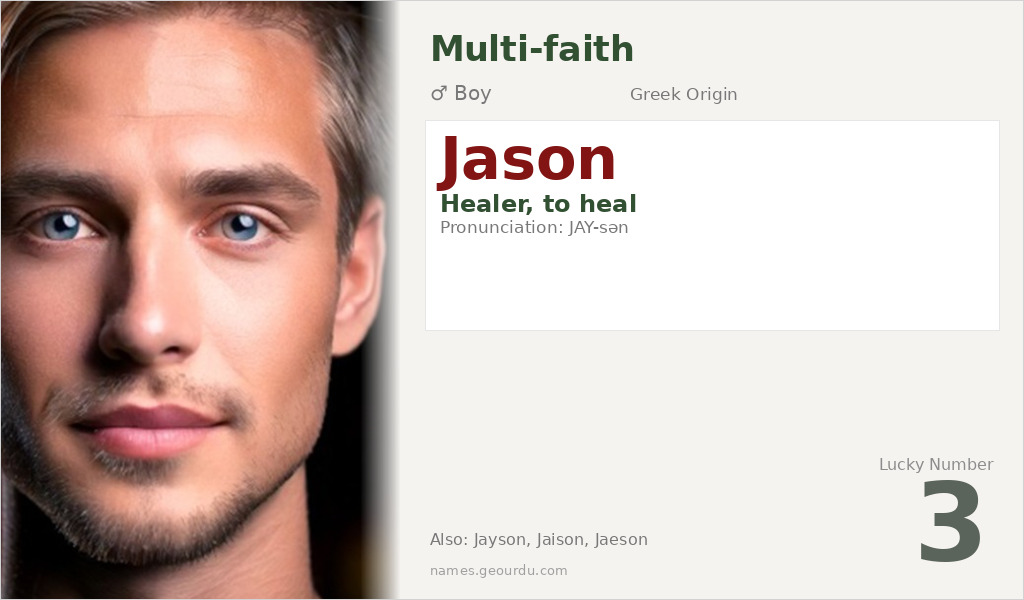
| 📛 Name | Jason |
| 💎 Meaning | Healer, to heal |
| 👤 Gender | Boy |
| 🕌 Religion | Multi-faith |
| 🌍 Origin | Greek |
| 🗣 Pronunciation | JAY-sən |
| ✍️ Urdu | جیسن |
| ✍️ Arabic | جيسون |
| 🔢 Numerology | 3 |
| ✨ Spellings | Jayson, Jaison, Jaeson, Jasen |
Origin & Cultural Significance
Jason originated in ancient Greece, first appearing in mythological texts as the son of Aeson and leader of the Argonauts. The name entered Christian tradition through the New Testament’s Book of Acts, where Jason appears as a believer in Thessalonica. During the Protestant Reformation, biblical names gained popularity in English-speaking countries, leading to Jason’s adoption beyond Greek-speaking regions. The name saw a significant surge in popularity in English-speaking countries during the mid-20th century, particularly in the United States where it ranked among the top 10 boy names from the 1970s through the 1990s. Today, Jason remains a widely recognized name across multiple cultures and religions, though its strongest associations remain with Greek heritage and Western naming traditions.
Personality Traits
Those named Jason often embody the qualities of their mythological namesake—leadership, courage, and determination in pursuing goals. The healing etymology suggests compassionate, nurturing tendencies, while the adventurous Argonaut connection implies a love for exploration and problem-solving. Modern cultural associations through famous bearers have added layers of charisma, athleticism, and creative talent to the name’s perceived personality traits.
Similar Names
If you like Jason, consider: Jasonides, Jasón, Iason, Joshua, Jasper, Jacob, Julian, Justin, Jared, Jonah
Famous People Named Jason
- Jason Momoa — American actor known for Aquaman and Game of Thrones
- Jason Statham — English actor known for action films like The Transporter
- Jason Bateman — American actor and director known for Arrested Development
- Jason Derulo — American singer and songwriter
- Jason Sudeikis — American actor and comedian known for Saturday Night Live and Ted Lasso
Frequently Asked Questions About Jason
What does Jason mean?
Jason means 'Healer' or 'to heal', derived from the ancient Greek verb ἰάομαι (iaomai).
Is Jason a boy or girl name?
Jason is traditionally and overwhelmingly a masculine name, though rare feminine variants exist in some cultures.
What is the origin of Jason?
Jason originates from ancient Greek language and mythology, with later adoption into Christian tradition through the New Testament.





