
Table of Contents
Heath is a distinctive name with deep roots in English landscape and language. Originally describing someone who lived on open heathland, this name carries the rugged beauty of untamed nature. From its origins as a topographic surname to its modern use as a given name, Heath evokes images of wide-open spaces and natural resilience. This name has gained popularity through notable bearers in entertainment and sports.
Meaning of Heath
The name Heath originates from the Old English word ‘hǣth,’ which specifically refers to heathland—open, uncultivated areas typically covered with low-growing shrubs like heather and gorse. This term evolved into Middle English as ‘hethe’ before becoming the modern ‘heath.’ As a surname, it functioned as what linguists call a topographic name, identifying individuals by their geographic surroundings. The Germanic root appears across related languages, including Old High German ‘heida’ and Old Norse ‘heiðr,’ all referring to similar open landscapes. The transition from surname to given name occurred in English-speaking countries during the 19th century, though it remained relatively uncommon until the mid-20th century.
| 📛 Name | Heath |
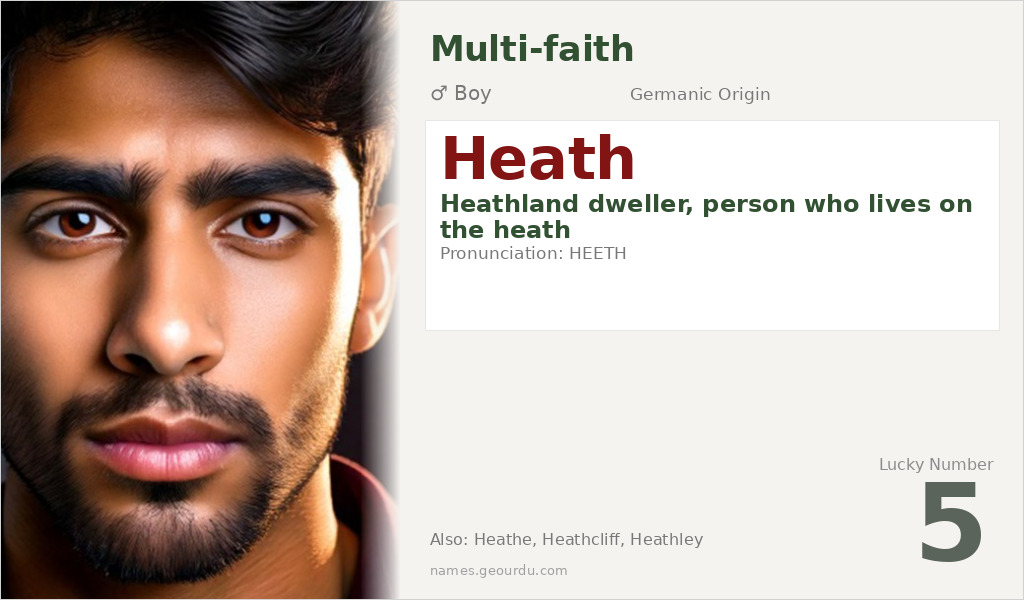
| 💎 Meaning | Heathland dweller, person who lives on the heath |
| 👤 Gender | Boy |
| 🕌 Religion | Multi-faith |
| 🌍 Origin | Germanic |
| 🗣 Pronunciation | HEETH |
| ✍️ Urdu | ہیتھ |
| ✍️ Arabic | هيث |
| 🔢 Numerology | 5 |
| ✨ Spellings | Heathe, Heathcliff, Heathley |
Origin & Cultural Significance
Heath has exclusively English origins, emerging from the Anglo-Saxon period when topographic surnames became common. These names helped distinguish people in small communities where many shared common given names. The heathlands of England, particularly in regions like Yorkshire, Dorset, and Surrey, provided the environmental context for this name’s development. While the name has been adopted by people of various religious backgrounds in English-speaking countries, it has no inherent religious association—unlike biblical or saint names that carry specific faith connections. The name’s popularity increased in the 20th century, particularly in Australia, the United States, and the United Kingdom.
Personality Traits
The name Heath suggests qualities of independence, resilience, and connection to nature—characteristics metaphorically linked to surviving in open heathland environments. Those bearing this name are often perceived as straightforward, practical, and authentic individuals who value simplicity and honesty. The earthy origins of the name may indicate someone grounded in reality rather than abstract ideals, with a strong sense of self-reliance. While personality traits associated with names are largely cultural perceptions rather than deterministic, the imagery of heathland contributes to these common associations.
Similar Names
If you like Heath, consider: Heathcliff, Heathrow, Heather, Heaton, Heathland
Famous People Named Heath
- Heath Ledger — Australian actor known for roles in 'Brokeback Mountain' and 'The Dark Knight'
- Heath Miller — American football player, tight end for the Pittsburgh Steelers
Frequently Asked Questions About Heath
What does Heath mean?
Heath means 'heathland dweller' or 'person who lives on the heath,' derived from the Old English word 'hǣth' referring to open, uncultivated land covered with shrubs like heather.
Is Heath a boy or girl name?
Heath is primarily a masculine name, though very rarely it has been used for girls. Its usage as a given name is overwhelmingly for boys in English-speaking cultures.
What is the origin of Heath?
Heath has English origins, specifically from Old English topographic terminology. It began as a surname describing where someone lived before becoming a given name in the 19th century.





