
Table of Contents
Henry is a timeless and regal name with deep historical roots across Europe. Derived from Germanic elements meaning ‘estate ruler’, it has been borne by kings, inventors, and literary characters for centuries. This classic name continues to enjoy widespread popularity for its strong, traditional sound and noble heritage. Parents choosing Henry often appreciate its connection to leadership, stability, and enduring appeal.
Meaning of Henry
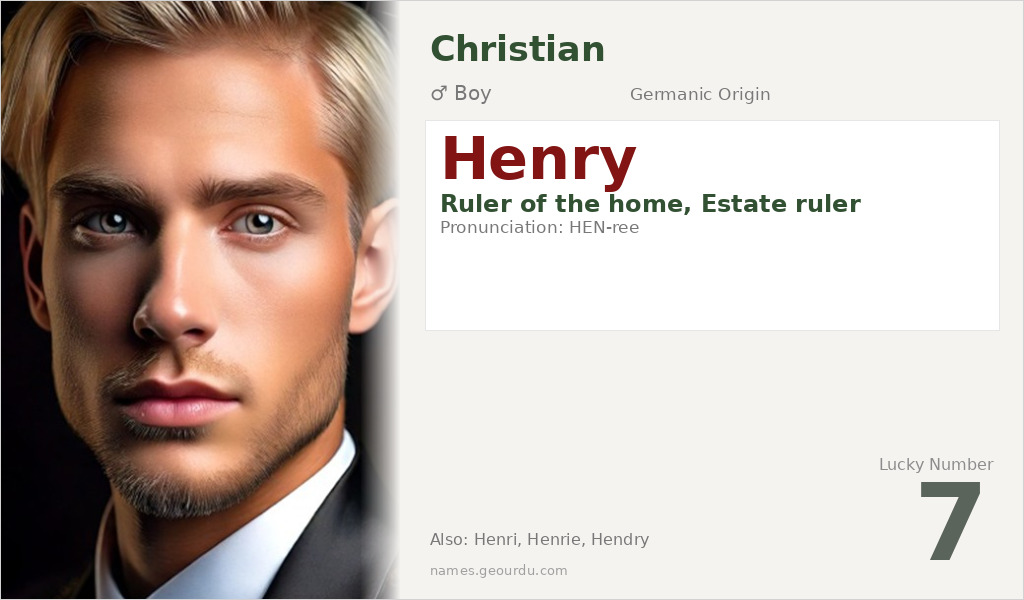
The name Henry has a well-documented etymology tracing back to the Germanic name ‘Heimirich’, which combines ‘heim’ (home, estate) and ‘ric’ (ruler, power). This literally translates to ‘ruler of the home’ or ‘estate ruler’, reflecting leadership within a domestic or territorial context. Through linguistic evolution, it became ‘Heinrich’ in Old High German, ‘Henri’ in French, and finally ‘Henry’ in English. The name’s meaning has remained consistent across these variations, always conveying authority and stewardship. Its royal associations—particularly with eight kings of England—have reinforced its connotations of governance and nobility throughout Western history.
| 📛 Name | Henry |
| 💎 Meaning | Ruler of the home, Estate ruler |
| 👤 Gender | Boy |
| 🕌 Religion | Christian |
| 🌍 Origin | Germanic |
| 🗣 Pronunciation | HEN-ree |
| ✍️ Urdu | ہنری |
| ✍️ Arabic | هنري |
| 🔢 Numerology | 7 |
| ✨ Spellings | Henri, Henrie, Hendry, Henery, Heinrich, Enrique, Henrik |
Origin & Cultural Significance
Henry originated among Germanic tribes in early medieval Europe, spreading through the Frankish Empire and later Norman conquests. It gained prominence in England after the Norman Conquest in 1066, with King Henry I establishing it as a royal name. The name proliferated across European monarchies, including France, Germany, and Portugal, often in forms like Heinrich, Henri, and Enrique. Its enduring popularity stems from this royal legacy, with notable bearers ranging from Holy Roman Emperor Henry IV to modern figures like author Henry James. While strongly associated with Christian European cultures due to its historical bearers, the name itself is linguistic rather than religious in origin.
Personality Traits
Those named Henry are often associated with qualities of leadership, reliability, and intellectual depth. The name’s meaning suggests someone who takes charge in their domain, whether family, work, or community. Historically, many Henrys have been innovators and reformers, combining traditional values with forward-thinking approaches. This blend of stability and intelligence makes the name appealing to parents seeking a classic yet substantive choice for their son.
Similar Names
If you like Henry, consider: Harold, Harry, Harrison, Henryk, Henrik
Famous People Named Henry
- Henry VIII — King of England from 1509 to 1547, known for his six marriages and role in the English Reformation
- Henry Ford — American industrialist and founder of the Ford Motor Company, pioneer of mass production
Frequently Asked Questions About Henry
What does Henry mean?
Henry means 'ruler of the home' or 'estate ruler', derived from the Germanic elements 'heim' (home) and 'ric' (ruler).
Is Henry a boy or girl name?
Henry is traditionally and overwhelmingly a boy's name, though rare feminine variants like Henrietta exist. Its historical bearers are exclusively male.
What is the origin of Henry?
Henry originates from the Germanic name 'Heimirich', evolving through Old High German 'Heinrich' and French 'Henri' before becoming the English 'Henry'. It has strong historical ties to European royalty.





