
Table of Contents
Manning is a distinguished name with roots in medieval England that has evolved from a surname to a popular given name. Carrying the meaning ‘son of the valiant man’, it embodies strength, heritage, and leadership qualities. This name gained modern prominence through famous athletic families and continues to be chosen for its strong, traditional sound. Explore the rich history and contemporary significance of the name Manning.
Meaning of Manning
The name Manning has a clear etymological foundation in Old English and Germanic languages. It combines the element ‘Mann’, an ancient personal name meaning ‘man’ or ‘warrior’, with the patronymic suffix ‘-ing’, which denotes ‘son of’ or ‘descendant of’. Thus, Manning literally translates to ‘son of Mann’ or more descriptively ‘son of the brave man’. This construction was common in early English naming traditions where surnames identified familial relationships. The name reflects the valor and strength associated with warrior cultures of Germanic tribes that settled in England. Over centuries, it transitioned from a descriptive surname to a standalone given name while retaining its core meaning of courageous lineage.
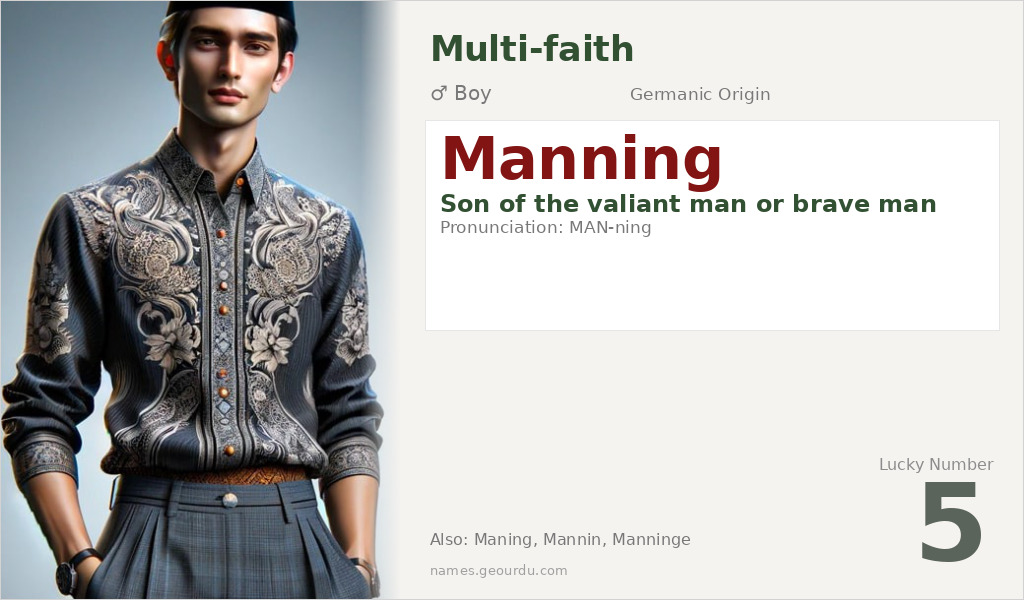
| 📛 Name | Manning |
| 💎 Meaning | Son of the valiant man or brave man |
| 👤 Gender | Boy |
| 🕌 Religion | Multi-faith |
| 🌍 Origin | Germanic |
| 🗣 Pronunciation | MAN-ning |
| ✍️ Urdu | میننگ |
| ✍️ Arabic | مانينغ |
| 🔢 Numerology | 5 |
| ✨ Spellings | Maning, Mannin, Manninge |
Origin & Cultural Significance
Manning originated as an English surname during the medieval period, derived from the Germanic personal name ‘Mann’. It emerged in England following the Anglo-Saxon settlements, where patronymic naming was common. The name appears in historical records from the 11th century onward, particularly in regions with strong Anglo-Saxon heritage. While primarily English in usage, similar constructions exist in other Germanic languages. In modern times, Manning gained recognition as a first name, especially in English-speaking countries, and became internationally known through prominent figures in sports and academia. The name carries no specific religious affiliation and is used across various cultural and faith backgrounds.
Personality Traits
Those named Manning often exhibit traits of confidence, reliability, and natural authority. The name’s meaning suggests inherited courage and a protective nature, making Mannings perceived as dependable leaders in both personal and professional spheres. They typically approach life with practical determination and respect for tradition while being adaptable to new circumstances. The athletic associations of the name in modern culture add connotations of teamwork, discipline, and competitive spirit.
Similar Names
If you like Manning, consider: Mann, Manningham, Manley, Mansfield, Manfred
Famous People Named Manning
- Peyton Manning — American Hall of Fame football quarterback
- Eli Manning — American former football quarterback, brother of Peyton
- Archie Manning — American former football quarterback, father of Peyton and Eli
- Manning Marable — American professor of history and African-American studies
Frequently Asked Questions About Manning
What does Manning mean?
Manning means 'son of the valiant man' or 'son of the brave man'. It originates from the Old English personal name 'Mann' (meaning man/warrior) combined with the patronymic suffix '-ing' (meaning son of).
Is Manning a boy or girl name?
Manning is traditionally and predominantly a boy's name, though as a surname-origin name, it could theoretically be used for any gender. Historically and culturally, it has been almost exclusively masculine.
What is the origin of Manning?
Manning has Germanic origins through Old English. It began as an English surname meaning 'son of Mann' and evolved into a given name. It is not specifically tied to any religion but comes from medieval English naming traditions.





