
Table of Contents
Phillip is a timeless name with deep historical roots that has maintained popularity across centuries and cultures. Derived from ancient Greek, this name carries the noble meaning ‘lover of horses’ and has been borne by kings, saints, and influential figures throughout history. Its classic sound and rich heritage make it a enduring choice for parents seeking a name with both tradition and strength. From ancient Macedonia to modern royalty, Phillip continues to be a name of distinction.
Meaning of Phillip
The name Phillip has a clear and well-documented etymology tracing back to ancient Greek. It originates from the Greek name Φίλιππος (Philippos), which combines φίλος (philos) meaning ‘friend’ or ‘lover’ and ἵππος (hippos) meaning ‘horse’. This compound name literally translates to ‘lover of horses’ or ‘friend of horses’. In ancient Greek culture, horses were highly valued symbols of wealth, status, and military prowess, making this name particularly significant among the aristocracy. The name appears in historical records as early as the 4th century BCE with Philip II of Macedon, and later in the New Testament with Saint Philip the Apostle. The meaning reflects the cultural importance of equestrianism in ancient Greek society, where horse ownership and horsemanship were markers of social standing and power.
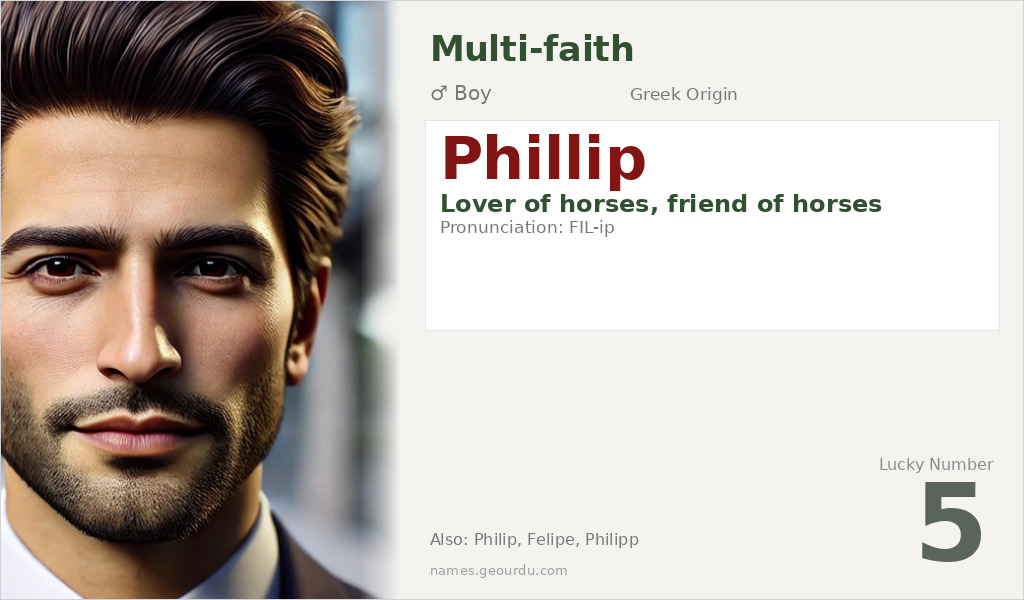
| 📛 Name | Phillip |
| 💎 Meaning | Lover of horses, friend of horses |
| 👤 Gender | Boy |
| 🕌 Religion | Multi-faith |
| 🌍 Origin | Greek |
| 🗣 Pronunciation | FIL-ip |
| ✍️ Urdu | فلپ |
| ✍️ Arabic | فيليب |
| 🔢 Numerology | 5 |
| ✨ Spellings | Philip, Felipe, Philipp, Phillipp, Filip, Filippo, Philippos |
Origin & Cultural Significance
Phillip originated in ancient Greece and spread throughout Europe and beyond through various historical channels. The name gained prominence with Philip II of Macedon (382-336 BCE), whose military and political achievements established Macedon as a dominant power in the ancient world. His son, Alexander the Great, further spread Greek culture and names throughout his empire. The name entered Christian tradition through Saint Philip the Apostle, one of the twelve disciples of Jesus mentioned in the Gospels. During the Middle Ages, the name was popularized in Western Europe through religious devotion and royal usage, particularly among French and English monarchs. Today, Phillip exists in numerous linguistic variations worldwide, including Felipe (Spanish/Portuguese), Filippo (Italian), Philippe (French), and Filip (Scandinavian/Slavic), demonstrating its enduring cross-cultural appeal.
Personality Traits
Those named Phillip often exhibit qualities associated with leadership, intelligence, and social grace. The name’s equestrian roots suggest characteristics of strength, elegance, and endurance, while its ‘friend’ component implies sociability and loyalty. Historically, many notable Phillips have been influential figures in politics, arts, and academia, reflecting the name’s association with achievement and distinction. Parents choosing this name often appreciate its balance of traditional gravitas and approachable warmth.
Similar Names
If you like Phillip, consider: Alexander, Theodore, Nicholas, Christopher, Andrew
Famous People Named Phillip
- Prince Philip, Duke of Edinburgh — husband of Queen Elizabeth II of the United Kingdom
- Philip II of Macedon — King of Macedon and father of Alexander the Great
- Philip Seymour Hoffman — Academy Award-winning American actor
- Saint Philip the Apostle — one of the twelve apostles of Jesus in the New Testament
- Philip K. Dick — influential American science fiction writer
Frequently Asked Questions About Phillip
What does Phillip mean?
Phillip means 'lover of horses' or 'friend of horses,' derived from the ancient Greek words philos (friend/lover) and hippos (horse).
Is Phillip a boy or girl name?
Phillip is traditionally and overwhelmingly a masculine name, though rare feminine variants like Philippa exist. Across all cultures and historical periods, Phillip has been used almost exclusively for boys.
What is the origin of Phillip?
Phillip originates from ancient Greek, specifically from the name Philippos (Φίλιππος). It gained historical prominence through Philip II of Macedon and entered Christian tradition through Saint Philip the Apostle.





