
Table of Contents
Pius is a distinguished name with deep roots in ancient Roman culture and Christian tradition. Derived directly from Latin, it carries connotations of devotion, duty, and righteousness that have resonated for centuries. From early saints to modern bearers, this name embodies a legacy of faith and moral integrity that continues to appeal to parents seeking a name with historical weight and spiritual meaning.
Meaning of Pius
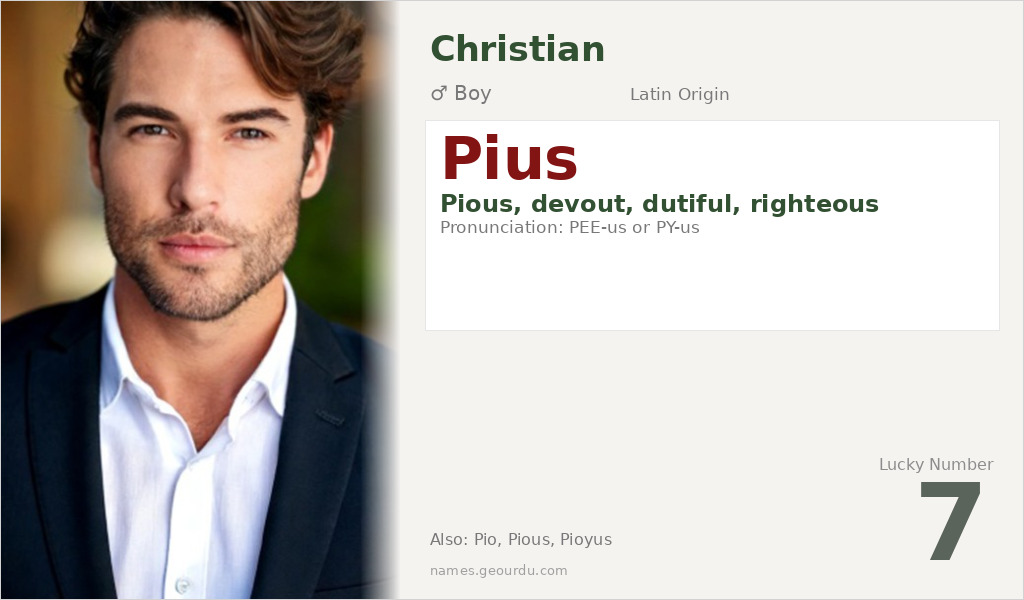
The name Pius comes from the Latin adjective ‘pius,’ which fundamentally means ‘pious, devout, dutiful, righteous, or faithful to natural ties.’ In Roman antiquity, the related concept of ‘pietas’ represented a complex virtue encompassing proper respect toward gods, family, and the state. This wasn’t merely religious piety but a broader ethical duty. The name entered Christian usage through early martyrs and saints, most notably Pope Pius I in the 2nd century. Throughout history, it has maintained its core semantic field of religious devotion and moral uprightness, making it one of the few names that directly expresses a spiritual quality.
| 📛 Name | Pius |
| 💎 Meaning | Pious, devout, dutiful, righteous |
| 👤 Gender | Boy |
| 🕌 Religion | Christian |
| 🌍 Origin | Latin |
| 🗣 Pronunciation | PEE-us or PY-us |
| ✍️ Urdu | پیوس |
| ✍️ Arabic | بيوس |
| 🔢 Numerology | 7 |
| ✨ Spellings | Pio, Pious, Pioyus |
Origin & Cultural Significance
Pius has its origins in ancient Rome, where it was used both as a personal name and an epithet. Several Roman emperors, including Antoninus Pius (86-161 CE), bore the name, emphasizing its association with duty and virtue. With the spread of Christianity, the name was adopted by early saints and subsequently by twelve popes from the 2nd to 20th centuries, cementing its place in Catholic tradition. While predominantly used in Christian contexts, particularly among Catholics, the name has also appeared in various European cultures influenced by Latin heritage. Its usage has been most consistent in Italian, German, Polish, and Scandinavian regions.
Personality Traits
Those named Pius are often associated with qualities of conscientiousness, tradition, and spiritual depth. They may exhibit a strong sense of duty and moral responsibility, whether in family life, community roles, or professional endeavors. While sometimes perceived as serious or reserved, they typically demonstrate reliability and integrity that earns respect from others. The name suggests someone who values principles over convenience and seeks meaning through devotion or service.
Similar Names
If you like Pius, consider: Pio, Piusz, Pietro, Peter, Devon, Fidelis, Amadeus, Benedict, Justus, Clement
Famous People Named Pius
- Pope Pius XII — 260th Pope of the Catholic Church (1939-1958)
- Pius Ncube — Zimbabwean Roman Catholic archbishop and human rights activist
Frequently Asked Questions About Pius
What does Pius mean?
Pius means 'pious, devout, dutiful, or righteous' and comes directly from the Latin word 'pius.'
Is Pius a boy or girl name?
Pius is exclusively a masculine name with historical usage as a boy's name in Christian traditions, particularly Roman Catholic.
What is the origin of Pius?
Pius originates from Latin and Roman culture, later adopted into Christian naming through early saints and popes.





