
Table of Contents
Michael is one of the most enduring and cross-cultural names in history, carrying profound theological weight across multiple faiths. From the archangel in Abrahamic traditions to countless historical figures and modern celebrities, this name has maintained its popularity for millennia. Its Hebrew origin gives it a meaning that resonates with questions of divinity and humility. Whether in its original form or numerous international variations, Michael remains a name of strength and significance.
Meaning of Michael
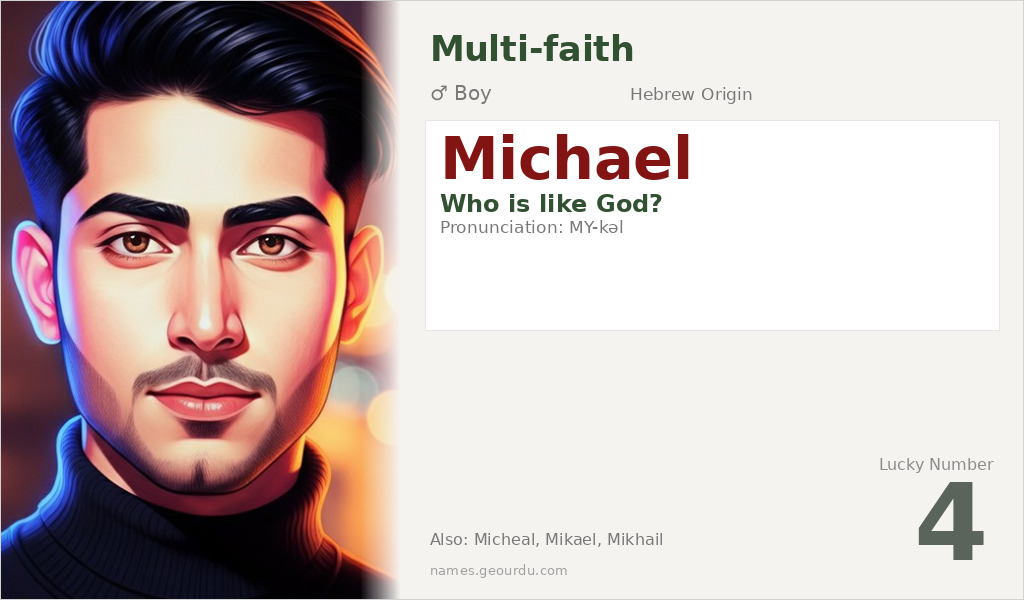
The name Michael derives from the Hebrew מִיכָאֵל (Mikha’el), which literally translates as ‘Who is like God?’ This is a rhetorical question emphasizing God’s uniqueness and supremacy, composed of three Hebrew elements: ‘mi’ meaning ‘who,’ ‘kha’ meaning ‘like,’ and ‘El’ referring to God. In biblical context, this name appears in the Book of Daniel where Michael is described as ‘one of the chief princes’ and a protector of Israel. The name’s theological significance ensured its preservation and adaptation across languages, including Greek (Μιχαήλ), Latin (Michael), Arabic (ميخائيل), and numerous European languages, all maintaining the core meaning.
| 📛 Name | Michael |
| 💎 Meaning | Who is like God? |
| 👤 Gender | Boy |
| 🕌 Religion | Multi-faith |
| 🌍 Origin | Hebrew |
| 🗣 Pronunciation | MY-kəl |
| ✍️ Urdu | مائیکل |
| ✍️ Arabic | ميخائيل |
| 🔢 Numerology | 4 |
| ✨ Spellings | Micheal, Mikael, Mikhail, Miguel, Michele |
Origin & Cultural Significance
Michael originated in ancient Hebrew culture as a theophoric name referencing the archangel Michael, who appears in the Hebrew Bible’s Book of Daniel. The name entered Christian tradition through the New Testament’s Book of Revelation, where Michael leads God’s armies against Satan. In Islam, Michael (Mīkāl) is recognized as one of the four archangels in the Quran. During the Middle Ages, the name spread throughout Europe via Christianization, becoming particularly popular among Christians who venerated Saint Michael the Archangel. Today, Michael exists in virtually every language and culture with Abrahamic influences, from Mikhail in Russian to Miguel in Spanish.
Personality Traits
People named Michael often embody characteristics associated with the archangel: protection, strength, and moral clarity. They are frequently seen as natural leaders who take responsibility seriously and stand up for what they believe is right. While individual personalities vary, the name’s historical and religious associations contribute to perceptions of reliability, courage, and principled behavior in those who bear it.
Similar Names
If you like Michael, consider: Gabriel, Raphael, Uriel, Daniel, Samuel
Famous People Named Michael
- Michael Jordan — American basketball legend
- Michael Jackson — American pop music icon
- Michael Faraday — British scientist who contributed to electromagnetism
- Michaelangelo — Renaissance artist and sculptor
Frequently Asked Questions About Michael
What does Michael mean?
Michael means 'Who is like God?' in Hebrew. It's a rhetorical question emphasizing God's uniqueness, derived from the Hebrew words 'mi' (who), 'kha' (like), and 'El' (God).
Is Michael a boy or girl name?
Michael is traditionally a boy's name across all cultures where it appears. While feminine variants like Michelle or Michaela exist, Michael itself is exclusively masculine in historical and contemporary usage.
What is the origin of Michael?
Michael originates from Hebrew (מִיכָאֵל) as the name of an archangel in the Hebrew Bible. It spread through Judaism, Christianity, and Islam, becoming one of the most cross-cultural names in history.





