
Table of Contents
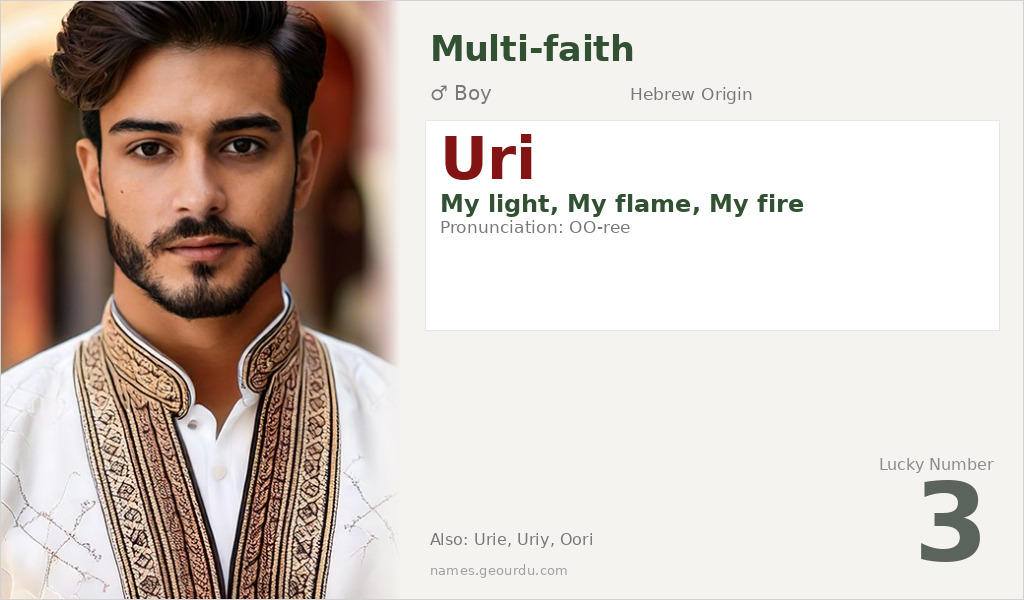
Uri is a distinctive Hebrew name with deep biblical roots and a beautiful meaning that has resonated across cultures for millennia. Meaning ‘my light’ or ‘my flame’, this name carries connotations of illumination, guidance, and warmth. While most commonly associated with Jewish tradition, Uri has been adopted by various cultures and appears in historical records from ancient Israel to modern times. Its simplicity and powerful meaning make it an enduring choice for parents seeking a name with both historical significance and contemporary appeal.
Meaning of Uri
The name Uri originates from the Hebrew language, specifically from the word ‘ur’ (אוּר) which means ‘light, flame, or fire’. When combined with the first-person possessive suffix ‘i’, it becomes ‘Uri’ meaning ‘my light’ or ‘my flame’. This etymology is well-documented in biblical Hebrew and appears in the Tanakh (Hebrew Bible) where Uri is mentioned as the name of several individuals, most notably Uri the son of Hur who was chosen by Moses to help construct the Tabernacle. The name should not be confused with Uriel, which adds the element ‘El’ (God) to mean ‘God is my light’. In modern Hebrew, the root ‘ur’ continues to be used in words related to light and illumination, maintaining the name’s linguistic connection to its original meaning.
| 📛 Name | Uri |
| 💎 Meaning | My light, My flame, My fire |
| 👤 Gender | Boy |
| 🕌 Religion | Multi-faith |
| 🌍 Origin | Hebrew |
| 🗣 Pronunciation | OO-ree |
| ✍️ Urdu | یوری |
| ✍️ Arabic | أوري |
| 🔢 Numerology | 3 |
| ✨ Spellings | Urie, Uriy, Oori |
Origin & Cultural Significance
Uri has its origins in ancient Hebrew culture and appears in the Hebrew Bible, making it one of the oldest continuously used names in recorded history. The name appears in Exodus 31:2 and 35:30, where Uri son of Hur is described as a skilled craftsman from the tribe of Judah who was filled with the spirit of God to work on the Tabernacle. Throughout Jewish history, the name has maintained popularity, particularly among Ashkenazi and Sephardic communities. In modern times, Uri has spread beyond Jewish communities and is used in various cultures, though it remains most common in Israel and among Jewish diaspora communities. The name’s biblical heritage and positive meaning have contributed to its enduring appeal across different religious and cultural contexts.
Personality Traits
Those named Uri often embody the illuminating qualities suggested by their name’s meaning. They tend to be perceptive individuals who bring clarity to complex situations and light to dark circumstances. With natural leadership abilities and creative problem-solving skills, Uris frequently find themselves in guiding roles where their insight benefits others. The name suggests someone with both intellectual brightness and emotional warmth, making them valued members of their communities and social circles.
Similar Names
If you like Uri, consider: Uriel, Uriah, Ari, Ori, Eli
Famous People Named Uri
- Uri Geller — Israeli-British illusionist and self-proclaimed psychic known for spoon-bending demonstrations
- Uri Avnery — Israeli writer, journalist, and peace activist who served in the Knesset
Frequently Asked Questions About Uri
What does Uri mean?
Uri means 'my light' or 'my flame' in Hebrew, derived from the word 'ur' (light/fire) with the possessive suffix 'i' (my).
Is Uri a boy or girl name?
Uri is traditionally and predominantly a masculine name, though some modern uses may be unisex. In its original Hebrew context and biblical usage, it is exclusively male.
What is the origin of Uri?
Uri originates from Hebrew language and culture, with documented usage in the Hebrew Bible (Tanakh). It is an ancient name that continues to be used in Jewish communities worldwide and has spread to other cultures.





