
Table of Contents
Steven is a timeless classic name with royal connotations that has maintained popularity across centuries and cultures. Derived from the Greek word for ‘crown,’ this name carries historical significance through early Christian tradition while remaining relevant in modern times. From Hollywood directors to scientific pioneers, numerous notable figures have borne this distinguished name. Its enduring appeal lies in its strong, clear sound and meaningful heritage.
Meaning of Steven
The name Steven has a clear and well-documented meaning: ‘crown’ or ‘wreath.’ It traces back to the Greek Στέφανος (Stephanos), which specifically referred to the wreath or crown awarded to victors in ancient Greek athletic games and military triumphs. This Greek term entered Latin as Stephanus, then evolved through Old English as Stēfan before becoming the modern Steven. The name gained particular prominence through Saint Stephen, the first Christian martyr mentioned in Acts 6-7 of the New Testament, whose Greek name reflected the ‘crown’ of martyrdom he received. Throughout its linguistic journey, the core meaning of ‘crown’ has remained consistent across languages and centuries.
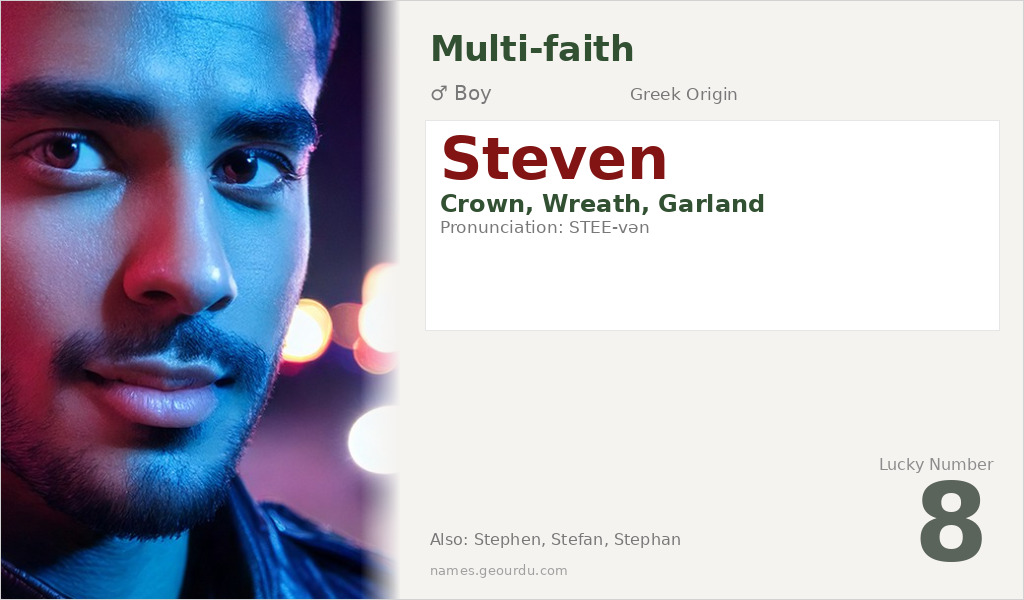
| 📛 Name | Steven |
| 💎 Meaning | Crown, Wreath, Garland |
| 👤 Gender | Boy |
| 🕌 Religion | Multi-faith |
| 🌍 Origin | Greek |
| 🗣 Pronunciation | STEE-vən |
| ✍️ Urdu | سٹیون |
| ✍️ Arabic | ستيفن |
| 🔢 Numerology | 8 |
| ✨ Spellings | Stephen, Stefan, Stephan, Stefán, Stefano, Esteban, Étienne, Steffen |
Origin & Cultural Significance
Steven originates from ancient Greece, specifically from the word stephanos meaning ‘crown’ or ‘wreath.’ The name spread throughout Europe via early Christianity, particularly through veneration of Saint Stephen, one of the first deacons and the first Christian martyr. During the Middle Ages, the name became popular across Christian Europe in various forms: Stephen in England, Étienne in France, Stefan in Germany and Scandinavia, and Stefano in Italy. The Steven spelling became particularly common in English-speaking countries from the 19th century onward. While strongly associated with Christian tradition due to Saint Stephen, the name has been adopted by people of various faiths and cultural backgrounds worldwide.
Personality Traits
People named Steven often project an image of reliability and leadership. They tend to be practical problem-solvers who approach challenges with determination and organizational skill. Many Stevens balance traditional values with forward-thinking perspectives, making them effective in both conventional and innovative environments. Their name’s meaning of ‘crown’ sometimes reflects in their ambitious nature and ability to take on significant responsibilities with grace.
Similar Names
If you like Steven, consider: Stephen, Stefan, Stephan, Stefano, Esteban
Famous People Named Steven
- Steven Spielberg — American film director, producer, and screenwriter
- Steven Gerrard — English former professional footballer and manager
- Steven Tyler — American singer, songwriter, and frontman of Aerosmith
- Steven Hawking — English theoretical physicist and cosmologist
- Steven Seagal — American actor, producer, and martial artist
Frequently Asked Questions About Steven
What does Steven mean?
Steven means 'crown' or 'wreath,' originating from the Greek name Stephanos (Στέφανος). This refers specifically to the crown awarded to victors in ancient Greek athletic competitions.
Is Steven a boy or girl name?
Steven is traditionally and overwhelmingly a masculine name, though very rare feminine variants exist (such as Stephanie, the feminine form). Across all cultures where it's used, Steven is considered a boy's name.
What is the origin of Steven?
Steven originates from ancient Greek, specifically from the word stephanos meaning 'crown.' It entered European languages through Latin Stephanus and was popularized by Saint Stephen, the first Christian martyr, before evolving into its modern English form.





