
Table of Contents
Wilfrid is a classic boy’s name with deep historical roots in English and Germanic traditions. Meaning ‘desiring peace’ or ‘willing peace’, this name carries centuries of cultural significance, particularly through its association with early English Christianity. From medieval saints to modern statesmen, Wilfrid has been borne by influential figures throughout history. Discover the rich etymology and enduring appeal of this timeless name.
Meaning of Wilfrid
The name Wilfrid originates from Old English and Germanic languages, combining two meaningful elements: ‘wil’ meaning ‘will, desire’ or ‘determination’, and ‘frið’ meaning ‘peace, protection, safety’. This compound construction was common in Germanic naming traditions, where parents would combine positive attributes to create meaningful names for their children. The name first appeared in England with the Anglo-Saxon settlement and was popularized by Saint Wilfrid of York in the 7th century. In Old English, it was spelled Wilfrið or Wilferð, with the modern spelling stabilizing after the Norman Conquest. The meaning ‘desiring peace’ reflects both personal aspiration and the historical context of early medieval England, where peace was a valued but often elusive state.
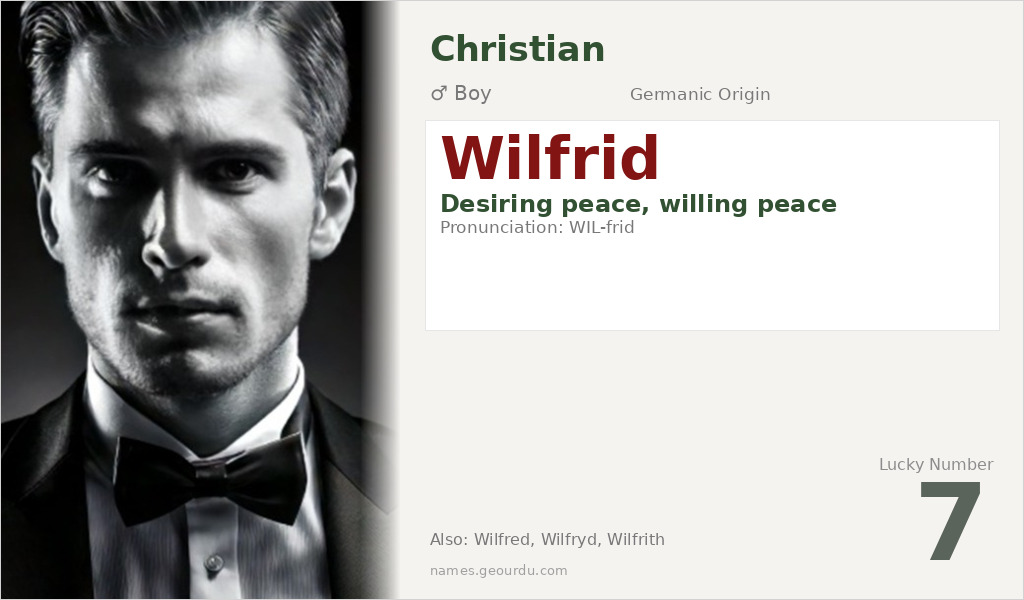
| 📛 Name | Wilfrid |
| 💎 Meaning | Desiring peace, willing peace |
| 👤 Gender | Boy |
| 🕌 Religion | Christian |
| 🌍 Origin | Germanic |
| 🗣 Pronunciation | WIL-frid |
| ✍️ Urdu | ولفریڈ |
| ✍️ Arabic | ويلفريد |
| 🔢 Numerology | 7 |
| ✨ Spellings | Wilfred, Wilfryd, Wilfrith, Wilferd |
Origin & Cultural Significance
Wilfrid has its origins in the Germanic languages brought to England by Anglo-Saxon settlers in the 5th-6th centuries. The name gained prominence through Saint Wilfrid (634-709 AD), a Northumbrian bishop who played a crucial role in establishing Roman Christianity in England and resolving the conflict between Celtic and Roman Christian traditions at the Synod of Whitby. The name spread throughout England and later to other English-speaking regions through colonization and migration. While primarily associated with English and Germanic cultures, variations of the name appear in other European languages due to the spread of Christianity and cultural exchange. The name’s religious significance comes specifically from its association with Saint Wilfrid rather than any inherent theological meaning.
Personality Traits
People named Wilfrid are often associated with qualities of diplomacy, determination, and peace-seeking behavior. The name’s meaning suggests someone who actively pursues harmony and resolution in challenging situations. Historically, bearers of this name have often been leaders, mediators, or individuals with strong convictions who work toward reconciliation. While personality traits vary by individual, the name carries connotations of thoughtful persistence and a desire to create understanding between differing perspectives.
Similar Names
If you like Wilfrid, consider: Wilfred, Wilbert, Wilbur, Wilhelm, Frederick
Famous People Named Wilfrid
- Saint Wilfrid — 7th-century English bishop and saint who helped establish Roman Christianity in Northumbria
- Wilfrid Laurier — Seventh Prime Minister of Canada (1896-1911), known for expanding Confederation and promoting national unity
Frequently Asked Questions About Wilfrid
What does Wilfrid mean?
Wilfrid means 'desiring peace' or 'willing peace', derived from the Old English/Germanic elements 'wil' (will/desire) and 'frið' (peace).
Is Wilfrid a boy or girl name?
Wilfrid is traditionally a masculine name, though feminine variants like Wilfreda exist. It has been used almost exclusively for boys throughout its history.
What is the origin of Wilfrid?
Wilfrid originates from Old English and Germanic languages, popularized in England by Anglo-Saxon settlers and Saint Wilfrid of York in the 7th century.





