
Table of Contents
Wright is a distinctive name with deep roots in craftsmanship and skilled labor. Originally an English occupational surname for wood or metal workers, it has evolved into a respected given name carrying connotations of precision, creativity, and practical skill. This name connects modern bearers to centuries of artisanal tradition while offering a strong, timeless sound.
Meaning of Wright
Wright originates from the Old English terms ‘wryhta’ or ‘wyrhta’, meaning ‘worker’ or ‘craftsman’. These terms specifically described someone who worked with materials like wood or metal, such as wheelwrights (wheel makers), cartwrights (cart makers), or shipwrights (ship builders). The word derives from the Proto-Germanic ‘*wurhtijaz’, meaning ‘worker’, and is connected to the Old English verb ‘wyrcan’ (to work or create). As English surnames developed from occupations in the Middle Ages, Wright became a common surname before transitioning to a given name in the 19th and 20th centuries, particularly in English-speaking countries like the United States and United Kingdom.
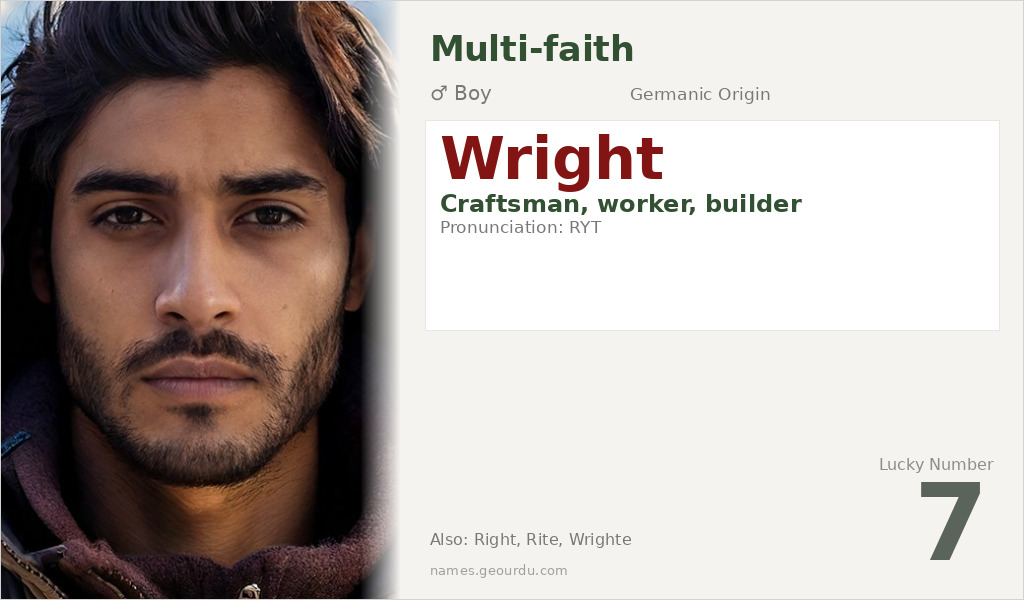
| 📛 Name | Wright |
| 💎 Meaning | Craftsman, worker, builder |
| 👤 Gender | Boy |
| 🕌 Religion | Multi-faith |
| 🌍 Origin | Germanic |
| 🗣 Pronunciation | RYT |
| ✍️ Urdu | رائٹ |
| ✍️ Arabic | رايت |
| 🔢 Numerology | 7 |
| ✨ Spellings | Right, Rite, Wrighte |
Origin & Cultural Significance
Wright has its origins in medieval England as an occupational surname during the period when surnames were becoming hereditary (approximately 12th-14th centuries). It emerged from the Germanic linguistic tradition brought to Britain by Anglo-Saxon settlers. Unlike many names with religious or natural element meanings, Wright reflects the practical naming conventions of medieval Europe where one’s trade often became their identifier. The name spread through English colonization to North America, Australia, and other regions, where it remains in use both as a surname and given name. Its transition from surname to first name followed broader Western naming trends where occupational surnames like Mason, Taylor, and Cooper became popular given names.
Personality Traits
Those named Wright often embody characteristics associated with craftsmanship: patience, attention to detail, and practical creativity. They may approach life as builders—whether of physical objects, systems, or relationships—valuing quality and durability. The name suggests someone who solves problems through skilled work rather than abstract theory, with a grounded, reliable nature that others find trustworthy.
Similar Names
If you like Wright, consider: Carter, Cooper, Mason, Taylor, Fletcher
Famous People Named Wright
- Frank Lloyd Wright — American architect known for organic architecture and designing Fallingwater
- Orville Wright — American aviation pioneer who, with brother Wilbur, achieved the first controlled, sustained flight of a powered aircraft
Frequently Asked Questions About Wright
What does Wright mean?
Wright means 'craftsman', 'worker', or 'builder'. It comes from Old English 'wryhta'/'wyrhta' and originally referred to someone who worked with wood or metal, like a wheelwright or shipwright.
Is Wright a boy or girl name?
Wright is primarily a boy's name, though like many occupational surnames turned given names, it could theoretically be used for any gender. Historically and currently, it is overwhelmingly masculine in usage.
What is the origin of Wright?
Wright originates from medieval England as an occupational surname derived from Old English. It has Germanic roots through the Proto-Germanic '*wurhtijaz' and belongs to the tradition of English surnames based on one's trade.





