
Table of Contents
Timo is a charming and internationally recognized name with deep historical roots. Derived from ancient Greek, this name carries the beautiful meaning of ‘honoring God’ and has traveled across continents and cultures. While particularly popular in German-speaking countries and Finland, Timo maintains a global appeal that transcends religious boundaries. Discover the rich etymology and cultural journey of this classic name.
Meaning of Timo
The name Timo originates from the Greek name Timotheos (Τιμόθεος), which is composed of two distinct elements: ‘timē’ (τιμή) meaning ‘honor, respect, or value’ and ‘theos’ (θεός) meaning ‘god or deity’. This combination creates the literal translation ‘honoring God’ or ‘one who honors God’. The name entered Christian tradition through Saint Timothy, a first-century Christian mentioned in the New Testament as a companion of Saint Paul. As Christianity spread throughout Europe, the name evolved into various forms across different languages, with Timo emerging as a popular diminutive in Germanic and Nordic regions. The name maintains its core meaning across all cultural adaptations.
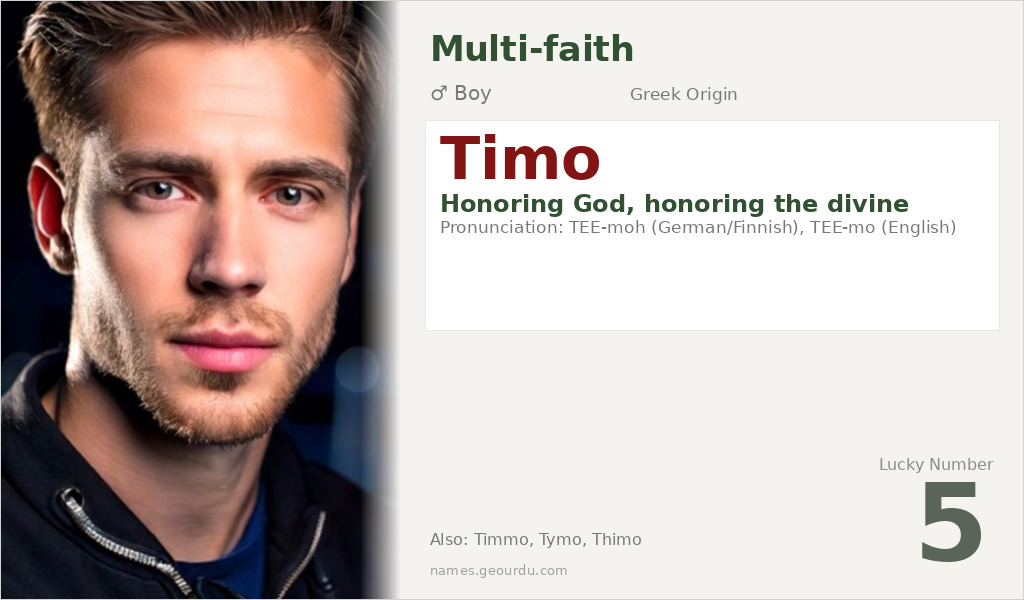
| 📛 Name | Timo |
| 💎 Meaning | Honoring God, honoring the divine |
| 👤 Gender | Boy |
| 🕌 Religion | Multi-faith |
| 🌍 Origin | Greek |
| 🗣 Pronunciation | TEE-moh (German/Finnish), TEE-mo (English) |
| ✍️ Urdu | ٹیمو |
| ✍️ Arabic | تيمو |
| 🔢 Numerology | 5 |
| ✨ Spellings | Timmo, Tymo, Thimo |
Origin & Cultural Significance
Timo has its origins in ancient Greece, where the full form Timotheos was used. The name gained significant prominence through early Christianity when Saint Timothy became an important figure in the New Testament. During the Middle Ages, the name spread throughout Europe via Christian missionaries and religious texts. In German-speaking countries, Timo emerged as a common short form of Timotheus, while in Finland it became established as an independent given name. Today, Timo is particularly popular in Germany, Austria, Switzerland, Finland, and the Netherlands, though it appears in various forms across many European cultures. The name’s journey reflects both classical Greek heritage and subsequent Christian cultural transmission.
Personality Traits
People named Timo are often characterized by their versatility and intellectual curiosity. They typically possess an adventurous spirit and enjoy exploring new ideas and experiences. Their adaptable nature allows them to thrive in various situations, while their inherent respect for others (reflected in the name’s meaning) often makes them well-liked and diplomatic individuals. These traits combine to create personalities that are both progressive and grounded in traditional values.
Similar Names
If you like Timo, consider: Timothy, Timotheus, Timofey, Tim, Timoš
Famous People Named Timo
- Timo Boll — German table tennis player, former world number one
- Timo Werner — German professional footballer who plays for Tottenham Hotspur
- Timo Soini — Finnish politician and former Minister for Foreign Affairs
- Timo Glock — German racing driver who competed in Formula One
Frequently Asked Questions About Timo
What does Timo mean?
Timo means 'honoring God' or 'one who honors God'. It comes from the Greek elements 'timē' (honor) and 'theos' (god), originally from the full name Timotheos.
Is Timo a boy or girl name?
Timo is primarily a masculine name used for boys. While some names have become unisex over time, Timo remains overwhelmingly male in all cultures where it's used, particularly in German, Finnish, and Dutch naming traditions.
What is the origin of Timo?
Timo originates from ancient Greek, specifically from the name Timotheos (Τιμόθεος). It gained popularity through Christian tradition via Saint Timothy and evolved as a diminutive form in Germanic and Nordic languages, particularly becoming established in German and Finnish naming customs.





