
Table of Contents
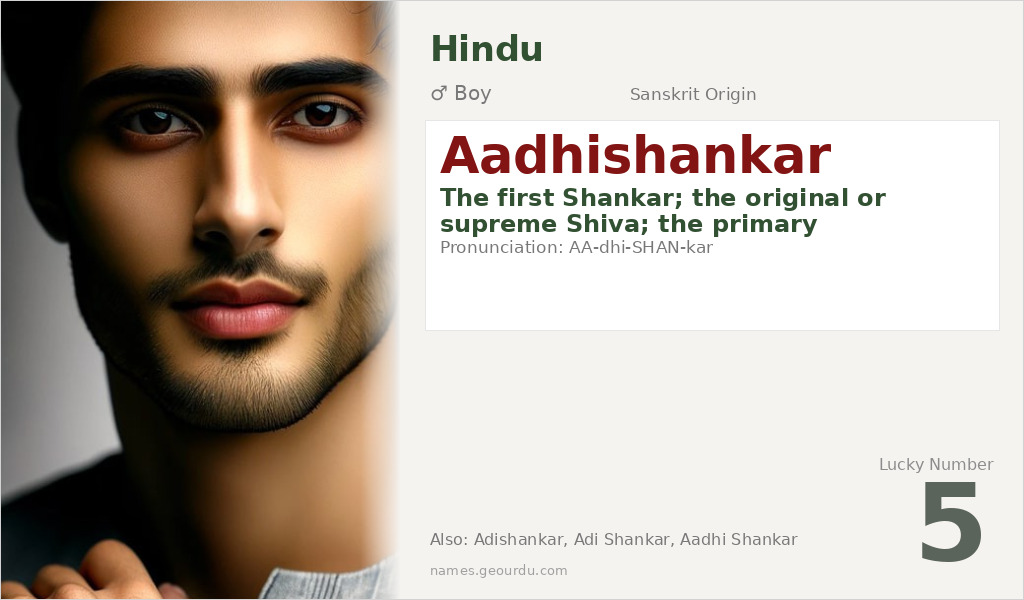
Aadhishankar is a profound Sanskrit name with deep roots in Hindu philosophy and theology. Meaning ‘the first Shankar’ or ‘supreme Shiva’, this name carries the weight of spiritual significance and intellectual heritage. Most famously associated with Sri Adi Shankaracharya, the 8th-century philosopher who established Advaita Vedanta, Aadhishankar represents primordial wisdom and divine manifestation. This name continues to inspire parents seeking a name with philosophical depth and cultural resonance.
Meaning of Aadhishankar
Aadhishankar derives from classical Sanskrit, combining ‘Aadhi’ (आधि), meaning ‘first, original, primary, or supreme’, with ‘Shankar’ (शंकर), one of the principal names of Lord Shiva meaning ‘the auspicious one’. The compound thus literally translates to ‘the first Shiva’ or ‘the supreme Shiva’. In Hindu tradition, this name specifically references Sri Adi Shankaracharya (788-820 CE), who is regarded as an incarnation of Shiva and founded the Advaita (non-dualistic) school of Vedanta philosophy. The name embodies the concept of primordial reality and the ultimate truth consciousness. Linguistically, it follows standard Sanskrit compounding rules where ‘aadhi’ serves as an attributive prefix modifying ‘shankar’.
| 📛 Name | Aadhishankar |
| 💎 Meaning | The first Shankar; the original or supreme Shiva; the primary manifestation of Lord Shiva |
| 👤 Gender | Boy |
| 🕌 Religion | Hindu |
| 🌍 Origin | Sanskrit |
| 🗣 Pronunciation | AA-dhi-SHAN-kar |
| ✍️ Urdu | آدھی شنکر |
| ✍️ Arabic | آدهي شانكار |
| 🔢 Numerology | 5 |
| ✨ Spellings | Adishankar, Adi Shankar, Aadhi Shankar, Adishankara |
Origin & Cultural Significance
Aadhishankar originates from classical Sanskrit, the liturgical language of Hinduism, and has been used primarily within Hindu communities across India and the diaspora. The name gained particular prominence through Sri Adi Shankaracharya, one of the most influential philosophers in Indian history who revived and systematized Hindu thought during the early medieval period. Culturally, the name represents not just a personal identifier but a connection to Advaita philosophy, which teaches the fundamental unity of the individual soul (Atman) with the ultimate reality (Brahman). While most commonly found in South Indian Brahmin communities, the name has spread throughout Hindu populations worldwide due to Shankaracharya’s pan-Indian influence and establishment of four major monastic centers.
Personality Traits
Those named Aadhishankar are often associated with intellectual depth, spiritual seeking, and philosophical inclination. The name suggests a personality drawn to fundamental truths, with potential for leadership in spiritual or academic realms. Individuals with this name may exhibit qualities of discipline, wisdom, and transformative thinking, reflecting the name’s association with one of Hinduism’s greatest philosophers. While personality traits vary individually, the name carries cultural expectations of seriousness, intelligence, and spiritual awareness.
Similar Names
If you like Aadhishankar, consider: Aditya, Shankar, Shiva, Adinath, Adishesha, Adipurusha, Shankara, Adhish, Adhiraj
Famous People Named Aadhishankar
- Adi Shankaracharya (788-820 CE) — Indian philosopher and theologian who consolidated the doctrine of Advaita Vedanta and established four mathas (monasteries) across India
- Adi Shankara — various modern individuals named after the philosopher, including scholars, artists, and religious leaders
Frequently Asked Questions About Aadhishankar
What does Aadhishankar mean?
Aadhishankar means 'the first Shankar' or 'supreme Shiva' in Sanskrit. It is a compound name combining 'Aadhi' (first/original) and 'Shankar' (Shiva).
Is Aadhishankar a boy or girl name?
Aadhishankar is exclusively a boy's name in Hindu naming tradition, as it refers to masculine divine principles and is associated with male historical and philosophical figures.
What is the origin of Aadhishankar?
Aadhishankar originates from Sanskrit, the classical language of Hinduism. It is most famously associated with Sri Adi Shankaracharya, the 8th-century philosopher who founded Advaita Vedanta.





