
Table of Contents
Abdul Rehman is a profoundly meaningful Arabic name that carries deep spiritual significance in Islamic tradition. As one of the most popular Muslim boy names worldwide, it beautifully combines devotion with one of God’s most cherished attributes. This name has been cherished for centuries across diverse Muslim communities, from the Middle East to South Asia and beyond. Understanding its linguistic roots reveals why it remains a timeless choice for parents seeking a name with both religious depth and beautiful meaning.
Meaning of Abdul Rehman
Abdul Rehman is a compound Arabic name with precise theological meaning. The first component ‘Abdul’ (عبد ال) literally translates to ‘servant of the’ and is always followed by one of the 99 names of Allah in Islamic naming conventions. The second component ‘Rehman’ (رحمن) specifically means ‘the Most Merciful’ and refers to God’s all-encompassing, universal mercy that extends to all creation regardless of faith. This distinguishes it from ‘Rahim’ (الرحيم), which refers to God’s particular mercy toward believers. The complete name therefore means ‘Servant of the Most Merciful’ and represents a declaration of servitude to God’s attribute of boundless compassion. In Arabic grammar, the definite article ‘al-‘ is assimilated into the pronunciation when preceded by ‘Abd’, resulting in ‘Abdul’ rather than ‘Abd al-‘. This name has been used since early Islamic history and appears in various forms across Muslim cultures.
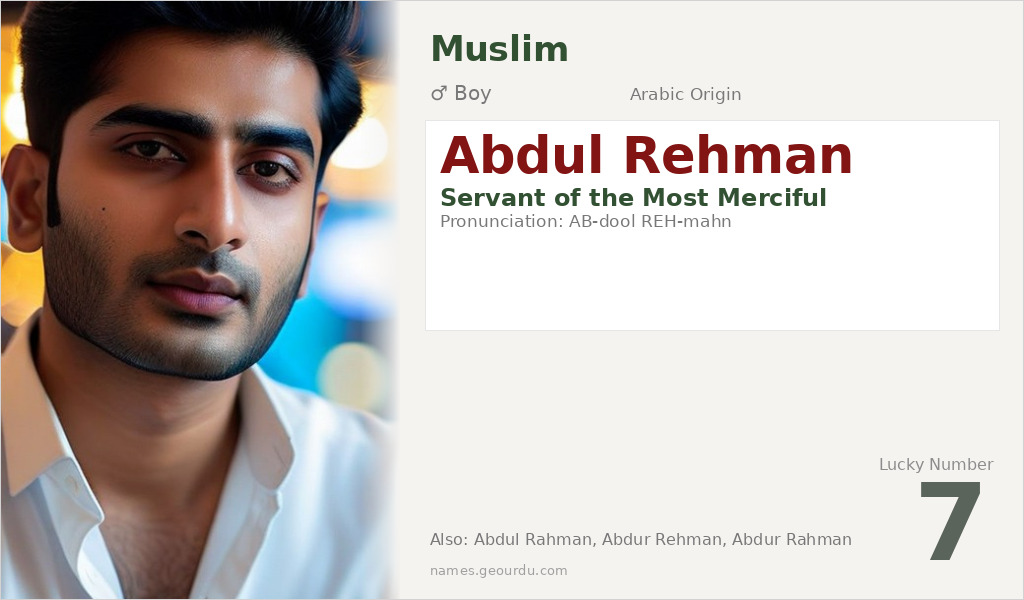
| 📛 Name | Abdul Rehman |
| 💎 Meaning | Servant of the Most Merciful |
| 👤 Gender | Boy |
| 🕌 Religion | Muslim |
| 🌍 Origin | Arabic |
| 🗣 Pronunciation | AB-dool REH-mahn |
| ✍️ Urdu | عبد الرحمن |
| ✍️ Arabic | عبد الرحمن |
| 🔢 Numerology | 7 |
| ✨ Spellings | Abdul Rahman, Abdur Rehman, Abdur Rahman, Abdulrahmaan |
Origin & Cultural Significance
Abdul Rehman originates from Classical Arabic and has been used since the early Islamic period, with historical records showing its usage among companions of the Prophet Muhammad. The name spread throughout the Muslim world as Islam expanded, becoming particularly popular in regions like the Arabian Peninsula, Persia, South Asia, and Southeast Asia. In many Muslim cultures, names beginning with ‘Abdul’ are considered among the most virtuous names as they directly express servitude to God. The name appears in various forms across languages: in Persian as ‘Abdolrahman’, in Urdu as ‘Abdur Rehman’, and in Turkish as ‘Abdurrahman’. Despite phonetic variations, the core meaning remains consistent across cultures. Historical figures bearing this name include several early Islamic scholars and rulers, contributing to its enduring popularity.
Personality Traits
While personality traits aren’t determined by names, cultural associations with Abdul Rehman often connect it to qualities of compassion, spiritual depth, and kindness. The name’s meaning ‘Servant of the Most Merciful’ may inspire bearers to embody merciful characteristics in their interactions. In many Muslim communities, such names are believed to influence character development by constantly reminding the individual of divine attributes. Those named Abdul Rehman are often expected to demonstrate patience, generosity, and a nurturing disposition toward others.
Similar Names
If you like Abdul Rehman, consider: Abdul Karim, Abdul Rahim, Abdul Qadir, Abdul Malik, Abdul Aziz
Famous People Named Abdul Rehman
- Abdul Rehman (cricketer) — Pakistani cricketer who played for the national team
- Abdul Rehman (footballer) — Afghan footballer who played as a midfielder
Frequently Asked Questions About Abdul Rehman
What does Abdul Rehman mean?
Abdul Rehman means 'Servant of the Most Merciful' in Arabic. It's a compound name where 'Abdul' means 'servant of the' and 'Rehman' refers to God's attribute of all-encompassing mercy.
Is Abdul Rehman a boy or girl name?
Abdul Rehman is exclusively a boy's name in all Muslim cultures. Names beginning with 'Abdul' (servant of) are masculine in Arabic grammar and Islamic naming tradition.
What is the origin of Abdul Rehman?
Abdul Rehman originates from Classical Arabic and has been used since early Islamic history. It's a theophoric name common across Muslim communities worldwide, particularly in Arabic-speaking regions, South Asia, and Southeast Asia.





