
Table of Contents
Abdul Shakoor is a meaningful Arabic name deeply rooted in Islamic tradition, combining devotion with divine attributes. As a compound name featuring one of Allah’s 99 names, it carries significant spiritual weight for Muslim families. This name has been used for centuries across the Muslim world, from the Middle East to South Asia. Understanding its linguistic components reveals why it remains a popular choice for boys in Muslim communities.
Meaning of Abdul Shakoor
Abdul Shakoor is composed of two Arabic elements: ‘Abdul’ meaning ‘servant of the’ and ‘Shakoor’ meaning ‘the Most Appreciative’ or ‘the Most Thankful’. Shakoor comes from the Arabic root sh-k-r (ش-ك-ر), which conveys concepts of gratitude, appreciation, and acknowledgment. In Islamic theology, Al-Shakoor is one of the 99 names of Allah, describing God as the One who appreciates even the smallest good deeds and multiplies rewards. The complete name therefore signifies ‘servant of the Most Thankful’, expressing devotion to a deity who recognizes and values human efforts. This naming convention follows a common pattern in Arabic where ‘Abdul’ is prefixed to divine attributes, creating names that embody both humility and spiritual aspiration.
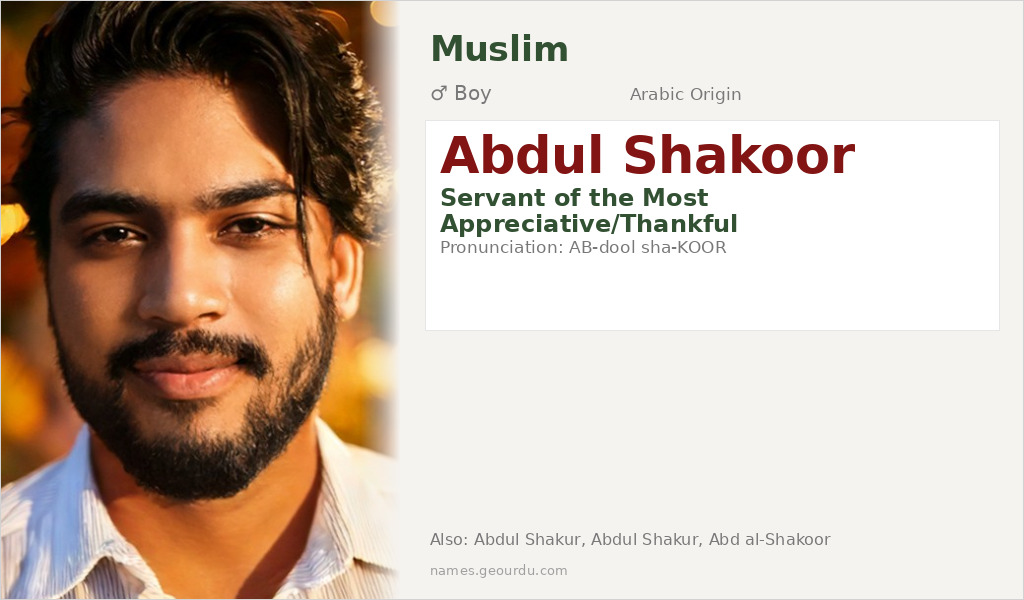
| 📛 Name | Abdul Shakoor |
| 💎 Meaning | Servant of the Most Appreciative/Thankful |
| 👤 Gender | Boy |
| 🕌 Religion | Muslim |
| 🌍 Origin | Arabic |
| 🗣 Pronunciation | AB-dool sha-KOOR |
| ✍️ Urdu | عبد الشکور |
| ✍️ Arabic | عبد الشكور |
| 🔢 Numerology | |
| ✨ Spellings | Abdul Shakur, Abdul Shakur, Abd al-Shakoor, Abd al-Shakur, Abdush Shakoor |
Origin & Cultural Significance
Abdul Shakoor originates from classical Arabic and Islamic naming traditions that developed in the 7th century CE with the advent of Islam. The practice of combining ‘Abdul’ with attributes of Allah became widespread as Muslims sought names that reflected monotheistic devotion. While the name is fundamentally Arabic, it has been adopted and adapted across various Muslim cultures including Persian, Urdu, Turkish, and South Asian languages. In regions like Pakistan, India, Bangladesh, and Afghanistan, the name maintains its Arabic form while being pronounced according to local phonetic patterns. Historical records show usage among scholars, poets, and religious figures throughout the Islamic world, particularly during the Mughal era in South Asia where Arabic-derived names flourished alongside Persian influences.
Personality Traits
The name Abdul Shakoor carries implicit expectations of gratitude and spiritual awareness. Those bearing this name are often encouraged to embody the quality of thankfulness (shukr) that the name references. In many Muslim cultures, names are believed to influence character, so Abdul Shakoor might be associated with someone who recognizes blessings, expresses appreciation readily, and maintains a positive outlook. The devotional aspect of the name suggests a person with strong religious or ethical principles, potentially leading to community respect and leadership roles in religious contexts.
Similar Names
If you like Abdul Shakoor, consider: Abdul Karim, Abdul Rahim, Abdul Qadir, Abdul Aziz, Abdul Malik
Famous People Named Abdul Shakoor
- Abdul Shakoor (19th century) – Indian Islamic scholar and poet from Lucknow known for his Persian and Urdu works
- Abdul Shakoor (contemporary) – Various individuals in South Asia and Middle East with this name, particularly in religious and academic circles
Frequently Asked Questions About Abdul Shakoor
What does Abdul Shakoor mean?
Abdul Shakoor means 'Servant of the Most Thankful' or 'Servant of the Most Appreciative' in Arabic. It combines 'Abdul' (servant of the) with 'Shakoor' (the Most Thankful), one of the 99 names of Allah in Islam.
Is Abdul Shakoor a boy or girl name?
Abdul Shakoor is exclusively a boy's name in Islamic naming tradition. The 'Abdul' prefix is masculine (feminine would be 'Amatul'), and compound names with divine attributes are typically given to males across Muslim cultures.
What is the origin of Abdul Shakoor?
Abdul Shakoor originates from classical Arabic and Islamic naming conventions that began in the 7th century. It follows the pattern of combining 'Abdul' (servant of) with attributes of Allah, specifically Al-Shakoor (the Most Thankful).





