
Table of Contents
Abram is a name steeped in ancient history and religious significance. As the original name of the biblical patriarch Abraham, it carries profound meaning across Jewish, Christian, and Islamic traditions. This Hebrew name has maintained its relevance for millennia, offering parents a connection to foundational religious narratives. With its strong meaning and historical weight, Abram continues to be a meaningful choice for boys today.
Meaning of Abram
The name Abram derives directly from the Hebrew אַבְרָם (Avram), composed of two elements: ‘av’ meaning ‘father’ and ‘ram’ meaning ‘high’ or ‘exalted’. Thus, Abram literally translates to ‘exalted father’ or ‘high father’. This etymology is well-documented in biblical scholarship and Semitic linguistics. In Genesis 17:5, God changes Abram’s name to Abraham (‘father of many nations’), making Abram the original form with distinct meaning. The name appears in ancient Aramaic and other Semitic languages with consistent interpretation. Its preservation through religious texts ensures its meaning remains unambiguous across cultures.
| 📛 Name | Abram |
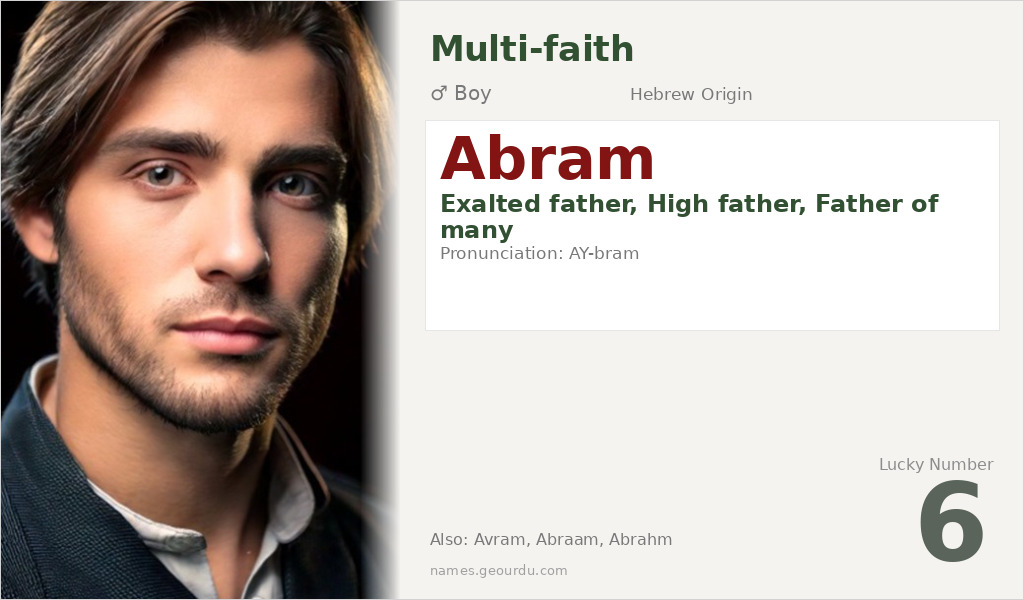
| 💎 Meaning | Exalted father, High father, Father of many |
| 👤 Gender | Boy |
| 🕌 Religion | Multi-faith |
| 🌍 Origin | Hebrew |
| 🗣 Pronunciation | AY-bram |
| ✍️ Urdu | ابرام |
| ✍️ Arabic | إبرام |
| 🔢 Numerology | 6 |
| ✨ Spellings | Avram, Abraam, Abrahm, Abrom |
Origin & Cultural Significance
Abram originates from ancient Hebrew culture as documented in the Torah/Old Testament. As the name of the first Hebrew patriarch before his covenant with God, it holds foundational importance in Judaism. The name spread through Christian tradition via biblical translations and entered Islamic tradition as Ibrahim (the Arabic form). While particularly significant in Abrahamic religions, the name has been adopted cross-culturally. Historical records show its use among early Christians, medieval Jews, and in various European contexts. The name maintains its Hebrew character even when used in non-Jewish communities due to its strong biblical associations.
Personality Traits
Those named Abram often embody the leadership and paternal qualities suggested by their name’s meaning. They tend to be natural protectors who provide stability and guidance to others. The historical weight of the name may inspire a sense of responsibility and moral strength. Many Abrams develop a thoughtful, principled approach to life that reflects their name’s ancient origins.
Similar Names
If you like Abram, consider: Abraham, Abiram, Abner, Abel, Adam
Famous People Named Abram
- Abram Petrovich Gannibal — African-born Russian military engineer and great-grandfather of Alexander Pushkin
- Abram S. Hewitt — American politician and industrialist, Mayor of New York City (1887-1888)
Frequently Asked Questions About Abram
What does Abram mean?
Abram means 'exalted father' or 'high father' in Hebrew. It comes from the Hebrew elements 'av' (father) and 'ram' (high/exalted).
Is Abram a boy or girl name?
Abram is exclusively a boy's name. It has been used as a masculine name since ancient times, originating as the name of the biblical patriarch.
What is the origin of Abram?
Abram originates from ancient Hebrew, specifically from the biblical name אַבְרָם (Avram). It is the original name of Abraham in the Torah/Old Testament before God changed it to Abraham.





