
Table of Contents
Abu Dawaniq is a distinctive Arabic name with deep historical roots in Islamic culture. Meaning ‘Father of small coins’ or ‘Father of small weights,’ this name reflects the practical and economic aspects of medieval Arab society. Unlike modern invented names, Abu Dawaniq carries authentic linguistic heritage and appears in early Islamic historical records. This guide explores the true meaning, origin, and significance of this traditional Arabic name.
Meaning of Abu Dawaniq
Abu Dawaniq is a compound Arabic name with clear etymological components. The first part, ‘Abu,’ is a common Arabic prefix meaning ‘father of,’ used to create kunyas (honorific nicknames) that often describe a person’s characteristics, profession, or family role. The second part, ‘Dawaniq,’ is the plural form of ‘danq’ (دانق), which was a small silver coin or weight unit in medieval Islamic economies, equivalent to 1/6 of a dirham. The complete name therefore translates literally to ‘Father of small coins’ or ‘Father of small weights.’ This naming pattern was common in early Islamic society, where individuals might be known by their association with particular trades, physical attributes, or social roles. The name appears in classical Arabic texts and hadith collections, confirming its historical usage.
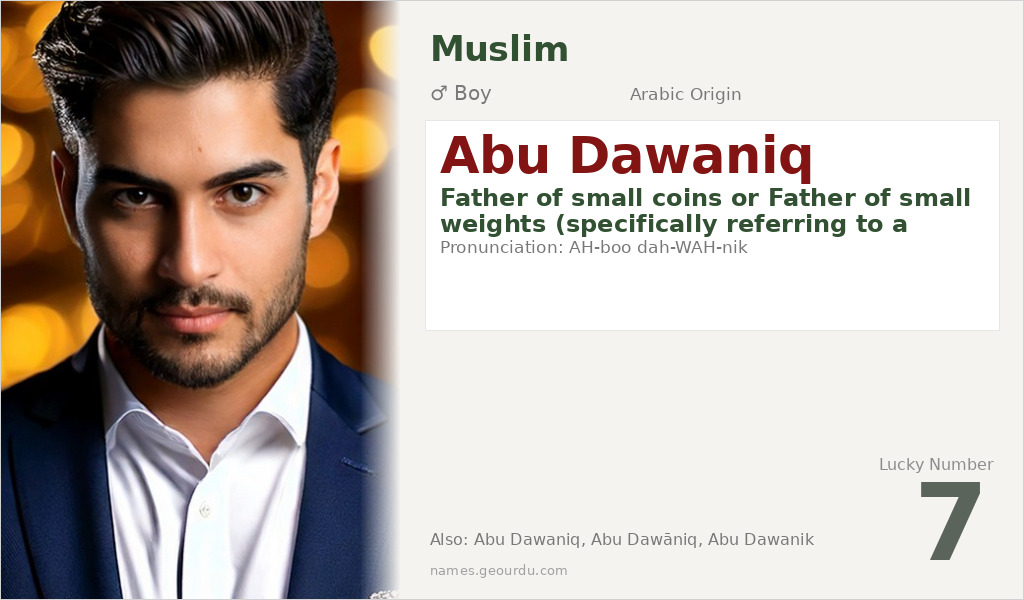
| 📛 Name | Abu Dawaniq |
| 💎 Meaning | Father of small coins or Father of small weights (specifically referring to a small unit of currency/weight) |
| 👤 Gender | Boy |
| 🕌 Religion | Muslim |
| 🌍 Origin | Arabic |
| 🗣 Pronunciation | AH-boo dah-WAH-nik |
| ✍️ Urdu | ابو دوانق |
| ✍️ Arabic | أبو دوانق |
| 🔢 Numerology | 7 |
| ✨ Spellings | Abu Dawaniq, Abu Dawāniq, Abu Dawanik, Abu Danik |
Origin & Cultural Significance
Abu Dawaniq originates from classical Arabic language and early Islamic culture (7th-9th centuries CE). The name reflects the economic systems of the early Islamic caliphates, where the daniq was a standard small currency unit. Unlike many modern Arabic names derived from religious concepts or desirable attributes, Abu Dawaniq represents a practical, occupational-style name that would have been given to someone associated with small-scale commerce, money-changing, or precise measurement. The name appears in historical records including biographical dictionaries of early Muslims and hadith transmitters. While not among the most common names today, it preserves an authentic connection to early Islamic social and economic life, particularly in regions like Iraq and the Levant where such naming conventions were prevalent.
Personality Traits
While personality traits associated with names are largely cultural interpretations rather than scientific facts, names like Abu Dawaniq often carry implied characteristics based on their meanings. The association with coins and weights suggests qualities of precision, fairness, practicality, and attention to detail. In Arabic naming traditions, such occupational or descriptive names were thought to reflect or influence a person’s character, with Abu Dawaniq implying someone who values accuracy, honesty in transactions, and careful consideration of small matters. These associations make the name particularly suitable for families valuing practical virtues and historical authenticity.
Similar Names
If you like Abu Dawaniq, consider: Abu Bakr, Abu Talib, Abu Huraira, Abu Dhar, Abu Hanifa
Famous People Named Abu Dawaniq
- Abu Dawaniq al-Kufi — Early Islamic scholar and transmitter of hadith from the 8th century
- Abu Dawaniq — Historical figure mentioned in medieval Arabic texts as a companion with this kunya
Frequently Asked Questions About Abu Dawaniq
What does Abu Dawaniq mean?
Abu Dawaniq means 'Father of small coins' or 'Father of small weights' in Arabic. It comes from 'Abu' (father of) and 'Dawaniq' (plural of daniq, a small medieval Islamic coin/weight unit).
Is Abu Dawaniq a boy or girl name?
Abu Dawaniq is exclusively a boy's name. In Arabic, names beginning with 'Abu' (father of) are masculine, as they refer to paternal relationships or characteristics.
What is the origin of Abu Dawaniq?
Abu Dawaniq originates from classical Arabic and early Islamic culture (7th-9th centuries CE). It reflects medieval Islamic economic systems where the daniq was a standard small currency unit, and follows traditional Arabic kunya (nickname) naming patterns.





